Woman Creates Glow-In-The-Dark Galaxy Painting For Boy Who Couldn’t Fall Asleep, Here’s His Reaction

Some children ask for a glass of water at bedtime. Others suddenly remember an urgent philosophical question about dinosaurs. Four-year-old Benjamin had a bigger objection: he did not want to sleep in his own room. Then artist Crispin Young Wilson transformed his ordinary ceiling into a secret universe that appeared only after the lights went out.
The result was more than a spectacular kids’ bedroom makeover. It turned a space Benjamin resisted into one he wanted to explore. His reactionpart confusion, part gasp, part repeated light-switch experimentationshowed how thoughtful design can replace bedtime tension with curiosity and comfort.
The Bedtime Problem That Inspired a Cosmic Solution
Wilson, an Oregon-based hardware professional and artist, was approached by a friend whose young son refused to sleep in his own bedroom. The family had recently moved into a new home, and the unfamiliar room had not yet become a place where Benjamin felt comfortable settling down for the night.
Moving can be exciting for adults, but for a child, it may feel as though someone picked up the entire world, shook it like a snow globe, and put everything back in the wrong place. Familiar sights, sounds, and routines suddenly change. Even a perfectly safe bedroom can seem strange when the lights go off.
Benjamin’s father hoped that Wilson could make the room more inviting. Rather than covering the walls with ordinary stars or installing a bright projector, she planned something quieter and considerably more magical: a glow-in-the-dark galaxy painting that would remain almost invisible during the day.
How Crispin Young Wilson Created the Hidden Galaxy
Wilson spent the day working on the ceiling with glow-in-the-dark pigments, prepared stencils, drop cloths, a sturdy ladder, black lights, and what every serious home-improvement project requires: good music.
A Landscape Inspired by Oregon
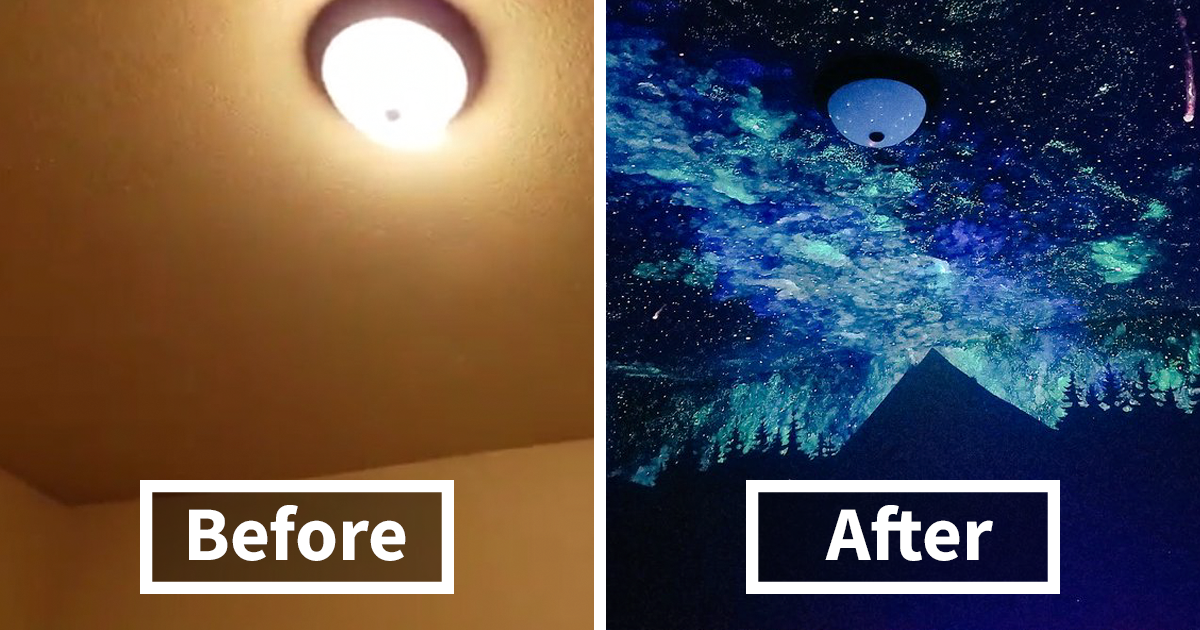
The completed mural was not simply a random scattering of dots. It combined a dense starscape with the silhouette of trees and a mountain landscape inspired by Mount Hood. Against the darkness, the forest appeared to frame an enormous glowing sky, giving the room the feeling of a peaceful campsite without the mosquitoes, cold ground, or suspicious rustling outside the tent.
The mural’s layered stars varied in brightness and size, creating depth rather than looking like a flat sheet of stickers. Some points resembled distant stars, while brighter clusters suggested clouds of cosmic dust or a luminous section of the Milky Way.
Invisible by Day, Spectacular by Night
One of the most clever features was the mural’s daytime appearanceor lack of one. With the lights on, the ceiling looked largely normal. When the room became dark, the painted landscape emerged.
Glow-in-the-dark materials absorb energy from light and release it gradually. This phenomenon, commonly known as phosphorescence, allows the pigments to continue glowing after the main light source has been removed. The effect fades over time and can be “recharged” through exposure to suitable light.
That disappearing act gave Benjamin two versions of the same room. During the day, it remained an ordinary place for playing and storing toys. At night, it became a private observatory.
Benjamin’s Reaction Was Better Than Any Review
Benjamin did not know what had been painted above his bed. When he entered the room, he was reportedly preparing to object to staying there. For a moment, the bedtime battle appeared ready to begin right on schedule.
Then the lights went off.
After a brief pause, Benjamin gasped and demanded to know what he was seeing. The protest disappeared as quickly as the ordinary ceiling had. Delighted by the glowing stars, he ran to the light switch and flipped it repeatedly, watching the galaxy vanish in daylight and return in darkness.
To a four-year-old, this was not merely paint. It was a mystery with a button.
Wilson later explained that Benjamin sounded proud of his new room. Reports following the makeover said that he began looking forward to bedtime and that the stars helped him relax and fall asleep. The mural also made his transition into the family’s new home more enjoyable.
The reaction helped Wilson’s work spread widely online. Viewers were fascinated not only by the technical skill but also by the kindness behind the project. Plenty of adults immediately decided that they, too, had been tragically deprived of a glowing galaxy ceiling.
Why a Bedroom Makeover Can Change a Child’s Attitude
A mural is not a medical treatment for insomnia, anxiety, or another sleep disorder. However, a child’s surroundings can influence whether bedtime feels familiar, peaceful, frightening, or overly stimulating.
The Room Became Something Benjamin Could Anticipate
Before the makeover, going into the bedroom meant separation from the rest of the family and settling into an unfamiliar space. Afterward, darkness revealed something enjoyable. The same moment that had previously triggered resistance now produced wonder.
That change matters because children often respond well to predictable, positive cues. A bath, a favorite story, a particular song, and a familiar goodnight phrase can all signal that sleep is approaching. In Benjamin’s case, the appearance of the stars became another cue.
Wonder Replaced Fear
Fear of the dark is common in childhood. Young imaginations are excellent at turning a coat on a chair into a monster with management responsibilities. Simply telling a frightened child that nothing is there may not immediately calm the emotional response.
Wilson’s mural did something different. It gave the darkness a friendly identity. Instead of being an empty space where something scary might hide, the room became a sky full of glowing stars.
The Design Created a Sense of Ownership
A personalized bedroom can help a child view the space as “my room” rather than “the place grown-ups keep trying to leave me.” Even though Benjamin did not paint the mural himself, it was created specifically for him. His excitement and pride suggest that the room had become a personal destination rather than a nighttime punishment.
What Sleep Research Says About Calming Bedtime Environments
Children need different amounts of sleep depending on age. Recommendations endorsed by major pediatric and sleep-medicine organizations generally call for 10 to 13 hours per day for children ages three to five, including naps, and nine to 12 hours for children ages six to 12.
Regularly getting enough sleep is associated with better attention, learning, memory, emotional regulation, behavior, and physical health. Unfortunately, knowing that sleep is important does not automatically persuade a four-year-old to stop negotiating like a tiny attorney.
Consistency Matters More Than a Single Decoration
Research on young children has linked consistent bedtime routines with earlier bedtimes, shorter delays before sleep, fewer nighttime awakenings, and longer sleep duration. A mural may make a room appealing, but the strongest results are likely to come when it supports a predictable routine.
A practical sequence might include cleaning up toys, brushing teeth, putting on pajamas, reading a book, dimming the lights, talking quietly about the stars, and saying goodnight at roughly the same time each evening.
Dark, Quiet, Cool, and Comfortable Usually Wins
Pediatric sleep guidance commonly recommends a bedroom that is dark, quiet, comfortable, and not too warm. For a child who is genuinely frightened by complete darkness, a small, dim light may be useful. The goal is reassurance without turning the room into an airport runway.
Bright screens are a different matter. Phones, tablets, televisions, and gaming devices can delay bedtime through both stimulating content and light exposure. A passive mural that gradually fades is less likely to demand continued interaction than a video, game, or endlessly scrolling feed.
Could a Galaxy Ceiling Be Too Stimulating?
It depends on the child and the design. Benjamin initially ran back and forth flipping the switch, which was an understandable reaction to discovering a universe above his bed. Any exciting new bedroom feature may cause a few nights of inspection before it becomes familiar.
A sleep-friendly galaxy mural should create a soft background rather than an intense light show. Extremely bright LEDs, flashing effects, moving projections, sound effects, or saturated blue illumination may keep some children alert. Subtle glow-in-the-dark details are quieter because they have no animation, notifications, advertisements, or surprise boss battles.
Parents can observe how a child responds. If the design encourages calm storytelling and quiet breathing, it may fit well into the routine. If the child spends an hour conducting interstellar traffic control, the room may need less light or firmer limits on switch flipping.
Tips for Creating a Safe Glow-In-The-Dark Bedroom
Choose Products Intended for Indoor Use
Not every luminous paint is suitable for a child’s bedroom. Read the manufacturer’s label and select a product designed for interior surfaces. Check the recommended application method, curing time, age precautions, ventilation instructions, and compatibility with the existing ceiling paint.
Water-based, low-odor, or lower-VOC products may be preferable for indoor projects, but labels still matter. “Low VOC” is not a magic phrase that replaces proper handling.
Ventilate During and After Painting
The U.S. Environmental Protection Agency recommends providing plenty of fresh air when painting or remodeling. Open windows when conditions allow, use fans to move air outward, and keep children away from the active work area.
Follow the product’s drying and curing guidance before allowing a child to sleep in the room. Paint fumes are not a charming bonus feature, no matter how accurately they capture the atmosphere of a spacecraft repair bay.
Secure the Work Area
Ceiling painting requires a stable ladder, protected floors, safe electrical access, and patience. Do not balance on furniture, work directly over an occupied bed, or leave containers and tools where children can reach them.
Test a Small Area First
Apply the paint to a sample board or inconspicuous section. Observe its appearance under normal light, after charging, and as it fades. This helps determine whether the result is soothing, bright enough to see, and subtle enough for sleep.
Use the Real Sky as Inspiration
NASA imagery offers an almost unlimited collection of galaxies, nebulae, star clusters, and Milky Way views. A mural does not need to be scientifically exact, but reference images can help create more natural variations in scale, density, and shape.
Families can also add recognizable constellations, a favorite planet, a mountain silhouette, or a hidden comet. The best design is one that feels personal rather than one that attempts to squeeze the entire observable universe over a twin bed.
The Bigger Lesson Behind the Viral Galaxy Painting
Wilson’s project became popular because it combined artistic skill with empathy. She did not simply decorate a ceiling; she listened to a family’s problem and changed the emotional meaning of a room.
The transformation also shows that practical solutions do not always need to feel clinical. A child struggling with bedtime may benefit from a consistent schedule, fewer screens, reassurance, and a calmer environment. Those sensible steps can coexist with imagination.
For Benjamin, the room’s appeal came from discovery. The art waited quietly until the light disappeared, then rewarded him with a sky that belonged only to nighttime. Instead of fighting the dark, he had a reason to welcome it.
Related Experiences: Helping Children Feel at Home at Bedtime
Families trying to recreate the spirit of Benjamin’s makeover do not necessarily need a professional muralist or the flexibility required to paint a ceiling for several hours. The most useful part of the story is the idea behind it: understand what makes the child uncomfortable, then help reshape the bedtime experience.
Experience One: Let the Child Help Plan the Room
A child who participates in choosing a theme, bedding, artwork, or constellation may feel more connected to the finished space. Parents can offer a small set of manageable choices: stars or planets, blue sheets or gray sheets, a moon picture or a rocket picture.
This is not the same as handing a preschooler an unlimited decorating budget and access to a demolition hammer. The adult controls safety and practicality; the child receives meaningful ownership. Even choosing where to place removable stars can turn the bedroom into a shared project rather than a room assigned by decree.
Experience Two: Connect the Decoration to a Story
Visual features become more comforting when they are part of a familiar narrative. A parent might invent a short story about a sleepy astronaut who visits one star each night. Another family might identify three glowing points and use them as reminders to take three slow breaths.
Repeated stories create continuity. The mural stops being a novelty and becomes part of the bedtime ritual. Children know what will happen next, which can reduce attempts to launch seventeen unrelated conversations after the lights go out.
Experience Three: Introduce the Room Before the First Night
When a family moves or a child begins sleeping independently, expecting an instant transition may create pressure. Spending positive daytime moments in the new room can help. The child might read there, organize favorite toys, choose a place for stuffed animals, or practice lying in bed while a parent remains nearby.
The goal is to build neutral and happy associations before bedtime adds separation and darkness. Benjamin’s mural worked partly because it transformed the unfamiliar room into something worth investigating.
Experience Four: Pair Creativity With Predictability
An impressive ceiling cannot compensate for a bedtime that shifts by several hours, late-evening screens, loud household activity, or unlimited negotiations. Creative design works best as one part of a stable routine.
Parents might dim the house lights, finish active play, brush teeth, read together, reveal the stars, and leave the room in the same order each night. Repetition can make the sequence feel safe. The mural provides emotional appeal; the routine provides structure.
Experience Five: Expect Progress, Not Perfection
A child may love a new galaxy room and still call for a parent, wake during the night, or test bedtime boundaries. That does not mean the project failed. Sleep habits usually develop through repeated experiences rather than one cinematic reveal.
Adults can respond calmly and consistently, praise small improvements, and avoid turning every difficult night into a major event. If a child has persistent trouble falling asleep, frequent awakenings, loud snoring, breathing pauses, severe anxiety, or daytime impairment, the family should discuss the problem with a pediatrician. A magical room can support healthy habits, but it should not delay help for a genuine medical or emotional concern.
Conclusion
Crispin Young Wilson’s glow-in-the-dark galaxy painting succeeded because it was beautiful, surprising, and deeply personal. Benjamin entered his room ready to resist bedtime. Seconds after the lights went out, he was gasping at the ceiling and repeatedly flipping the switch to make the stars disappear and return.
The mural did not merely brighten a dark room. It changed what darkness meant. Combined with a consistent bedtime routine, a comfortable sleep environment, and patient support from parents, imaginative bedroom design can help children develop more positive feelings about sleeping independently.
Sometimes the path to a calmer bedtime begins with ordinary advice: fewer screens, predictable routines, and a quiet room. Sometimes it also includes an entire galaxy painted over the bed. Parenting is flexible that way.