Woman Says These “Realistically Proportioned” Disney Princess Make Her Mad, And Here’s Why

Disney princesses have survived wicked stepmothers, sea witches, cursed castles, runaway snowmen, and an alarming number of conversations with woodland animals. Yet one challenge remains surprisingly difficult: surviving an internet debate about their waistlines.
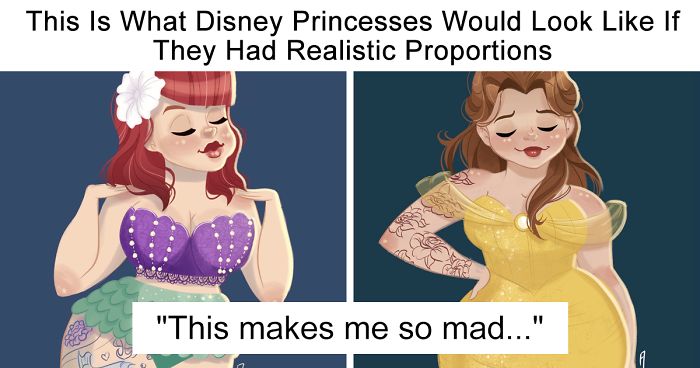
A viral collection of edited Disney princess images attempted to show familiar characters with supposedly “realistically proportioned” bodies. Cinderella, Ariel, Jasmine, Belle, Elsa, and other famously slender heroines were redrawn with fuller figures. Many viewers praised the artwork for making the princesses more relatable. Others saw the images as a cheerful celebration of body diversity.
One woman, however, said the project made her angrynot because she opposed larger bodies, but because of the word realistic. Her objection was simple: thin women are real women, too. Calling only the fuller versions realistic seemed to replace one narrow beauty standard with another.
That reaction turned a collection of fan art into a much bigger conversation about Disney princess body proportions, body positivity, representation, animation, and the dangerous habit of appointing one body type as the official ambassador of reality.
What Were the “Realistically Proportioned” Disney Princesses?
The viral images belonged to a long-running category of online art in which creators redesign Disney characters. Some artists give princesses ordinary hairstyles, visible aging, practical clothing, realistic facial features, muscular bodies, disabilities, or different cultural details. Others adjust their famously tiny waists and narrow limbs.
These projects usually begin with a reasonable observation: many Disney heroines are designed according to highly stylized beauty conventions. Their eyes are enormous, their noses are tiny, their hair behaves as though humidity signed a nonaggression treaty, and their waists sometimes appear narrower than their necks.
Illustrator Loryn Brantz, for example, previously edited several princesses by making only small adjustments to their waistlines. Other artists have created fuller or more muscular versions of characters such as Mulan, Jasmine, Tiana, Ariel, and Cinderella. Some artists explicitly describe this work as representation rather than correction. Crystal Walter has said her fuller Disney characters were not intended to define realism; they were created so fat viewers could see themselves in characters they already loved.
That distinction matters. “Here is another possible body” sends a different message from “Here is what a real body looks like.” The first expands the guest list. The second risks checking identification at the door.
Why Did the Woman Get Mad?
She Felt the Word “Realistic” Erased Naturally Thin Women
The woman’s criticism focused less on the drawings than on their label. She argued that slender women without dramatic curves still have real, naturally occurring bodies. A woman can be thin, broad, petite, tall, muscular, soft, curvy, straight-shaped, or somewhere between several categories without becoming an optical illusion.
Online commenters expressing similar views said they did not resemble Disney princesses exactly, but they also did not resemble the fuller redesigns. Some felt that describing one alternative as realistic implied that their own slim bodies were fake, unhealthy, or invalid.
That does not mean the original Disney proportions are anatomically ordinary. A real woman may naturally be very thin, but she generally does not have eyes occupying half her face, a waist barely wider than her wrist, and hair containing enough volume to shelter a family of bluebirds.
The critic’s stronger point was that thinness itself should not be confused with impossibility. A naturally slender body and an exaggerated cartoon body are not the same thing.
She Believed “Realistic” Had Quietly Become a Synonym for “Larger”
Body-positive artwork often responds to decades of narrow beauty ideals by showing bodies that mainstream entertainment has ignored. That corrective purpose is understandable. The trouble begins when the language suggests that increasing a character’s weight automatically makes her more authentic.
A larger body is realistic. A medium-sized body is realistic. A narrow body is realistic. So are bodies with strong shoulders, small chests, large chests, thick thighs, short legs, long torsos, visible stomachs, disabilities, scars, and features that refuse to cooperate with online beauty filters.
Reality is not a dress size. It is a crowded department store with terrible lighting and almost nothing available in every size.
She Objected to Replacing One Beauty Rule With Another
Traditional beauty culture has often said that a woman must be thin to be attractive. A poorly framed body-positivity message can accidentally reverse the insult and suggest that thin women are less authentic, less womanly, or less deserving of representation.
Neither message is inclusive. Genuine body diversity does not require taking a crown away from one woman before handing it to another. The goal should be more characters, more shapes, more personalities, and more ways of being heroicnot a royal decree announcing the kingdom’s new approved waist measurement.
Were the Original Disney Princess Bodies Realistic?
Not particularlyand that is partly intentional.
Animation depends on exaggeration. Artists alter proportions to communicate age, personality, movement, emotion, and visual appeal. Villains may receive sharp angles, looming silhouettes, or dramatic gestures. Heroes often receive rounder features, large expressive eyes, and recognizable shapes that remain readable during fast movement.
No reasonable viewer watches The Little Mermaid and demands an immediate anatomical investigation because Ariel can sing underwater. Disney stories are fantasies. Mice sew dresses, household objects perform musical numbers, and a carpet demonstrates better navigation skills than many people using three mapping apps.
However, “it is a cartoon” does not end the discussion. Artists choose what to exaggerate. When male characters display a broad range of ages, builds, noses, faces, and waistlines while leading women repeatedly receive similar youthful silhouettes, the pattern becomes noticeable.
Researchers examining Disney’s female characters have reported extremely small waist-to-hip ratios among princesses. The issue is not that every princess is thin; it is that many are thin in remarkably similar and exaggerated ways.
The controversy surrounding Merida illustrates the concern. After the heroine of Brave joined the official Disney Princess brand, a more glamorous promotional design appeared with a slimmer waist, larger eyes, makeup, and a more polished dress. The backlash produced a petition with more than 200,000 signatures, as critics believed the redesign weakened the qualities that had made Merida distinctive.
In other words, stylization is not automatically harmful, but sameness can still communicate something. When courage, goodness, romance, and royal status repeatedly arrive in similar packaging, audiences may reasonably ask why imagination stops at the rib cage.
What Does Research Say About Disney Princesses and Body Image?
The evidence is more complicated than the loudest social media posts suggest.
A study involving girls between ages three and six found that brief exposure to appearance-focused children’s media did not increase body dissatisfaction during the experiment. However, nearly one-third of the participating girls already wanted to change something about their appearance, while almost half reported worrying about being fat. That suggests body concerns can appear early, even when one short media exposure cannot be blamed for creating them.
Long-term research has also challenged the idea that princess culture inevitably damages children. A follow-up study reported that children who engaged strongly with princess culture when young did not have worse body image years later. Some girls also developed more progressive views about gender, possibly because newer heroines such as Mulan, Elsa, and Moana are active protagonists rather than decorative passengers waiting for Prince Charming’s rideshare.
A later UC Davis study followed young children and examined the body type of each child’s favorite Disney princess. Children who favored average-bodied characters such as Moana showed higher body esteem one year later and participated in a broader range of play. Importantly, liking a thin princess was not associated with body-image harm. Researchers described average-bodied heroines as potentially offering a protective benefit rather than thin heroines automatically causing damage.
Broader media research still gives parents reasons to pay attention. Repeated exposure to idealized appearance content, especially when combined with comparison-based social media, can contribute to body dissatisfaction among children and adolescents. Media is rarely the only influence; family comments, peers, advertising, personal temperament, and cultural expectations also matter.
The fairest conclusion is not “Disney princesses ruin children” or “cartoons never affect anyone.” Media influence is cumulative, contextual, and different for each child. One animated waistline is unlikely to control a person’s self-image. A lifetime of repeated messages about which bodies receive love, adventure, admiration, and merchandise may carry more weight.
Why the Debate Became So Heated
People Were Arguing About Different Things
Supporters of the redesigns were often discussing visibility: “I rarely see a body like mine treated as beautiful.” Critics were discussing accuracy: “Do not call my thin body unreal.” Artists were discussing creative freedom. Parents were discussing children’s confidence. Health-focused commenters were discussing weight and physical well-being.
Everyone arrived at the same online banquet carrying a different casserole, and then became furious that nobody was eating the same meal.
The conflict becomes easier to understand when those separate concerns are acknowledged. A fuller princess can provide meaningful representation without claiming that every woman should share her proportions. A thin princess can remain beautiful without being the only body permitted to wear a crown.
The Word “Real” Carries Emotional Weight
Advertising has spent decades selling “real women” campaigns, usually in response to airbrushed models and narrow beauty ideals. The phrase can feel empowering to people excluded from fashion and entertainment. Yet it can also create a new boundary around womanhood.
There are no imaginary women walking around paying taxes, losing socks in dryers, and pretending they remembered to cancel a free trial. Women of every size are real. The more useful contrast is not “real versus thin.” It is “diverse human bodies versus a repetitive commercial ideal.”
A Better Way to Reimagine Disney Princesses
Artists should remain free to redesign fictional characters however they choose. Fan art is exploration, not government policy. The best projects, however, usually communicate their purpose precisely.
Calling a series “Disney princesses with diverse body types,” “fuller Disney princesses,” or “princesses reimagined in my body type” is clearer than presenting one adjusted figure as the corrected version of reality.
Future character design could go further by creating genuinely distinct silhouettes from the beginning. A princess might be short and powerful, tall and narrow, broad-shouldered, visibly disabled, plus-sized, muscular, middle-aged, or simply built like an ordinary person who has never been invited to a royal fitting.
The characters should also be allowed to keep those designs across movies, dolls, posters, costumes, and merchandise. Representation loses some of its power when a heroine appears sturdy and distinctive on screen but is slimmed, softened, and covered in glitter before reaching the toy aisle.
Most importantly, diverse bodies should participate in diverse stories. A larger heroine should not exist only to discuss self-acceptance. A thin heroine should not be treated as vain or fragile. Characters of every size should be allowed to solve mysteries, lead nations, make mistakes, rescue friends, fall in love, refuse romance, fight dragons, and occasionally spend an entire weekend doing absolutely nothing productive.
The Human Experience Behind the Disney Princess Body Debate
Imagine two children looking at the same redesigned princess.
The first child has a fuller body and has already noticed that nearly every celebrated heroine in her favorite movies is much smaller. She may not know terms such as “media representation” or “beauty standard,” but she understands patterns. Heroes look one way. Princess costumes fit one type of child comfortably. Compliments in movies often gather around youth, thinness, flawless skin, and flowing hair.
When she sees a fuller Cinderella or Jasmine, she does not necessarily interpret the picture as medical advice. She may simply experience recognition. For a moment, the magic belongs to someone shaped like her. The glass slipper is no longer guarded by an invisible size requirement.
The second child is naturally thin. Perhaps classmates already tease her about having narrow legs, a flat chest, or a body they describe as fragile. When she sees the edited image labeled “realistic,” she may hear an unintended message: the original body is wrong, and therefore a body resembling hers is not fully real.
Both responses can be sincere. Neither child must surrender her feelings so the other can feel represented.
Adults experience similar contradictions. A plus-sized viewer may feel unexpectedly emotional upon seeing Belle with a stomach that does not disappear beneath her dress. Another woman may feel frustrated because every so-called realistic redesign gives characters the same exaggerated curves, leaving straight-shaped and athletic women invisible yet again.
Someone recovering from an eating disorder may be sensitive to language that praises extreme thinness. Someone who struggles to gain weight may be equally sensitive to jokes suggesting thin people need sandwiches. Body commentary often arrives disguised as concern, humor, encouragement, or activism, but the body receiving the commentary may still experience it as judgment.
This is why real-world conversations about the artwork work best when they begin with curiosity. A parent watching a princess movie with a child can ask what the character does well, what makes her brave, and whether real people all look alike. The discussion does not need to become a graduate seminar every time Elsa sings. A few thoughtful questions can teach children that animation uses exaggeration and that appearance is only one small part of a person.
Adults can also examine their own habits. Children hear casual complaints about stomachs, diets, wrinkles, thighs, and “earning” dessert. They notice when relatives praise weight loss without knowing why it occurred. They notice which bodies become punch lines and which bodies are photographed, celebrated, or treated as romantic.
A child may spend 90 minutes watching a princess movie, but she spends years listening to the adults around her. The comments made in kitchens, fitting rooms, schools, and family gatherings may influence her more directly than a cartoon character’s waist.
The most constructive experience is not forcing children to reject princesses. It is helping them enjoy fantasy without mistaking a character-design formula for an entrance exam. Let them love the songs, dresses, adventures, and talking animals. Then make sure their real world contains many kinds of women who are valued for humor, kindness, skill, courage, intelligence, leadership, creativity, and resilience.
Representation works best as addition. Add a fuller princess. Add a thin princess with a less exaggerated skeleton. Add a muscular heroine, a disabled queen, a short adventurer, and a grandmother who saves the kingdom before lunch. Do not erase anyone. Expand the castle.
Conclusion: Realism Is a Range, Not a Replacement
The woman angered by the “realistically proportioned” Disney princesses raised a fair concern: calling only larger bodies realistic can invalidate naturally thin women. At the same time, the artists and viewers supporting fuller redesigns also have a legitimate point. Disney’s princess lineup has historically favored a narrow, highly stylized version of feminine beauty, leaving many people hungry for characters who resemble them.
The solution is not to decide whether Cinderella should be thin or curvy forever. It is to stop acting as though only one Cinderella-shaped body can be beautiful, heroic, lovable, or magical.
Disney princess body proportions are worth discussing because visual patterns can communicate cultural values. Yet the research does not support panic, blanket bans, or the assumption that every child absorbs the same message. Stories, family conversations, merchandise, social media, peers, and personal experiences all shape how viewers interpret what they see.
One body type should not be renamed reality at the expense of another. Real women come in an inconveniently large variety of shapeswhich may be terrible news for standardized character templates but excellent news for storytellers.
Note: This article synthesizes reporting, cultural commentary, artist interviews, child-development research, and body-image studies from Bored Panda, Business Insider, My Modern Met, UC Davis, Brigham Young University reporting covered by TIME, Wiley, Vanity Fair, Vogue, Common Sense Media, and research available through the National Institutes of Health.