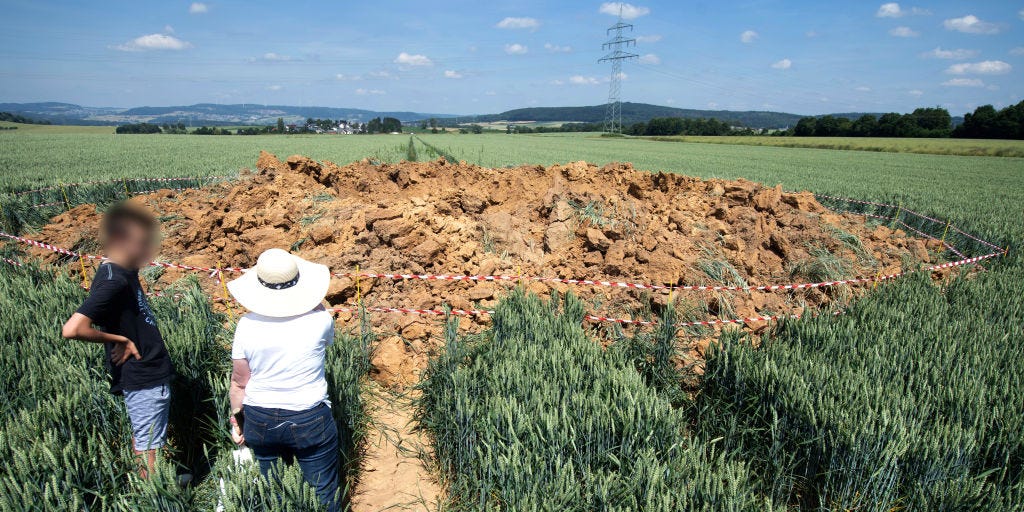
World War II Bomb Explodes 75 Years Later, Creates Massive Crater in German Field

A quiet field near Limburg, Germany, became an unexpected reminder that history sometimes refuses to stay buried. In June 2019, residents near the village of Ahlbach woke before sunrise to a loud boom, a tremor, and the sort of mystery that makes everyone suddenly very interested in local geology. By the next afternoon, officials discovered a huge crater in a field: roughly 33 feet wide and 13 feet deep. The suspected cause was not a meteor, a prank, or an overenthusiastic mole with demolition training. It was a World War II bomb, likely buried for more than seven decades before detonating on its own.
The incident quickly became international news because it combined two things people rarely expect to see in the same sentence: “World War II bomb explodes” and “German field.” Yet for Germany, unexploded ordnance is not a strange footnote. It is a regular, dangerous, and expensive legacy of the war. Even today, construction crews, farmers, police, and bomb-disposal experts still deal with buried bombs left behind by the massive Allied air campaigns of the 1940s.
What happened in that German field was dramatic, but it was not entirely surprising. Beneath parts of Europe, the Second World War is still present in metal, chemicals, fuses, and explosives slowly aging underground. The Ahlbach crater was a sudden reminder that old weapons can still behave like weapons, even after the world around them has changed from battlefield to farmland.
The Explosion That Turned a Field Into a Crater
The blast occurred in the early hours of Sunday morning near Ahlbach, a district close to Limburg in the German state of Hesse. Residents reported hearing a loud explosion around 4 a.m. and feeling the ground shake. When daylight arrived, the result was impossible to miss: a gaping hole in the field, deep enough to swallow a small car and wide enough to make any farmer reconsider breakfast.
Police later said there was no sign that farm equipment, construction machinery, or human activity had caused the explosion. Explosive ordnance specialists examined the crater and concluded that the most likely cause was an aerial bomb from World War II. The crater’s shape, size, and blast pattern pointed toward a buried munition rather than a natural collapse or modern accident.
Fortunately, no one was injured. That detail matters because a blast of this size could have been deadly if it had happened near homes, workers, livestock, or a road. The field absorbed the force. The nearby community absorbed the shock. And the rest of the world absorbed another lesson in how long the physical consequences of war can last.
Why Was a World War II Bomb Still Underground?
During World War II, Germany was heavily bombed by Allied forces. Industrial cities, rail lines, military installations, bridges, ports, and transportation hubs were frequent targets. Bombers released enormous quantities of explosives over German territory, and not every bomb detonated on impact. Some malfunctioned. Some landed in soft soil. Some buried themselves deep below the surface and remained hidden for decades.
These unexploded bombs are commonly known as unexploded ordnance, or UXO. The term may sound technical and tidy, but the reality is neither. A UXO can be a bomb, shell, grenade, mine, or other military explosive that failed to detonate as intended. It may appear harmless after decades underground, but it can still contain active explosive material and unstable components.
In Germany, unexploded World War II bombs are discovered regularly. They are often found during road work, building construction, river dredging, and farming. Cities such as Berlin, Hamburg, Frankfurt, Cologne, Munich, and Dresden have all dealt with major bomb scares or evacuations. In some cases, tens of thousands of people have had to leave their homes while specialists defused or safely destroyed a buried bomb.
How Can a Bomb Explode After 75 Years?
It sounds almost absurd: a bomb waits underground for 75 years and then suddenly decides, “Today seems dramatic.” But explosives experts have long warned that old munitions can become more dangerous with age, not less.
One likely explanation involves the bomb’s chemical detonator. Many World War II-era bombs used delayed-action fuses or chemical components that could degrade over time. As metal corrodes and internal materials shift, the fuse mechanism may become unstable. Groundwater, soil pressure, freeze-thaw cycles, vibration, and chemical reactions can all contribute to a dangerous change inside the device.
In other words, an unexploded bomb is not necessarily sleeping peacefully. It may be rusting, leaking, corroding, and slowly becoming more unpredictable. Time does not politely deactivate every explosive. Sometimes it makes the engineering worse, the fuse less stable, and the danger harder to detect.
The German field explosion appears to have been one of those rare cases where no construction crew struck the device and no bomb squad was attempting to defuse it. The bomb seems to have detonated spontaneously after decades underground. That is rare, but not impossible.
The Scale of the Crater: What It Revealed
The crater measured about 10 meters across and 4 meters deep, or roughly 33 feet wide and 13 feet deep. That size suggests a powerful blast. The explosion disturbed soil, created a steep-sided pit, and left behind a scene that looked more like a wartime photograph than a modern rural field.
For investigators, the crater itself became evidence. Blast craters can reveal important clues: the depth of the explosive, the direction of force, the amount of displaced earth, and whether the explosion came from below ground. In Ahlbach, the crater’s size and shape supported the conclusion that an old bomb had detonated beneath the surface.
The explosion was also strong enough for residents to feel it as a tremor. Some reports described it as registering like a minor earthquake. That detail gave the story extra attention, but it also showed how much energy can remain inside old wartime explosives. A bomb does not become gentle just because it has spent decades under crops.
Germany’s Ongoing Battle With Unexploded Ordnance
The Ahlbach crater was shocking, but Germany’s bomb-disposal problem is much larger than one field. Every year, authorities find thousands of tons of leftover munitions from World War II. Many are discovered during construction projects, especially in cities that were heavily bombed. Before major building work begins, developers often consult historical aerial photographs and conduct surveys to identify possible bomb sites.
When a suspicious object is found, the process can become a major public-safety operation. Police create exclusion zones. Residents evacuate. Roads close. Trains stop. Hospitals, schools, businesses, and nursing homes may need special assistance. Bomb-disposal technicians then examine the device, determine the fuse type, and decide whether it can be defused or must be detonated in place.
These operations are routine in Germany, but “routine” does not mean “safe.” Bomb technicians face real danger, especially when dealing with corroded fuses or damaged casings. Some fuses are designed to resist removal. Others become so unstable that even slight movement is risky. The work requires patience, technical skill, and nerves that most of us misplace when our phone battery drops below 10 percent.
Why German Cities Still Evacuate Thousands
Modern Germany has built highways, apartment blocks, train stations, schools, museums, and office towers over land that was once bombarded from the air. This creates a strange overlap between normal life and buried danger. A construction worker may be digging a foundation for a new building and suddenly uncover a bomb dropped before their grandparents were born.
Large evacuations happen because blast zones can be wide. Even a single 500-pound or 1,000-pound bomb can send fragments flying over a dangerous distance. Authorities must consider nearby homes, public transportation, hospitals, power lines, gas lines, and crowds. Closing a city district for several hours may be inconvenient, but it is far better than gambling with an unstable explosive.
In recent years, German cities have repeatedly evacuated thousands of people after discovering World War II bombs. Frankfurt, Cologne, Dresden, Hanover, and other cities have all faced major disposal operations. These events remind residents that the war’s physical remains are not confined to museums. Some are still under parking lots, riverbanks, railway yards, and fields.
What Made the Ahlbach Case So Unusual?
Most World War II bombs discovered in Germany are found before they explode. A construction crew spots metal. Survey equipment detects an anomaly. Police are called. Specialists arrive. Residents leave. The bomb is defused or destroyed under controlled conditions.
The Ahlbach case was different because the bomb apparently exploded by itself. No one had dug it up. No one had struck it with machinery. No one was trying to move it. The bomb had likely remained underground since the war, hidden beneath ordinary farmland, until its aging fuse or chemical components finally failed.
That spontaneous detonation made the story feel eerie. It also raised public awareness about a problem that can otherwise seem invisible. A buried bomb is easy to ignore until it announces itself with a crater.
The Human Side of a Forgotten Bomb
It is tempting to treat the crater as a strange curiosity, the sort of odd news story people share with a raised eyebrow and a comment like, “Well, that’s one way to aerate a field.” But behind the surprise is a serious human story.
For residents near Ahlbach, the blast was a frightening reminder that their peaceful landscape once belonged to a continent at war. For farmers, it raised practical concerns about land that may look ordinary but hide dangerous debris. For bomb-disposal teams, it was another example of why their work remains essential. And for historians, it offered a physical reminder that war does not end neatly when treaties are signed.
World War II ended in Europe in 1945, but its leftovers are still being found across the continent. Bombs remain in German soil, French fields, British cities, Polish forests, and coastal waters. Some are mapped. Many are not. The past, in this case, is not only remembered. It is buried, corroding, and occasionally explosive.
Why This Story Still Matters Today
The story of the World War II bomb exploding 75 years later matters because it challenges the way we think about history. Many people imagine the war as black-and-white footage, textbook chapters, memorial plaques, and museum exhibits. Those things are important, but they can make the conflict feel distant. A crater in a modern German field makes it immediate again.
It also shows how war creates long-term costs that continue for generations. The people who heard the Ahlbach explosion were not the people who started the war. The farmer who found the crater did not drop the bomb. The bomb technicians who investigated it were dealing with a danger created long before they were born. That is one of the grim truths of modern warfare: weapons can outlive the politics, soldiers, leaders, and strategies that put them there.
Unexploded ordnance also affects land use and public planning. Before roads, buildings, or infrastructure projects can move forward in some areas, authorities must check for buried munitions. This adds cost, time, and risk. It also requires specialized knowledge, historical research, and public cooperation during evacuations.
What To Do If You Find a Suspected Old Bomb
The safest advice is simple: do not touch it. Do not move it. Do not poke it with a shovel. Do not take a selfie beside it. Definitely do not say, “I saw a video about this once,” and begin your personal audition for the world’s worst bomb-disposal documentary.
If someone discovers a suspicious metal object that may be a munition, they should move away, warn others nearby, and contact local authorities immediately. In countries with known unexploded ordnance risks, police and emergency services have established procedures for handling these discoveries. Professionals can assess the object and call specialized disposal teams.
Old bombs may be rusty and unimpressive-looking, but appearances mean nothing. A corroded fuse can be more unstable than a clean one. A bomb that failed to detonate in 1944 can still kill in 2026. The correct response is distance, caution, and expert help.
Experiences and Reflections: Living With History Beneath Your Feet
Stories like the Ahlbach crater create a strange feeling because they turn an ordinary place into a historical scene overnight. Imagine walking past the same field for years, seeing crops rise and fall with the seasons, hearing tractors in the distance, maybe thinking mostly about weather, harvests, and whether the local roadworks will ever end. Then one morning, the land opens up with a blast from a war that ended long before many residents were born.
That kind of experience changes how people see familiar ground. A field is no longer just a field. It becomes a layered place, carrying traces of farmers, families, soldiers, pilots, engineers, and emergency workers. The landscape starts to feel less like a flat surface and more like a memory archive. Some pages are peaceful. Some are dangerous. Some are buried several meters deep.
For people who live in regions affected by wartime bombing, this awareness can become part of everyday life. Construction delays caused by bomb discoveries may be frustrating, but they are also accepted as necessary. Evacuation notices may interrupt routines, yet most residents understand the reason. A person may grumble about leaving home for a few hours, but no one wants to be the person who argued with a 500-pound bomb and lost.
Farmers face a particularly unusual relationship with this hidden history. Their work depends on soil, and soil remembers. A plow, drainage project, or field improvement can reveal objects that have waited underground for generations. Most days, farming is about weather, equipment, markets, and patience. In former war zones, it can also include caution about what lies below the roots.
The Ahlbach explosion also offers a lesson for readers far from Germany. Many countries still deal with unexploded ordnance from past conflicts. In Europe, Asia, North Africa, and parts of the Pacific, old bombs and shells continue to affect communities. Some places face an even heavier burden from land mines, cluster munitions, and artillery shells. The problem is not only historical; it is humanitarian, environmental, and economic.
There is also a deeper emotional experience attached to these discoveries. A buried bomb is not just a piece of metal. It is evidence of fear, strategy, violence, survival, and loss. When one is found or detonates, it reminds people that war leaves behind more than stories. It leaves behind physical risks that can interrupt birthdays, school days, commutes, hospital operations, and harvest seasons decades later.
At the same time, the response to these discoveries shows something hopeful. Communities evacuate. Police coordinate. Specialists risk their safety to protect others. Historians and surveyors help identify danger zones. Engineers design safer construction processes. Residents return home when the all-clear is given. Life resumes, not because the past disappeared, but because people learned how to manage its remains.
The massive crater in the German field was alarming, but it also became a visible lesson. It showed why remembrance is not only about ceremonies and anniversaries. Sometimes remembrance is practical. It means funding disposal teams, respecting evacuation orders, preserving records, teaching people what not to touch, and acknowledging that the consequences of war can remain active long after the fighting stops.
In that sense, the Ahlbach crater was more than a hole in the ground. It was a message from history, delivered loudly and without an appointment. The message was clear: the past is not always past, and peace requires more than the absence of battle. It also requires the slow, careful work of making old battlefields safe again.
Conclusion
The World War II bomb that exploded near Ahlbach, Germany, roughly 75 years after it was dropped, created a massive crater and a powerful reminder of the war’s unfinished legacy. No one was injured, but the blast showed how dangerous unexploded ordnance can remain after decades underground. Germany’s ongoing work to find, defuse, and safely remove wartime bombs is not just a technical challenge; it is a public-safety mission shaped by history.
The crater may eventually fill in. Crops may grow again. The field may return to looking ordinary. But the story remains extraordinary because it proves that history can still shake the ground beneath modern life. Sometimes the past whispers through museums and memorials. Sometimes it explodes at four in the morning and leaves a 33-foot-wide hole in a German field.
Note: This article is based on real reported details about the 2019 Ahlbach/Limburg field explosion, Germany’s long-running unexploded ordnance problem, and documented public-safety responses to World War II-era bombs.