
Archaeology is often presented as a dignified search for pottery, temples, and tasteful museum exhibits. Then somebody opens a peat bog and finds a face staring back.
Across the world, excavations have uncovered chained prisoners, decapitated warriors, severed hands, ritual sacrifices, anti-vampire burials, and entire landscapes scattered with human bones. These strange archaeological finds may look like props from a horror movie, but each one offers real evidence about how people lived, died, feared, punished, worshiped, and understood the unknown.
Before entering this historical haunted house, one warning is necessary: human remains are not decorations. They belonged to real people, and the most responsible researchers study them with care. With that flashlight firmly in hand, here are ten creepy archaeology discoveries that prove the past did not need a screenwriter to become terrifying.
1. Tollund Man: The Face in the Bog
In 1950, peat cutters working in Denmark uncovered what appeared to be the recent victim of a murder. The man’s face was so well preserved that his closed eyes, chin stubble, wrinkles, and calm expression remained clearly visible. Police were contacted, but the suspected crime scene was roughly 2,300 years old.
Now known as Tollund Man, the body had been naturally preserved by the cold, acidic, oxygen-poor environment of a peat bog. He wore a pointed leather cap and a belt, but little else. A braided leather cord remained around his neck, and examinations indicated that he had been hanged.
Researchers have debated whether he was executed, sacrificed, or killed for another reason. His carefully positioned body and final meal of grains and seeds have often been interpreted as evidence of ritual activity. Yet archaeology cannot read intentions directly. It can reveal the rope, the stomach contents, and the placement of the body, but not the final conversation that occurred beside the bog.
The most unsettling feature is his expression. Tollund Man does not look skeletal or remote. He looks asleep, as though somebody might tap his shoulder and receive a very inconvenient response.
2. Poland’s Anti-Vampire Burials
Hollywood vampires receive velvet capes and dramatic castles. People suspected of becoming vampires in early modern Europe received much less glamorous treatment.
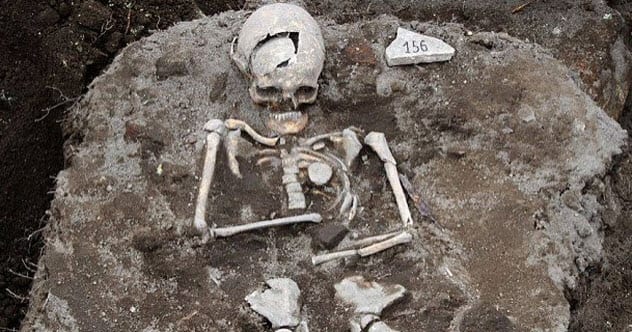
At a cemetery in Drawsko, Poland, archaeologists found several unusual burials dating mainly to the 17th and 18th centuries. Some bodies had iron sickles placed across their necks or abdomens. Others had stones positioned beneath their jaws. The arrangement may have been intended to stop a corpse from rising, with the sickle theoretically cutting the body if it attempted to move.
Later research challenged the idea that these individuals were outsiders. Chemical analysis suggested they were local people, not mysterious travelers who had frightened the community. Disease outbreaks, unexpected deaths, physical differences, or behavior considered socially troubling may have caused suspicion to fall on them.
These macabre burials reveal how communities tried to manage fear before modern medicine explained epidemics and decomposition. A swelling corpse, blood-like fluid near the mouth, or slowly growing hair and nails could seem supernatural to observers unfamiliar with postmortem changes.
The real horror was not that vampires existed. It was that ordinary people could become targets after death because their neighbors needed an explanation for tragedy.
3. The Screaming Mummy of Prince Pentawer
Most Egyptian mummies were arranged with care, their mouths closed and their bodies prepared for eternity. One royal mummy, however, was preserved with its head tilted back and its mouth open in an expression that resembles a final scream.
The mummy was discovered in the royal cache at Deir el-Bahari and became known as Unknown Man E. Genetic testing later indicated that he was related to Pharaoh Ramesses III. Researchers have connected him to Prince Pentawer, a son implicated in the famous “harem conspiracy” against the pharaoh.
Ancient legal records describe a plot involving members of the royal household. Ramesses III was attacked, and modern scans revealed a deep wound across his throat. Pentawer was tried and apparently compelled to take his own life, although the precise circumstances remain uncertain.
The mummy’s unusual treatment adds to the mystery. He was wrapped in sheepskin, a material considered ritually impure in some ancient Egyptian contexts, and he appears not to have received the elaborate preparation normally afforded to royalty.
His open mouth does not prove that he died screaming; postmortem muscle relaxation can create dramatic expressions. Still, the combination of royal conspiracy, violent death, irregular burial, and a face fixed in apparent agony gives this archaeological mystery an atmosphere no movie studio could improve.
4. The Mass Child Sacrifice at Huanchaquito-Las Llamas
On Peru’s northern coast, near the former Chimú capital of Chan Chan, archaeologists uncovered one of the largest known mass child-sacrifice events in the Americas.
The site of Huanchaquito-Las Llamas contained the remains of more than 140 children and over 200 young camelids, primarily llamas. The event occurred around 1450, several decades before the Chimú Empire was absorbed by the Inca.
Many children were approximately 5 to 14 years old. Evidence on their remains indicated that their chests had been opened, possibly as part of a ritual involving removal of the heart. The children and animals were carefully arranged, suggesting a centrally organized ceremony rather than chaotic violence.
Footprints preserved in dried mud indicate that groups moved across the site during wet conditions. Researchers have proposed that unusually destructive rainfall and flooding associated with an El Niño event may have inspired the sacrifice. In this interpretation, the Chimú leadership turned to an extraordinary offering when established religious responses appeared to fail.
It is tempting to label ancient people irrational and move on. A more difficult conclusion is that societies under environmental and political pressure can normalize extreme actions when authorities present them as necessary for collective survival. That lesson is considerably scarier than any supernatural curse.
5. Sixteen Severed Hands at Ancient Avaris
During excavations at Avaris, an ancient capital in Egypt’s Nile Delta, archaeologists discovered pits containing severed human hands. Not random hand bones. Not damaged skeletons. Hands deliberately removed and deposited near a palace.
The palace complex dates to the period when the Hyksos ruled parts of northern Egypt, roughly between the 17th and 16th centuries B.C.E. Early reports described 16 right hands, while a later osteological study closely analyzed remains representing at least 12 individuals.
Ancient Egyptian art and written records refer to warriors cutting off the right hands of defeated enemies. The trophies could be presented to a ruler in exchange for recognition or gold. Until the Avaris discovery, scholars mainly knew the practice from images and texts. The pits provided disturbing physical evidence that the custom was more than artistic symbolism.
Researchers cannot determine with certainty whether the victims were alive when their hands were removed. The placement near a ceremonial space, however, strongly suggests that the remains formed part of a public military ritual.
Apparently, ancient performance reviews could be exceptionally literal: “Please provide evidence of your battlefield productivity.”
6. The Shackled Dead of Phaleron
At the ancient cemetery of Phaleron, near Athens, excavators found rows of men buried together. Dozens still wore iron restraints around their wrists.
The burial dates to the turbulent Archaic period of Greek history. The men appear to have been relatively healthy when they died, and their orderly placement suggests a controlled execution rather than casualties hastily collected after a battle.
One theory connects them to the failed coup of Cylon, an aristocrat and former Olympic champion who attempted to seize control of Athens in the seventh century B.C.E. According to later accounts, some of his supporters sought sanctuary but were killed after being promised safe passage. The date and circumstances make the connection possible, but not proven.
That uncertainty is important. Archaeology often uncovers the victims before it finds their names. Shackles can demonstrate captivity, and bone injuries may reveal violence, but identifying the political event responsible requires additional evidence.
Even without a final verdict, the Phaleron burials expose a side of ancient Greece frequently hidden behind polished marble statues. The culture that helped shape democracy also experienced coups, executions, factional violence, and political revenge. Philosophy was thriving, but so was the prison industry.
7. The Decapitated Vikings of Ridgeway Hill
While surveying land for a road project near Weymouth, England, archaeologists uncovered a mass grave filled with decapitated bodies. The skulls had been placed separately from the rest of the remains.
Forensic and isotopic analysis indicated that the dead were young men of Scandinavian origin. The grave contained the remains of more than 50 individuals, most likely Vikings who were captured and executed between the late 10th and early 11th centuries.
Cut marks suggest that some men required several blows to be beheaded. This was not the swift, elegant sword stroke commonly shown in historical dramas. The execution appears to have been violent, difficult, and possibly performed before an audience.
Researchers have proposed several explanations. The men may have belonged to a raiding force, a mercenary group, or an elite band of warriors captured by local Anglo-Saxons. The deaths occurred during a period of intense conflict between Scandinavian armies and English kingdoms, but no surviving record identifies the exact event.
The arrangement of bodies and heads transforms the pit from a simple burial into evidence of deliberate humiliation. Killing the men ended the immediate threat; separating and displaying their remains may have delivered a message to anyone considering the same career path.
8. The Butchered Human Bones of Herxheim
At Herxheim in southwestern Germany, archaeologists uncovered a Neolithic settlement surrounded by unusual ditches packed with fragmented human remains. The deposits date to approximately 7,000 years ago and represent hundreds of individuals.
Many bones show cut marks, deliberate breakage, scraping, and other forms of processing. Some skulls were modified into bowl-like shapes. The patterns resemble techniques used to butcher animals, including breaking long bones to reach marrow.
One interpretation is ritual cannibalism on a large scale. Another argues that the remains were processed during complex funerary ceremonies, possibly after bodies had been transported from distant communities. Chemical evidence indicates that many individuals did not grow up locally, making Herxheim a regional gathering place, a center of sacrifice, or both.
Responsible analysis requires emphasizing that cannibalism is difficult to prove. Cut marks demonstrate defleshing, but they do not automatically reveal why flesh was removed or whether it was eaten. Archaeologists compare fracture patterns, burning, tooth marks, skeletal representation, and site context before proposing such a conclusion.
Whatever happened, Herxheim was not an ordinary cemetery. Something highly organized and socially significant occurred there, leaving behind one of Europe’s most unsettling prehistoric assemblages.
9. The Aztec Tower Built From Human Skulls
Spanish accounts described an enormous rack of human skulls in the Aztec capital of Tenochtitlan. For centuries, some historians wondered whether the reports had been exaggerated to portray the Aztecs as especially brutal. Then archaeologists found the structure.
Excavations near Mexico City’s Templo Mayor revealed part of the Huey Tzompantli, a monumental skull display associated with the religious center of the Aztec capital. Researchers found skulls incorporated into circular towers with mortar, as well as evidence of the wooden rack on which heads had originally been displayed.
More than 600 skulls had been identified in the tower sections by 2020. Many belonged to adult men, who may have been captured warriors, but the presence of women and children showed that the victims came from more varied backgrounds than previously assumed.
The display had several functions. It honored the gods, demonstrated imperial power, transformed defeated enemies into sacred offerings, and warned visitors that Tenochtitlan was not accepting applications for hostile takeover.
Its discovery also illustrates why archaeology matters. Historical documents can be biased, incomplete, or propagandistic. Physical evidence may confirm part of an account while forcing researchers to revise other details. In this case, the skull tower was realand apparently enormous.
10. Roopkund, India’s Skeleton Lake
High in the Himalayas lies Roopkund, a small glacial lake surrounded by human bones. When snow and ice melt, skulls, ribs, and long bones can become visible around the shore, creating one of the world’s most famous archaeological horror-story landscapes.
Early theories proposed that the dead were soldiers, traders, epidemic victims, or pilgrims killed in a single catastrophe. Scientific testing made the mystery stranger.
A major ancient-DNA study analyzed 38 individuals and found that they belonged to three genetically distinct groups. Some had South Asian ancestry and died in several events between approximately the seventh and tenth centuries. Another group had ancestry associated with the eastern Mediterranean and died roughly 1,000 years later. One person had Southeast Asian ancestry.
The results disproved the simple idea that everybody at the lake died together. Some of the South Asian individuals may have been pilgrims, and injuries on certain skulls have inspired theories about deadly hail. However, the causes of death remain unresolved, especially for the later Mediterranean-related group.
Why did people with such different origins reach the same remote lake centuries apart? Why did so many die there? Roopkund offers no tidy ending. It simply waits beneath the ice, periodically revealing another piece of a story whose final chapter is missing.
Why These Strange Archaeological Finds Matter
These discoveries are frightening because they collapse the comfortable distance between the present and the past. A skull tower is an abstract historical fact until excavators find the mortar between the bones. A political execution becomes harder to romanticize when the prisoners’ shackles remain locked around their wrists.
Macabre archaeological finds also reveal recurring human responses to uncertainty. Communities created anti-vampire burials when disease could not be explained. Rulers displayed bodies to advertise power. Societies used sacrifice when environmental disaster seemed uncontrollable. Victors mutilated enemies to transform violence into ceremony.
At the same time, interpretation must remain cautious. An unusual burial is not automatically evidence of witchcraft. A broken bone does not always prove murder. A frightening facial expression on a mummy does not preserve the exact emotion felt at death. Context, laboratory analysis, dating, and comparison with other sites separate archaeology from campfire storytelling.
The most compelling ancient mysteries are not those researchers pretend to have solved. They are the discoveries where evidence narrows the possibilities while leaving one door slightly open.
Experiencing Archaeology’s Darker Side
The Difference Between Reading and Standing There
Reading about creepy archaeology discoveries from a comfortable chair creates a safe kind of fear. The photograph is contained inside a screen. The bones are thousands of miles away. You can close the tab, inspect the refrigerator, and confirm that no Iron Age bog person has moved into the vegetable drawer.
Standing at an archaeological site or viewing human remains in a museum produces a different reaction. The first surprise is usually scale. A mass grave is not a single dramatic skeleton posed for a documentary. It may be an uneven layer of bodies extending across an excavation trench, with each individual requiring patient recording. A skull rack is not merely a gruesome object; it is architecture designed to affect crowds.
The second surprise is silence. Horror films rely on music, sudden movement, and characters making extremely poor basement-related decisions. Archaeological sites are often quiet. That stillness makes the evidence feel more immediate. A shackle, rope, cut mark, or child’s footprint can communicate violence without theatrical assistance.
What Visitors Often Notice First
People tend to focus on faces. Tollund Man attracts attention because his features remain recognizable. Egyptian mummies can create the same effect. A preserved face bypasses the mental category of “ancient artifact” and registers as a person. Visitors notice closed eyelids, uneven teeth, hair, fingernails, and injuriesthe small details shared with living bodies.
Personal objects can be equally powerful. Clothing, combs, sandals, jewelry, food, and tools reveal that the deceased had routines before becoming an archaeological discovery. A sacrificed child may have traveled with others. A captured warrior once recovered from an old leg injury. A bog body ate a final meal without knowing that scientists would analyze it two millennia later.
These details create empathy, but they can also encourage invented stories. A calm-looking face does not prove peaceful acceptance. Valuable grave goods do not guarantee that someone was loved. Researchers must distinguish emotional impressions from testable evidence.
How to Explore Macabre Archaeology Responsibly
Visitors interested in unusual ancient rituals and archaeological horror stories should begin with museums, archaeological parks, university projects, and publications that explain context. Sensational photographs without excavation records often circulate online with false captions. A “vampire skeleton” may be an ordinary burial photographed from a misleading angle, while an alleged giant can turn out to be a sculpture, animal bone, or enthusiastic use of photo-editing software.
Human remains deserve particular care. Different countries and descendant communities have different rules governing excavation, display, analysis, and repatriation. Taking cheerful selfies beside exposed burials, touching bones, or removing objects from a site can be disrespectful and may destroy scientific information. Archaeology’s darkest discoveries are not theme-park props.
The Feeling That Stays With You
The lasting experience is rarely simple fear. It is recognition. The people represented by these finds worried about illness, political instability, natural disaster, hostile outsiders, social order, and death. Their solutions sometimes appear shocking, but the underlying emotions are familiar.
That is why these strange archaeological finds remain so compelling. They do not show a past populated by monsters. They show humans capable of tenderness, terror, organization, belief, cruelty, and desperate improvisation. The costumes change. The anxieties are surprisingly durable.
After exploring archaeology’s darker side, the past may no longer feel safely buried. It feels close enough to whisperand unlike a movie ghost, it brings laboratory reports.