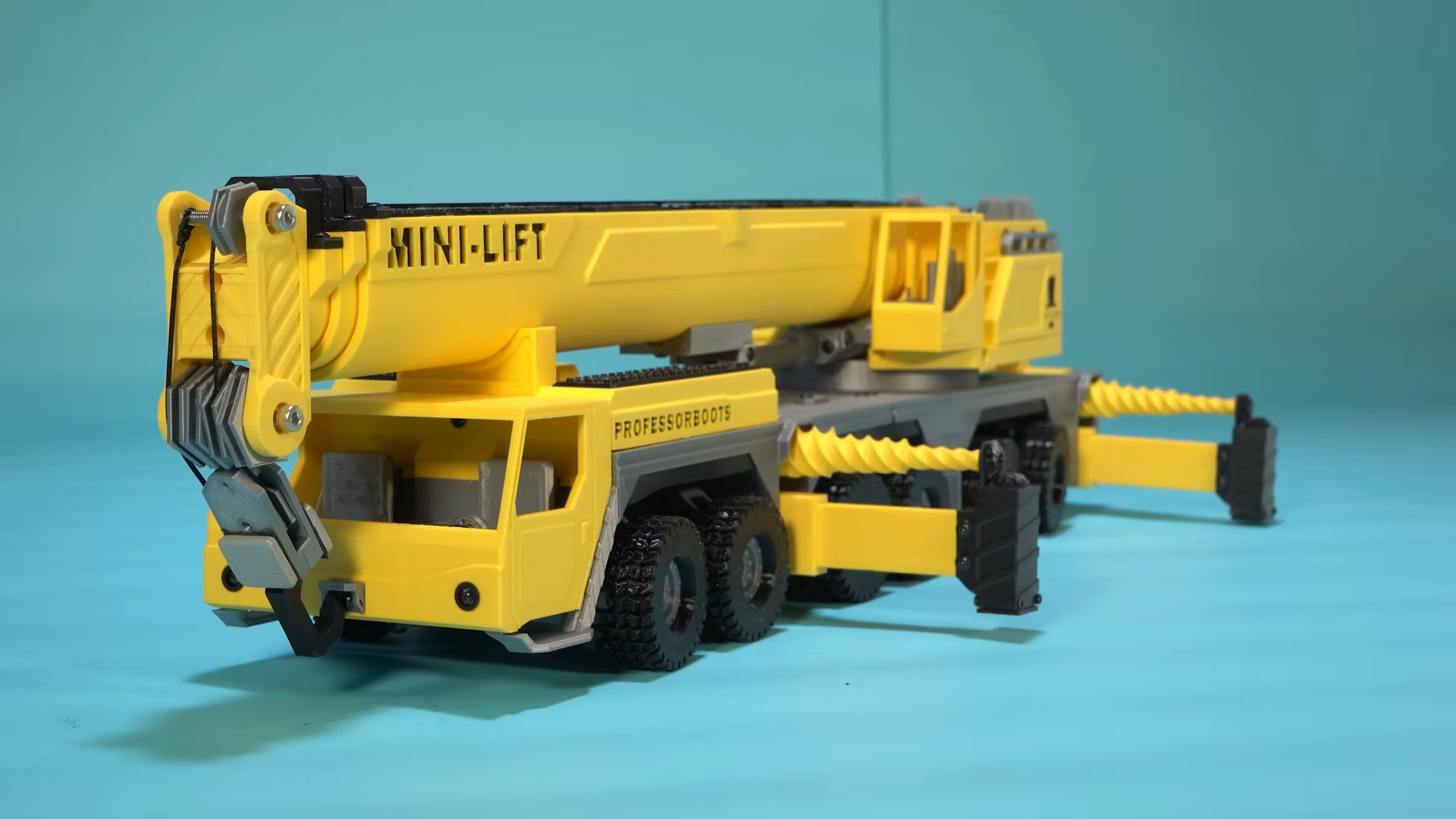

Some projects politely sit on a desk. Others roll in, deploy outriggers, stretch a telescoping boom across the room, and make every nearby coffee mug look like a construction-site hazard. The 3D printed RC crane with an epic 3-foot reach belongs proudly in the second category.
This remote-controlled crane, created by maker ProfessorBoots and inspired by the real-world Liebherr LTM 1300 mobile crane, is not just a plastic shell pretending to be heavy equipment. It drives, stabilizes itself, extends a long boom, moves small loads, and combines the best parts of 3D printing, RC engineering, embedded electronics, and “I may have underestimated this weekend project” energy.
For hobbyists, it is a reminder of how far desktop fabrication has come. A few years ago, a functional RC crane this ambitious would have required machining tools, custom metal parts, and a workshop that smelled permanently like cutting oil. Today, a dedicated builder can produce much of the structure on a consumer 3D printer, wire up motors and microcontrollers, and create a miniature construction machine that looks ready to ask for a permit.
Why This 3D Printed RC Crane Is Getting Attention
The big headline is obvious: a 3-foot telescoping boom. In scale-model terms, that is dramatic. It gives the crane presence, reach, and the delightful ability to make ordinary household objects feel like tiny cargo in an industrial yard.
But the reach is only part of the story. The project reportedly uses ten gearmotors, four servos, and two ESP32 microcontrollers. That is not “add wheels and call it a robot.” That is a coordinated mechanical system with drive functions, steering, boom movement, stabilization, and control logic. In other words, this crane has more going on than some group projects in engineering class.
A Mini Mobile Crane, Not a Desk Ornament
Many 3D printed models look fantastic but do not do much beyond collecting dust and compliments. This build is different because it focuses on function. The crane can roll into position, deploy stabilizer legs, extend its boom, and move lightweight objects. The outriggers are especially important because cranes, even tiny ones, are basically long levers looking for an excuse to tip over.
The design takes cues from real mobile cranes. Full-size machines use outriggers to widen their support base before lifting. This model brings that same principle into the RC world, making the machine feel more authentic and helping users understand why construction equipment is shaped the way it is.
The Engineering Behind the Epic 3-Foot Reach
A long boom is exciting, but it also creates problems. The farther the hook moves away from the crane body, the more leverage it creates. Even a small object can produce surprising stress when it hangs at the end of a long arm. That is why a working 3D printed crane boom needs thoughtful design, not just more plastic.
The telescoping boom must balance stiffness, weight, friction, and printability. Too thin, and it flexes like a pool noodle having a bad day. Too thick, and the motors struggle to move it. Too tight, and the boom binds. Too loose, and it wobbles. The sweet spot lives somewhere between mechanical precision and printer reality.
Why 3D Printing Works So Well for RC Construction Equipment
3D printing is ideal for projects like this because it allows complex parts to be made in small batches without expensive molds or machining. Gear housings, brackets, body panels, servo mounts, linkages, and cosmetic details can all be designed digitally, printed, tested, revised, and printed again.
That iteration loop is the secret sauce. When a part does not fit, the builder can adjust the CAD file instead of filing plastic until midnight while questioning life choices. When a bracket cracks, it can be thickened, reoriented, or reinforced. When a panel looks boring, it can gain vents, ribs, or scale details because every crane deserves a little runway confidence.
Materials, Infill, and Print Orientation Matter
A functional RC crane is a great example of why print settings are not decorative trivia. For load-bearing parts, infill pattern, wall thickness, print orientation, and layer adhesion all matter. A beautiful part can still fail if the layer lines are positioned exactly where the stress wants to pull them apart.
For a crane, important parts include the boom sections, axle supports, outrigger arms, gear mounts, motor brackets, and rotating joints. These pieces should be printed with strength in mind. More infill can help, but it is not magic. In many cases, extra perimeters and smart orientation do more for strength than simply cranking infill to 100% and hoping the printer understands ambition.
PLA, PETG, or Something Stronger?
PLA is easy to print, stiff, and great for prototypes. PETG adds toughness and better heat resistance, which can help for parts that flex or handle repeated stress. Nylon and fiber-reinforced filaments can offer even better mechanical performance, but they demand more from the printer and the person operating it. They are less “click print and snack” and more “dry your filament, tune your settings, and speak respectfully to the nozzle.”
For many hobby RC builds, a mixed-material approach makes sense. Decorative panels can be PLA. Functional brackets may benefit from PETG or reinforced filament. Tires, pads, bumpers, and grippy details can use TPU. The crane becomes less of a single print job and more of a small manufacturing ecosystem.
Electronics: The Brain Behind the Boom
The ESP32 is popular in DIY robotics because it offers wireless connectivity, enough processing power for control tasks, and a friendly ecosystem for Arduino-style programming. In a complex RC crane, microcontrollers can manage motor outputs, servo signals, controller input, and movement sequencing.
Servos are useful for controlled angular motion, while gearmotors are better suited for continuous rotation, drive systems, winches, and mechanical extension. A crane that uses both has the flexibility to steer, drive, lift, rotate, and extend in ways that feel satisfyingly mechanical.
Why Multiple Motors Make the Build More Realistic
Real construction machinery rarely moves with one simple motor. A mobile crane has drive systems, steering systems, boom extension, boom elevation, stabilizers, winches, rotation mechanisms, and locking systems. A detailed RC version needs several independent motions to feel convincing.
That is why the reported use of ten gearmotors and four servos is impressive. It suggests the builder did not settle for a “looks close enough” model. Instead, the crane appears designed to mimic the choreography of real equipment. Watching a boom extend while the machine stabilizes itself is half engineering lesson, half tiny construction ballet.
Design Inspiration: The Liebherr LTM 1300 Look
The project is inspired by the Liebherr LTM 1300, a family of serious mobile cranes known for road-going mobility and telescopic lifting capability. The inspiration shows in the model’s proportions: multi-axle carrier, long boom, stabilizer system, and counterweight behavior.
Scale models work best when they capture the logic of the original machine. The goal is not only to copy the appearance but to preserve the reason behind the shape. A mobile crane looks the way it does because every feature solves a problem. The low carrier provides mobility. The outriggers fight tipping. The boom reaches over obstacles. The counterweight helps balance the load. When those functions appear in a 3D printed RC crane, the model becomes more than cute; it becomes educational.
What Makes This Project Advanced?
This is not the best first 3D printing project unless your idea of “beginner-friendly” includes debugging electronics, assembling drivetrains, tuning printed tolerances, and possibly inventing new expressions of frustration. A simple RC car is one thing. A functional crane with a 3-foot reach is a much bigger challenge.
The advanced difficulty comes from the number of systems that must work together. The printed parts must fit. The boom must slide smoothly. The motors must produce enough torque. The wiring must survive movement. The controller must respond predictably. The center of gravity must remain under control. The builder must keep track of screws that appear to teleport into another dimension.
Mechanical Tolerances Are the Real Boss Fight
With 3D printing, a digital design does not always become a perfect physical part. Filament type, printer calibration, temperature, layer height, and slicer settings can change dimensions. Sliding mechanisms like telescoping booms are especially sensitive. A fraction of a millimeter can separate smooth motion from plastic-on-plastic misery.
That is why test prints are valuable. Printing a small section of a boom joint before committing to the entire assembly can save hours. Functional models reward patience, measurement, and the humble willingness to reprint the same part while muttering, “This is fine.”
Safety and Practical Use
Even though this is a model, it should be treated with respect. A long boom creates leverage, and moving parts can pinch fingers, snag wires, or strain motors. This crane is best used for small, lightweight objects and demonstration loads, not for lifting pets, phones, coffee cups, or anything that would make a parent say your full name.
Good practice includes testing on a flat surface, extending the outriggers before lifting, starting with very light loads, and watching for flex in the boom or base. End stops, current limiting, and careful software limits can help protect motors and printed parts. The goal is to enjoy the miniature construction drama without turning the workshop into a tiny accident report.
Why Makers Love Projects Like This
The popularity of a 3D printed RC crane is not just about the final machine. It is about the process. Builders get to touch several disciplines at once: CAD design, mechanical engineering, electronics, programming, RC control, materials science, and troubleshooting. It is a playground for curious people who enjoy solving problems that did not exist until they created them.
Projects like this also show how accessible engineering has become. A teenager, hobbyist, student, or weekend tinkerer can explore concepts once limited to professional labs. They can learn torque, leverage, gear reduction, structural stiffness, PWM control, and wireless communication through a machine that actually moves.
The Joy of Functional Scale Models
Functional scale models have a special charm because they shrink big machines without shrinking the engineering ideas. A static crane model says, “Look at me.” A working RC crane says, “Look at me lift this tiny box with unnecessary seriousness.” That extra movement makes the project memorable.
There is also a satisfying contrast between the humble material and the ambitious result. Filament enters the printer as a spool of plastic spaghetti. After enough design, printing, wiring, and assembly, it becomes a machine with articulated motion and a 3-foot reach. That transformation is the magic trick at the heart of desktop fabrication.
Experience Notes: Building, Testing, and Living With a 3D Printed RC Crane
Working around a project like this feels less like assembling a toy and more like managing a tiny construction company where every employee is a motor and none of them read the meeting agenda. The first experience most builders notice is the print queue. A crane with this much mechanical complexity is not a one-evening print. It is a parade of brackets, boom sections, housings, linkages, panels, supports, and mysterious pieces that only make sense three days later.
The second experience is tolerance testing. A telescoping boom looks simple from the outside, but it teaches humility quickly. If the parts are too tight, the boom refuses to extend. If they are too loose, it rattles like a shopping cart with trust issues. Sanding, reprinting, adjusting slicer settings, and checking alignment become part of the ritual. The reward comes when the boom finally slides smoothly and you suddenly feel like you personally negotiated peace between plastic and physics.
Then comes wiring. The electronics stage is where the crane begins to feel alive, but it can also look like a robot ate a bowl of spaghetti and regretted nothing. Motors need power. Servos need signal. Microcontrollers need clean wiring. Moving parts need enough slack so wires do not pull loose, but not so much slack that the machine drags its own nervous system across the table. Cable management is not glamorous, but on a moving RC crane, it is the difference between reliable operation and a very small electrical soap opera.
Testing should begin slowly. The smartest approach is to test one function at a time: drive, steering, outriggers, boom lift, boom extension, rotation, and winch behavior. When everything is tested individually, combined movement becomes less scary. The first full deployment is the big moment. The crane rolls into place, the stabilizers go down, the boom rises, and suddenly the project stops being a collection of printed parts and becomes a machine with personality.
Using the crane also changes how you look at everyday objects. Bottle caps become cargo. Cardboard scraps become construction materials. A small wooden block becomes “critical infrastructure.” You may find yourself setting up miniature job sites on a desk, complete with dramatic pauses before every lift. It is ridiculous in the best possible way.
The most valuable experience, however, is learning how interconnected design choices are. A heavier boom requires stronger lift mechanics. Stronger mechanics require better mounts. Better mounts may need more print time. More print time encourages better planning. One change travels through the whole machine like gossip through a group chat. That is why this kind of project teaches engineering thinking so effectively. It does not simply ask, “Can you print this?” It asks, “Can you make all of this work together?”
Conclusion
The 3D printed RC crane with an epic 3-foot reach is the kind of project that makes desktop manufacturing feel genuinely powerful. It blends ambitious scale modeling with practical robotics, turning printed plastic, gearmotors, servos, and ESP32 control into a working miniature crane that can drive, stabilize, extend, and lift small objects.
More importantly, it shows what modern makers can do when they combine curiosity with patience. This is not a simple print-and-display model. It is a mechanical challenge, an electronics puzzle, a CAD exercise, and a lesson in leverage wearing a construction-crane costume. And honestly, that is a beautiful thing.
For anyone fascinated by 3D printing, RC vehicles, robotics, or construction equipment, this project is a towering reminder that the maker movement is still full of surprises. Sometimes those surprises arrive with outriggers, a telescoping boom, and the quiet confidence of a tiny machine that thinks your desk is a job site.