Dozens Of People Named Josh Join Friendly Battle For Naming Rights, Tumblr User Recaps It

Every so often, the internet stops arguing about pineapple on pizza, celebrity haircuts, or whether a hot dog is a sandwich, and gives humanity something strangely pure. The Josh Fight was one of those rare moments: a pandemic-era joke that somehow escaped the group chat, put on sneakers, grabbed a pool noodle, and marched into a Nebraska park.
The premise sounded like something a bored teenager would invent after too much soda: gather people named Josh, make them battle for the right to keep the name, and crown one true Josh. But in April 2021, the joke became real. Dozens of people named Josh plus many non-Joshes who simply wanted to witness history being gently whacked with foam showed up in Lincoln, Nebraska, for a friendly mock battle that became a viral internet legend.
What made the event especially delightful was the way social media recapped it. Tumblr users, Reddit commenters, Twitter spectators, and news outlets treated the whole thing like a medieval tournament written by a sleep-deprived meme committee. There were coordinates. There were rules. There was rock-paper-scissors. There were pool noodles. There was even a tiny champion known as “Little Josh.” Frankly, Shakespeare could never.
How the Josh Fight Started: One Joke, Many Joshes
The story began in April 2020, during the early stage of the COVID-19 pandemic, when many people were trapped indoors and forced to confront their own hobbies, sourdough starters, and questionable internet impulses. A college student named Josh Swain, from Arizona, created a Facebook Messenger group chat with other people who shared his name.
The message was simple, dramatic, and beautifully ridiculous: the Josh Swains would meet at a set of coordinates one year later and fight for the right to keep the name. Everyone else would, in theory, have to change theirs. It was not a serious legal proposal, obviously. No courthouse was preparing a “Department of Josh Reassignment.” But the screenshot spread online because it had the exact ingredients of a perfect meme: low stakes, high drama, and a level of commitment nobody asked for but everyone appreciated.
At first, the challenge targeted people with the full name Josh Swain. But as the meme grew, the audience expanded. Soon, it was not just Josh Swains. It was all Joshes. If your birth certificate, nickname, gaming handle, or inner spiritual identity said “Josh,” you were welcome to enter the foam battlefield.
Why Lincoln, Nebraska Became the Battleground
The coordinates selected for the original battle landed near Lincoln, Nebraska. That was partly because Nebraska sits close to the center of the United States, making it feel like neutral territory for a national Josh dispute. It was also random enough to be funny. Nothing says “ancient naming-rights duel” quite like a field in the Midwest.
There was one small problem: the original location was private property. The real world, unlike memes, has property lines and people who do not necessarily want hundreds of foam-armed strangers charging across their land. The event was moved to the Air Park Green Area in Lincoln, giving the Josh Fight a safer and more public home.
That move mattered. It transformed the gathering from a chaotic internet dare into an actual community event. Instead of trespassing for the sake of a name-based joke, attendees could meet, laugh, donate, and battle in a controlled space. The result was less “unhinged flash mob” and more “family-friendly festival accidentally designed by Tumblr.”
The Day of the Josh Fight
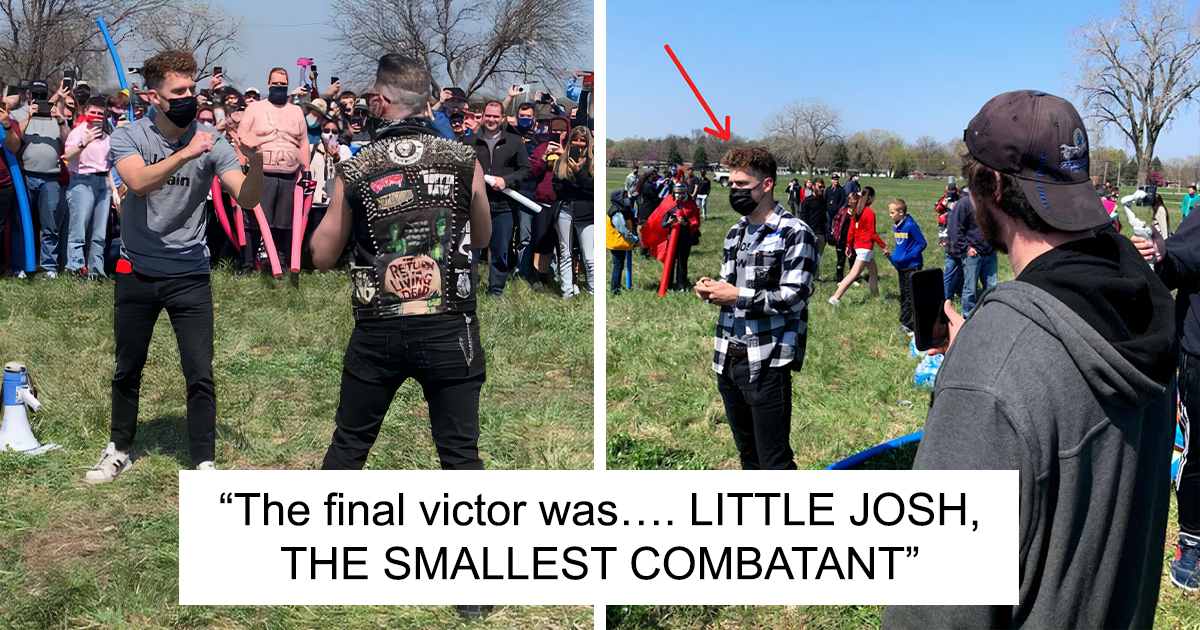
On April 24, 2021, people showed up. Not just a few people. Hundreds came to Lincoln, including many named Josh and many more who were simply there to watch the most wholesome absurdity of the week unfold in real time.
The event began with a showdown between two men named Josh Swain. Rather than using swords, legal documents, or a dramatic courtroom objection, the duel was decided by rock-paper-scissors. This was the correct choice. Rock-paper-scissors is the ancient democratic instrument of playground justice, snack distribution, and deciding who has to ask the waiter for extra ketchup.
Arizona Josh Swain won that match, earning the right to remain the official Josh Swain of the meme’s origin story. Then came the larger pool noodle battle for participants named Josh. Finally, the event opened into a broader noodle brawl where non-Joshes could also join the fun. Foam noodles flew. Crowds cheered. The internet received exactly the kind of harmless nonsense it desperately needed.
Little Josh: The Tiny Champion Who Stole the Show
Every great battle needs a hero. The Josh Fight found one in Joshua Vinson Jr., affectionately known as “Little Josh.” He was only a child, but he became the symbolic winner of the pool noodle battle and was crowned in front of a cheering crowd.
His victory was not just funny; it was perfect storytelling. A group of grown people named Josh gathered from around the country to settle a ridiculous naming dispute, and the crown went to a kid. That is not just a meme ending. That is a Pixar ending with better cardio.
Little Josh reportedly received a Burger King crown and champion-style recognition. The image of a child standing victorious after a field full of adults whacked each other with pool noodles became the emotional center of the event. The internet, often accused of being a giant blender full of bad takes, collectively agreed: this was good.
From Meme to Meaningful Fundraiser
The most surprising part of the Josh Fight was not that people showed up. The internet has convinced people to do stranger things with far less planning. The surprising part was that the event turned into a meaningful fundraiser.
Organizer Josh Swain encouraged donations to benefit the Children’s Hospital & Medical Center Foundation in Omaha, Nebraska. Attendees and online supporters helped raise thousands of dollars, and the event also gathered food and supplies for the Food Bank of Lincoln. Later, Josh Cellars, a wine brand with the most conveniently relevant name imaginable, announced a $30,000 donation in support of the fundraiser.
This is where the Josh Fight became more than a goofy viral moment. It showed how internet humor can become real-world generosity when someone gives the joke a positive direction. A meme about naming rights turned into help for children’s medical care and local hunger relief. That is a pretty strong return on investment for a joke that began with “there can only be one.”
Why Tumblr Loved the Josh Fight
Tumblr has always had a special talent for turning internet events into mythology. A normal recap might say, “People named Josh met in Nebraska and had a pool noodle fight.” A Tumblr-style recap says, in effect, “Behold, the Swainbowl, the Noodle War, the coronation of Little Josh, and the ancient foam rite by which the name was preserved.”
That dramatic framing helped the Josh Fight travel even farther online. Tumblr users treated the event like a saga, breaking down the origin, the rules, the characters, and the outcome with the breathless seriousness of a historian describing a royal succession crisis. The contrast made it funnier: everyone knew it was silly, but everyone also agreed to pretend it was extremely important.
This is a major reason the Josh Fight became sticky content. It was easy to understand, easy to share, and easy to retell. The joke did not require insider knowledge. You did not need to follow a fandom, understand a political reference, or decode a 17-layer meme format. You only needed to know one thing: a bunch of people named Josh were going to fight for the name Josh.
The Ingredients of a Perfect Viral Event
1. A Simple Concept
The best viral stories are easy to explain in one sentence. “People named Josh fought with pool noodles for the right to keep the name” is instantly understandable. It is also instantly funny. You can say it to a friend, a parent, or a confused coworker, and they will get the joke before the microwave finishes reheating lunch.
2. A Built-In Deadline
The original challenge gave people a full year to prepare. That created anticipation. The date became part of the meme. Instead of disappearing after one viral screenshot, the idea sat in public memory like a weird calendar appointment: remember, the Joshes are fighting next April.
3. Low Stakes, High Commitment
Nobody was truly losing their name. Nobody was filing paperwork to become “Former Josh No. 47.” But the participants committed to the bit anyway. That gap between the seriousness of the presentation and the harmlessness of the actual stakes made the event irresistible.
4. Visual Comedy
Pool noodles are funny. Adults holding pool noodles like legendary weapons are funnier. A crowd of Joshes charging into battle with colorful foam tubes is the kind of visual that practically edits itself into internet history.
5. A Feel-Good Ending
The event raised money, collected food, crowned a child champion, and gave people a shared laugh during a stressful time. That made it safe to enjoy. It was not mean-spirited. It was not built on embarrassment. It was a joke that invited everyone in, even people tragically not named Josh.
What the Josh Fight Says About Internet Culture
The Josh Fight is a reminder that online culture is not only about outrage, doomscrolling, or people writing 900-word arguments about sandwich geometry. Sometimes the internet creates community from absolutely nothing. Sometimes a screenshot becomes a gathering. Sometimes a joke becomes a fundraiser. Sometimes a child named Josh becomes the champion of all Joshes.
It also shows that people are hungry for playful shared experiences. During the pandemic, many were isolated, bored, anxious, and overwhelmed. The idea of gathering outdoors for a silly, harmless event gave people a reason to laugh together. The absurdity was the point. Nobody needed the name Josh to be settled. People needed a story that felt joyful.
In that sense, the Josh Fight worked like a modern folk festival. It had a legend, a ritual, costumes, spectators, a champion, and a moral: when life gets weird, bring a pool noodle and try to make it useful.
Specific Examples That Made the Event Memorable
Several details helped the Josh Fight rise above the average viral stunt. The first was the official-sounding structure. There was a rock-paper-scissors duel for Josh Swains, a pool noodle battle for Joshes, and a wider brawl for anyone ready to participate. That organization gave the chaos a story arc.
Another memorable detail was the relocation from private land to Air Park. It showed that the organizer and local participants were trying to keep the event safe and respectful. That mattered because internet jokes can quickly become messy when they collide with real places and real people.
The charity angle was equally important. By connecting the event to Children’s Hospital & Medical Center and the Food Bank of Lincoln, Josh Swain and supporters turned attention into action. In the attention economy, that is not always easy. Viral fame often evaporates in a day. The Josh Fight managed to convert laughter into donations.
Finally, Little Josh’s victory gave the story a perfect ending. Without him, the event would still have been funny. With him, it became adorable, cinematic, and almost suspiciously well-written. If someone had invented that ending in a screenplay, a producer might have said, “Too cute. Make it more realistic.” Reality, for once, ignored the note.
SEO Analysis: Why People Still Search for the Josh Fight
Search interest around the Josh Fight, Battle of the Joshes, and Little Josh continues because the story functions as evergreen internet culture. It is not tied to a complicated news cycle. It is a self-contained event with a funny title, clear characters, and a satisfying payoff.
People search for it for several reasons. Some want to know whether the event was real. Others saw a Tumblr recap, Reddit post, TikTok clip, or meme screenshot and want the full story. Many simply enjoy unusual human-interest stories that prove the internet can occasionally behave like a golden retriever with Wi-Fi.
For publishers, the Josh Fight is also a strong example of how viral stories should be covered: explain the origin clearly, provide the real-world details, highlight the charitable outcome, and avoid pretending the joke is more serious than it is. The tone should be playful but accurate. In other words, treat the pool noodle with respect, but do not call it a spear.
Experiences Related to the Josh Fight: What We Can Learn From a Friendly Battle for Naming Rights
The Josh Fight may seem like a one-off internet oddity, but it reflects experiences many people recognize. Almost everyone has been part of a joke that unexpectedly grew bigger than expected. Maybe it was a group chat joke that turned into a birthday tradition. Maybe it was an office gag that became an annual award. Maybe it was a family nickname that somehow survived three generations and now appears on holiday cards. The Josh Fight is simply the deluxe, national, foam-weapon version of that experience.
One relatable lesson is that shared silliness can build community fast. People do not always need a serious reason to gather. Sometimes they need a safe reason to be ridiculous together. A costume party, a themed fun run, a charity mustache contest, or a neighborhood “best ugly sweater” competition works because the activity lowers the pressure. Nobody has to be impressive. Nobody has to deliver a TED Talk. You just show up, laugh, and participate in the bit.
The Josh Fight also shows the value of committing to harmless fun. Plenty of jokes die because everyone is too embarrassed to follow through. But when people commit, the joke becomes an experience. The attendees who traveled to Lincoln did not just watch a meme; they entered it. That is a different level of participation. It is the difference between liking a post and becoming part of the story.
There is also a practical lesson for event organizers. If a joke becomes popular, structure matters. The Josh Fight worked because it was moved to a public location, given basic rules, connected to charity, and kept lighthearted. Any community event, even a silly one, needs safety, clarity, and a purpose. The more people attend, the less you can rely on “everyone will figure it out.” Pool noodles are soft, but logistics are not.
For brands, creators, and social media managers, the Josh Fight is a case study in positive virality. The event was funny before any company touched it. When Josh Cellars supported the fundraiser, the brand connection made sense because of the shared name and charitable angle. That is why it felt natural rather than forced. The lesson is clear: the best brand moments do not hijack the joke; they help the joke do something good.
On a personal level, the story is a reminder that joy often comes from low-stakes participation. You do not need to win a championship, launch a startup, or climb a mountain to create a meaningful memory. Sometimes you just need a strange invitation, a sunny park, a group of cheerful strangers, and a pool noodle that has seen things.
The Josh Fight also reminds us that identity can be playful. Names are personal, but they are also social. Meeting dozens of people who share your name can feel bizarre, funny, and oddly bonding. It turns something ordinary into a club. For a few hours, being named Josh was not just a name; it was a ticket to the most specific convention in America.
Finally, the experience shows why people still love stories like this years later. The world is full of serious problems, and nobody should pretend a pool noodle battle fixes them all. But small, joyful events matter because they give people energy, connection, and a story worth retelling. The Josh Fight did not solve the internet, but it did prove that the internet can still produce something generous, hilarious, and deeply human. That is a victory worthy of a paper crown.
Conclusion
The story of dozens of people named Josh joining a friendly battle for naming rights remains one of the internet’s most charming modern legends. What began as a pandemic boredom joke by Josh Swain became a real gathering in Lincoln, Nebraska, complete with rock-paper-scissors, pool noodles, charity donations, food bank support, and the unforgettable coronation of Little Josh.
Its lasting appeal comes from its simplicity. The Josh Fight was silly without being cruel, organized without becoming corporate, and viral without losing its heart. It gave people a reason to laugh together during a difficult period and turned online attention into real-world good. In the grand history of internet events, that makes it more than a meme. It makes it a small, foam-covered miracle.