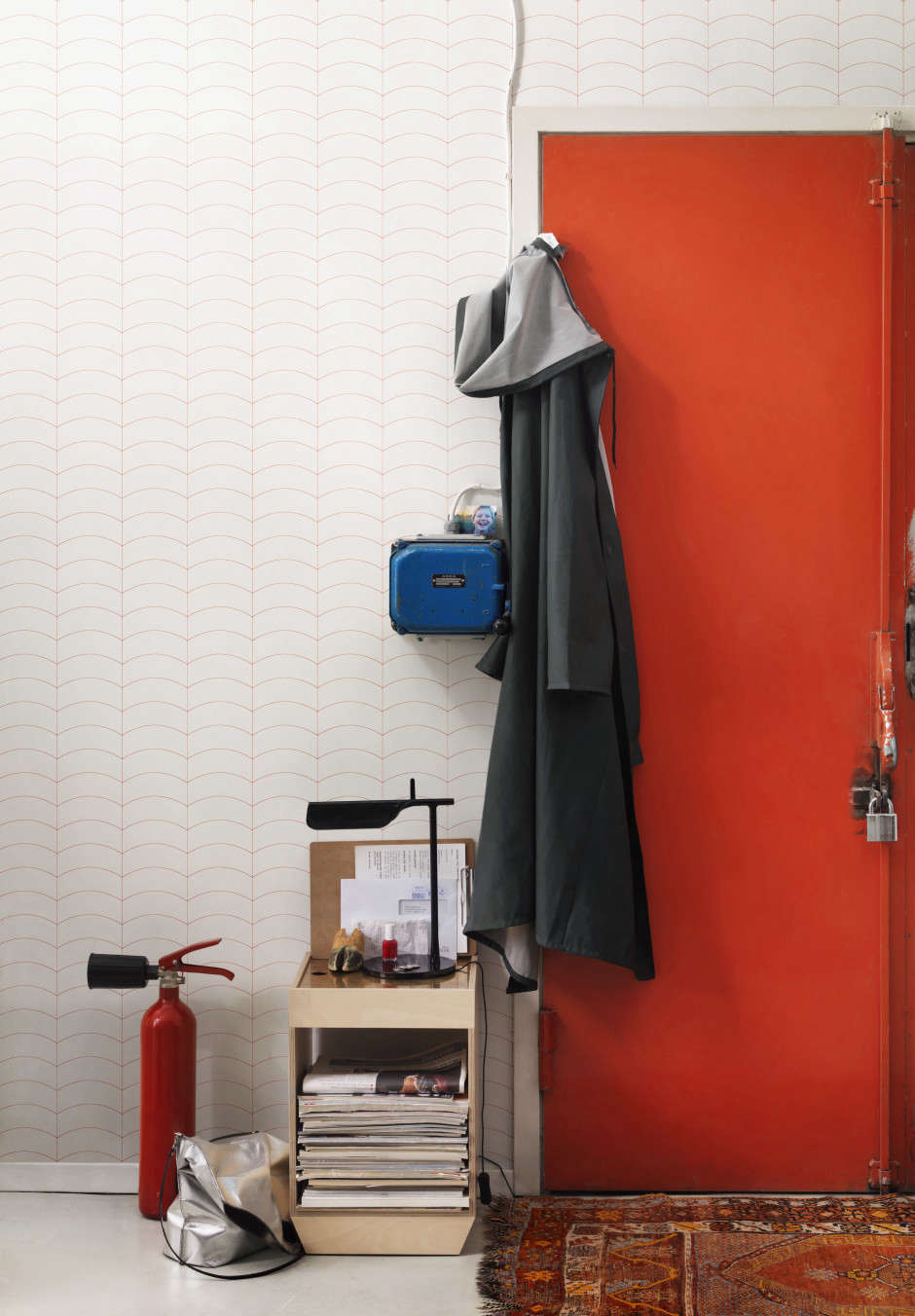

Eco’s Corn Wallpaper sounds, at first, like something you might find in a farmhouse kitchen next to a basket of suspiciously decorative gourds. But no, this is not wallpaper covered in buttered kernels, smiling scarecrows, or country-cute cornfields. It is far more interesting than that. Eco’s Corn Wallpaper is a graphic, architectural wallcovering inspired by Chicago’s famous Marina City towers, the rounded high-rises affectionately nicknamed the “Corn Cobs.” In other words, this wallpaper takes a landmark of American modernism, flattens it into a precise repeating pattern, and lets your wall pretend it went to design school.
Created by the Swedish design and architecture studio Claesson Koivisto Rune for Eco Wallpaper, Corn belongs to a collection that treats wallpaper as more than background decoration. It is pattern, structure, memory, and architectural rhythm. The design uses thin lines and a measured repeat to echo the curved balconies and stacked geometry of Marina City. The result is subtle from a distance and clever up close, which is exactly the kind of interior detail that makes guests lean toward the wall and say, “Wait, is that architecture?” Congratulations: your wallpaper has started a conversation.
This article explores the design story behind Eco’s Corn Wallpaper, how it fits into modern interiors, why architectural wallpaper has become so appealing, and how to use it without making your room look like a blueprint had a nervous breakdown. We will also cover eco-conscious wallpaper considerations, installation tips, styling ideas, and real-life experience notes for anyone considering a pattern with this much quiet confidence.
What Is Eco’s Corn Wallpaper?
Eco’s Corn Wallpaper is a patterned wallcovering from Eco Wallpaper, designed by Claesson Koivisto Rune. The product is part of the studio’s wallpaper collection and is identified with product code 1801. It has a roll width of 53 centimeters, a straight match, and a repeat of approximately 4.81 centimeters. Those technical details may sound tiny, but in wallpaper land they matter. A straight match means each strip aligns horizontally with the next, helping the pattern continue cleanly across the wall. The small repeat gives Corn its disciplined, architectural texture rather than a large scenic mural effect.
The defining idea behind the wallpaper is Chicago’s Marina City, a mid-century mixed-use complex designed by Bertrand Goldberg. Marina City’s cylindrical towers are famous for their curved balconies, which create a stacked, scalloped appearance. Locals and architecture lovers often call them the Corn Cobs because, frankly, once you see the resemblance, you cannot unsee it. Eco’s Corn Wallpaper turns that architectural nickname into a refined graphic language.
A Wallpaper Inspired by a Building, Not a Barn
The word “Corn” can be misleading if you are expecting rustic harvest imagery. This is not a wallpaper about corn as a crop. It is a wallpaper about corn as an architectural metaphor. Marina City’s towers look like giant concrete corn cobs rising beside the Chicago River, and the wallpaper borrows that visual logic. The pattern uses slim linear marks to suggest repetition, curvature, and vertical rhythm. It feels urban, not rural; modern, not kitschy.
That makes Eco’s Corn Wallpaper especially appealing for people who like design with a backstory. It is not simply “nice lines on a wall.” It is a design conversation between Stockholm and Chicago, between wallpaper and skyscraper, between domestic interiors and city-scale architecture. That is a lot for a wallcovering to carry, but Corn does it without shouting. Very Scandinavian of it.
The Design Story: Claesson Koivisto Rune and Architectural Pattern
Claesson Koivisto Rune is known for work that crosses architecture, furniture, lighting, product design, and interiors. Founded in Stockholm in 1995 by Mårten Claesson, Eero Koivisto, and Ola Rune, the studio has built an international reputation for designs that are clean, thoughtful, and often quietly experimental. Their wallpaper collection for Eco reflects that same approach: patterns that look simple at first glance but become richer when you understand the reference.
Corn sits comfortably among designs that translate architectural ideas into surface decoration. Instead of treating wallpaper as floral filler or visual noise, the collection treats it like a tool architects might actually enjoy. That is part of the charm. Wallpaper has not always been beloved by modern architects, who historically preferred clean planes, exposed materials, and walls that did not appear to be wearing patterned pajamas. Corn challenges that old prejudice by making wallpaper feel architectural, not fussy.
Why Architectural Wallpaper Works
Architectural wallpaper succeeds when it adds order without becoming cold. Eco’s Corn Wallpaper does this through repetition, scale, and restraint. Its pattern is regular enough to feel calm, yet distinctive enough to avoid disappearing completely. It has movement, but not chaos. It hints at structure, but it does not require your living room to submit a zoning application.
This balance is useful in modern interiors because many homes already contain strong visual elements: open shelving, framed art, textured rugs, sculptural lighting, and increasingly large televisions that insist on being the black rectangle emperor of the room. A wallpaper like Corn can support these elements instead of fighting them. It adds depth to the wall while staying controlled.
Why Marina City Matters to the Pattern
Marina City is one of Chicago’s most recognizable architectural landmarks. Designed by Bertrand Goldberg and developed in the 1960s, the complex was ambitious for its time, combining residential towers, parking, commercial uses, entertainment, and a marina into a dense urban project. Its twin cylindrical towers were famous not only for their height and engineering but also for their organic form. Goldberg rejected the rigid box as the only model for high-rise living, and Marina City’s rounded balconies became a symbol of that idea.
The connection between Marina City and Eco’s Corn Wallpaper is important because it explains the pattern’s personality. The design is not random geometry. It comes from a building that challenged architectural convention. The wallpaper’s thin lines echo the towers’ curved, repeating balconies, translating concrete mass into graphic delicacy. Where Marina City is monumental, Corn is intimate. Where the towers shape a skyline, the wallpaper shapes a room.
From Chicago Skyline to Interior Wall
That transformation is the magic. A person may never live in Marina City, but they can bring a whisper of its design language into a hallway, study, powder room, or bedroom. The wallpaper becomes a scaled-down tribute to urban architecture. It is like owning a poster of a landmark, except subtler and harder for your cat to knock off the wall.
Eco Wallpaper and the Rise of More Responsible Wallcoverings
Eco Wallpaper is a Swedish wallpaper brand associated with contemporary, livable design. The name naturally raises questions about sustainability, and modern buyers are right to ask them. Wallpaper is not just a decorative surface; it is a manufactured product involving paper or nonwoven substrates, inks, coatings, adhesives, packaging, and shipping. A beautiful wall should not require pretending materials do not matter.
Today’s eco-conscious wallpaper conversation usually focuses on several practical factors: responsibly sourced paper or fibers, low-emission inks, water-based printing processes, PVC-free options, durable design, and adhesives with lower volatile organic compound emissions. In the United States, homeowners often look for signals such as FSC-certified paper, GREENGUARD certification, low-VOC claims, and transparent material specifications. Not every wallpaper will check every box, so the smart approach is to read the product details before ordering.
Why Low-VOC Materials Matter
Volatile organic compounds, or VOCs, are chemicals that can evaporate into indoor air from some paints, adhesives, finishes, cleaners, and building products. For wallpaper buyers, this matters most when choosing adhesives, inks, and coated materials. A low-VOC or water-based system can be a better choice for bedrooms, nurseries, offices, and other spaces where people spend long hours. Good ventilation during and after installation is also wise. The goal is not to panic over every roll of wallpaper, but to choose thoughtfully and let the room breathe like it just finished yoga.
Where Eco’s Corn Wallpaper Works Best
Because Corn is graphic and architectural, it works best in spaces that benefit from rhythm and refinement. It does not need to dominate a room. In fact, its charm often comes from restraint. Used well, it can make a space feel designed rather than simply decorated.
Entryways and Hallways
Hallways are ideal for architectural wallpaper because they are transitional spaces. People pass through them quickly, so the pattern can be interesting without becoming overwhelming. Eco’s Corn Wallpaper can give a narrow hallway a sense of movement and depth. Its linear rhythm may help the space feel intentional, especially when paired with simple lighting, wood trim, and a clean runner rug.
Home Offices
A home office needs energy, but not the kind of energy that makes your email inbox look calm by comparison. Corn’s structured pattern can add visual intelligence behind a desk or on the wall facing your workstation. It suggests focus and order, making it a strong backdrop for shelves, a writing table, or a video-call wall. Yes, it may quietly tell your coworkers that you have taste. No, that is not illegal.
Powder Rooms
Small bathrooms and powder rooms are perfect places to experiment with wallpaper. A compact architectural pattern can turn a tiny room into a jewel box without requiring a huge design commitment. Corn’s graphic nature pairs well with matte black fixtures, chrome, warm brass, white porcelain, or a simple stone countertop. Because powder rooms are often used briefly, a pattern can be bolder than it might be in a bedroom.
Bedrooms
In a bedroom, Eco’s Corn Wallpaper works best when used as a headboard wall or in a muted colorway. The small repeat can create a textile-like effect from a distance, adding texture without visual clutter. Pair it with linen bedding, warm woods, and soft lighting to keep the space restful. Avoid overcrowding the room with competing patterns unless your design goal is “boutique hotel lobby after three espressos.”
How to Style Eco’s Corn Wallpaper
The easiest way to style Corn is to respect its architectural roots. Think clean shapes, honest materials, and a palette that lets the pattern breathe. This wallpaper does not need ornate furniture to prove itself. It prefers confident simplicity.
Pair It With Mid-Century Modern Furniture
Because the inspiration comes from a mid-century architectural landmark, Corn naturally pairs with mid-century furniture. Consider walnut case goods, slim-legged chairs, low sofas, globe lamps, and simple ceramic accessories. The wallpaper’s linear movement can complement curved furniture forms, especially rounded mirrors, oval tables, or sculptural lounge chairs.
Add Warm Natural Materials
Architectural patterns can sometimes feel cool, so balance them with warmth. Wood, wool, jute, linen, leather, cork, and handmade ceramics all soften the geometry. A natural oak console against Corn Wallpaper can look especially strong because the grain of the wood contrasts with the precision of the pattern. It is the design equivalent of pairing a tailored blazer with perfectly worn-in jeans.
Use Art Carefully
You can hang art over patterned wallpaper, but choose pieces with enough negative space or strong framing. Black-and-white photography, simple line drawings, abstract prints, or architectural sketches can work beautifully. Avoid very busy art unless the pattern color is extremely subtle. The wall already has a rhythm; your art does not need to bring a drum solo.
Installation Tips for a Clean Result
Wallpaper installation is where dreams either become beautiful walls or a cautionary tale involving paste, panic, and one strip that is somehow upside down. Eco’s Corn Wallpaper has a straight match and a small repeat, which can make alignment more manageable than large-scale scenic patterns. Still, careful preparation is essential.
Prepare the Wall Properly
The wall should be clean, dry, smooth, and stable. Fill holes, sand rough spots, remove flaking paint, and wipe away dust. If the wall is textured, consider skim coating before installation. Wallpaper highlights imperfections more often than it hides them, especially under side lighting. A smooth wall gives the pattern the best chance to look crisp.
Order Samples First
Always order a sample before committing to full rolls. Wallpaper changes dramatically depending on light, wall size, nearby colors, and the emotional condition of your overhead bulb. A pattern that looks quiet online may appear more active in a small room. Tape the sample to the wall and observe it in morning, afternoon, and evening light.
Measure With the Repeat in Mind
Because Corn has a repeating pattern, calculate extra material for matching and trimming. Even small repeats create some waste. Measure the wall height and width, account for doors and windows carefully, and follow the manufacturer’s roll calculator if available. When in doubt, order a little more than you think you need. Future-you will be grateful when a repair is needed and the dye lot has not vanished into wallpaper history.
Keep the First Strip Perfectly Plumb
The first strip determines the entire wall. Use a level or plumb line rather than trusting the corner, because corners are often as straight as a politician’s apology. Once the first strip is vertical, each following strip has a better chance of aligning properly. Work slowly, smooth bubbles outward, and trim with a sharp blade.
Eco’s Corn Wallpaper vs. Other Wallpaper Styles
Compared with botanical wallpaper, Corn feels more urban and intellectual. Compared with stripes, it has more story. Compared with murals, it is easier to live with because the repeat is smaller and less scene-specific. Compared with plain paint, it adds dimension and personality without requiring a room full of accessories.
That makes it a strong option for homeowners who want something distinctive but not theatrical. It is not the wallpaper equivalent of entering a room wearing a feather cape. It is more like a well-cut jacket with a surprising lining: refined, smart, and memorable when noticed.
Who Should Choose Eco’s Corn Wallpaper?
Eco’s Corn Wallpaper is a good choice for design lovers, architecture fans, mid-century modern enthusiasts, and homeowners who prefer patterns with meaning. It suits people who want a wallcovering that feels sophisticated rather than sugary. It is also ideal for anyone drawn to Scandinavian design but tired of rooms that look like they were assembled entirely from beige whispers.
It may not be the best choice for someone seeking a lush floral, a dramatic landscape mural, or a rustic farmhouse look. Despite its name, Corn is not country. It is city-minded, graphic, and architectural. If your dream wall includes sunflowers, roosters, and a sign that says “Gather,” this wallpaper may politely excuse itself.
Experience Notes: Living With Eco’s Corn Wallpaper
Imagine installing Eco’s Corn Wallpaper in a small entryway. At first, the pattern may seem restrained, almost quiet. Then the afternoon light hits the wall, and the fine lines begin to show their depth. The entry no longer feels like a blank pass-through. It feels composed. A simple bench suddenly looks more intentional. A coat hook becomes part of a design moment. Even the pile of shoes by the door seems slightly more cultured, although still guilty.
One of the best experiences with architectural wallpaper is how it rewards repeated viewing. Big novelty patterns can be exciting for two weeks and exhausting by the third. Corn is different because its reference is embedded, not obvious. Most visitors will first notice the texture and rhythm. Architecture fans may catch the Marina City connection. Others may simply say the room feels “cool” or “finished,” which is decorator code for “I do not know why this works, but it does.”
In a home office, the experience can be even better. A patterned wall behind a desk creates a sense of zone and purpose. Corn’s lines offer visual movement without stealing attention from work. It can make a plain white room feel like a studio, especially when paired with a wood desk, a black task lamp, and a few carefully chosen books. The trick is to avoid overdecorating. Let the wallpaper be the intelligent friend in the room, not the loud one telling stories at maximum volume.
In a powder room, Corn can feel unexpectedly playful. Because guests see the space briefly, they are more likely to appreciate the detail without growing tired of it. Add a round mirror to echo the curved inspiration of Marina City. Use a simple vanity, clean fixtures, and perhaps one excellent hand soap that smells like you have your life together. The wallpaper provides the character; the rest of the room should support it.
There are also practical lessons. First, lighting matters. A pattern made of fine lines can appear stronger under raking light, especially near windows or wall sconces. Test a sample near the actual light source before ordering. Second, seams matter. Because the design is linear, careful alignment is important. A professional installer may be worth the cost if the wall is large or highly visible. Third, restraint matters. Corn can wrap an entire small room beautifully, but in a larger living room it may work better on one defined area, such as a reading nook, fireplace wall, or built-in shelving backdrop.
The most satisfying part of living with Eco’s Corn Wallpaper is that it feels personal without being overly decorative. Many wallpapers announce a theme: tropical paradise, English garden, grandmillennial tea party, mysterious forest where a fox may own real estate. Corn announces an interest: architecture, pattern, modernism, and thoughtful design. That gives it longevity. It is easier to live with a smart pattern than a trendy one.
Maintenance is straightforward if the wallpaper is installed correctly and treated according to manufacturer guidance. Avoid harsh scrubbing unless the product is specifically rated for it. Dust gently, address stains quickly, and keep high-moisture rooms well ventilated. Wallpaper is durable, but it is not a superhero. It does not want steam baths, mystery splashes, or toddlers testing crayons in the name of artistic development.
Overall, the experience of using Eco’s Corn Wallpaper is best described as quiet transformation. It does not turn a room into a spectacle. It gives the room a point of view. That is the difference between decoration and design. Decoration says, “Here is something pretty.” Design says, “Here is why this belongs.” Corn belongs when you want architecture on the wall, not just pattern for pattern’s sake.
Conclusion
Eco’s Corn Wallpaper is a clever, refined wallcovering that turns one of Chicago’s most iconic architectural forms into a subtle repeating pattern. Designed by Claesson Koivisto Rune for Eco Wallpaper, it bridges Scandinavian restraint and American architectural history. Its inspiration, Marina City’s famous Corn Cob towers, gives the design a memorable origin story, while its thin lines and compact repeat make it practical for real interiors.
For homeowners, renters, designers, and architecture lovers, Corn offers a way to add character without visual chaos. It works beautifully in entryways, offices, powder rooms, bedrooms, and other spaces that benefit from texture, order, and a little design-world wit. With thoughtful installation, careful styling, and attention to material choices, Eco’s Corn Wallpaper can make a wall feel smarter, warmer, and far more interesting than another coat of safe beige paint. Beige, of course, has done nothing wrong. It has simply been asked to carry too many rooms for too many years.
Note: This article is written as original publish-ready content and is based on real product information, architectural context, wallpaper installation practices, and sustainable wallcovering considerations.