
Calculating annuity payments sounds like one of those tasks designed to make a calculator hide under the couch. There are interest rates, payment periods, account balances, and enough parentheses to make anyone suspicious. But the basic idea is wonderfully practical: you are figuring out how much regular income a lump sum can produce over a certain period of time.
Whether you are comparing retirement income options, planning a fixed withdrawal schedule, reviewing an insurance illustration, or simply trying to understand what your savings could pay you each month, learning how to calculate annuity payments gives you a useful financial superpower. No cape required. A spreadsheet helps, but it is optional.
An annuity is generally a contract with an insurance company in which you pay a lump sum or a series of contributions, and the insurer agrees to make payments immediately or in the future. Some annuities pay for a fixed number of years, while others may be designed to provide income for life. The formula in this guide is most useful for estimating level payments from a fixed account balance over a defined period.
What Is an Annuity Payment?
An annuity payment is a recurring payment made at regular intervals. It might be monthly, quarterly, annually, or even weekly. In retirement planning, people often use annuity calculations to estimate how much income a savings balance can provide without running out before a chosen date.
For example, imagine you have $250,000 available at retirement. You want the money to last 20 years, and you expect it to earn a steady return while you withdraw funds each month. The annuity payment formula can estimate your monthly income.
There are two common payment structures:
- Ordinary annuity: Payments occur at the end of each period, such as at the end of every month.
- Annuity due: Payments occur at the beginning of each period, such as on the first day of every month.
The difference sounds tiny, but receiving money earlier means the remaining balance has slightly less time to earn interest. Finance has a habit of making tiny details wear very expensive hats.
The Core Annuity Payment Formula
For a standard ordinary annuity, use this formula:
PMT = PV × [r / (1 - (1 + r)-n)]
Here is what each variable means:
- PMT = payment amount each period
- PV = present value, or the amount available today
- r = interest rate per payment period
- n = total number of payments
This formula assumes a level payment amount, a constant interest rate, and a fixed payout period. It is useful for many retirement-income projections, savings drawdown plans, loans, and fixed-period annuity estimates.
How to Calculate Annuity Payments: 8 Steps
Step 1: Decide What You Are Trying to Calculate
Before touching a formula, define the goal. Are you calculating how much monthly income a retirement balance can provide? Are you comparing a lump sum with a stream of pension payments? Are you estimating how long your money may last if you withdraw a certain amount each month?
For this guide, the goal is to calculate the periodic payment produced by a known starting balance. That means you need three key ingredients: the available balance, the expected rate of return, and the payout period.
Be careful not to confuse an investment account balance with an insurance company’s guaranteed income benefit base. In some annuity contracts, the value used to calculate a guaranteed withdrawal benefit may differ from the amount you could receive by surrendering the contract. That is a contract detail, not a math mistake.
Step 2: Identify the Payment Timing
Next, determine whether payments are made at the beginning or end of each period.
Most standard financial calculations assume an ordinary annuity, where payments happen at the end of the month, quarter, or year. This is common for retirement withdrawals and many pension-style calculations.
An annuity due pays at the beginning of the period. Rent is a classic example because you usually pay before you enjoy the month in the apartment. For an annuity due, multiply the ordinary annuity payment by:
1 + r
In other words:
PMT (annuity due) = PMT (ordinary annuity) × (1 + r)
The difference may be modest in one month, but it becomes more noticeable over many years. Money is patient. It remembers every day you let it compound.
Step 3: Determine Your Starting Balance
Your starting balance is the amount that will fund the payments. In the formula, this is called the present value, or PV.
Suppose you have:
- $250,000 in retirement savings
- No additional contributions planned
- A goal of receiving monthly payments for 20 years
Your present value is:
PV = $250,000
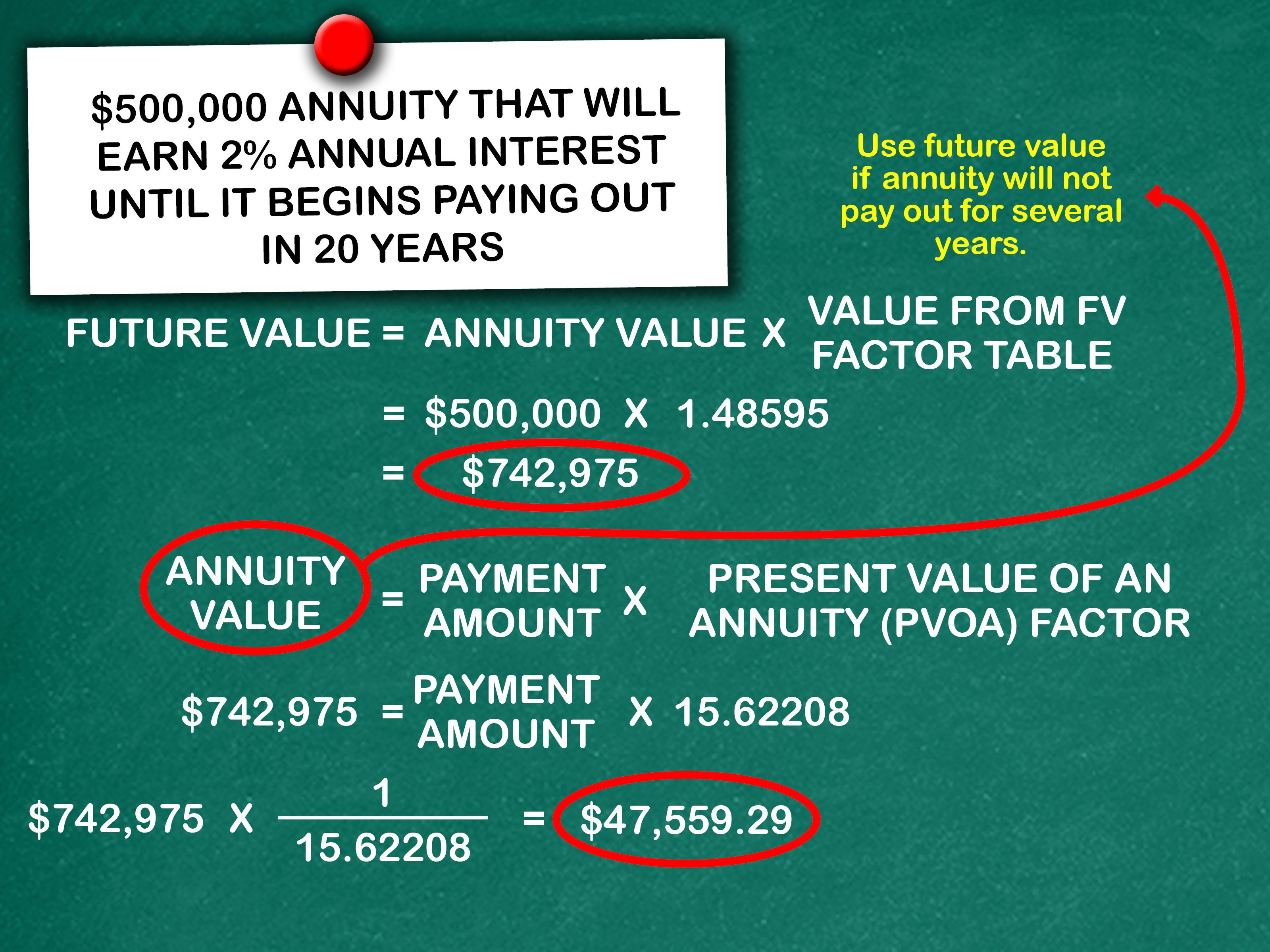
If you are buying a deferred annuity and your payments will begin years from now, you may first need to estimate the future value of your money. A basic future-value formula is:
FV = PV × (1 + r)n
For example, $100,000 growing at 5% annually for 10 years would become approximately $162,889 before withdrawals begin. Once you know the future balance, that future balance becomes the starting point for your payment calculation.
Step 4: Convert the Interest Rate to Match the Payment Schedule
This step is where many otherwise excellent calculations trip over their shoelaces. Your interest rate and payment schedule must use the same time period.
If your annual interest rate is 5.4% and you want monthly payments, divide the annual rate by 12:
r = 0.054 ÷ 12 = 0.0045
Your monthly interest rate is therefore 0.45%, expressed as a decimal in the formula.
Here are a few common conversions:
- Monthly payments: annual rate ÷ 12
- Quarterly payments: annual rate ÷ 4
- Semiannual payments: annual rate ÷ 2
- Annual payments: use the annual rate as-is
Always convert percentages into decimals before calculating. A rate of 5.4% becomes 0.054. Entering 5.4 instead of 0.054 is a fast way to create a payment estimate suitable for buying a small moon.
Step 5: Calculate the Total Number of Payments
The next variable is n, the total number of payment periods.
If you want payments for 20 years and they occur monthly:
n = 20 × 12 = 240 payments
If payments are quarterly for 15 years:
n = 15 × 4 = 60 payments
The number of payments matters enormously. A shorter payout period produces larger payments because the balance is used up more quickly. A longer payout period lowers each payment but can provide more financial breathing room.
Step 6: Plug the Numbers Into the Annuity Formula
Now use the ordinary annuity payment formula:
PMT = PV × [r / (1 - (1 + r)-n)]
Using the example above:
PV = 250,000r = 0.0045n = 240
The calculation becomes:
PMT = 250,000 × [0.0045 / (1 - (1.0045)-240)]
The estimated monthly payment is approximately:
$1,705.63 per month
That means a $250,000 balance earning a steady 5.4% annual rate could provide about $1,706 per month for 20 years, assuming monthly withdrawals at the end of each month and no additional fees or taxes.
Step 7: Check Your Result With a Simple Reality Test
Never accept a calculator result just because it looks official. Calculators are confident creatures. They will produce nonsense with the same calm expression they use for correct answers.
Start by estimating the total withdrawals:
$1,705.63 × 240 = approximately $409,351
That total is higher than the original $250,000 because the remaining balance continues to earn interest over the 20-year period. The payment includes both principal and investment earnings.
Now consider what happens if you lower the assumed return. With a lower rate, the monthly payment should decrease. With a longer payout period, the monthly payment should also decrease. If your result moves in the opposite direction, revisit your inputs.
If the interest rate is 0%, the formula becomes much simpler:
PMT = PV ÷ n
For a $250,000 balance paid over 240 months with no interest:
$250,000 ÷ 240 = $1,041.67 per month
This comparison shows why return assumptions matter so much. The higher-payment example is not magic; it is the result of earnings on the remaining balance.
Step 8: Adjust for Fees, Taxes, Inflation, and Real-Life Contract Rules
The formula gives you a useful estimate, but real annuity income is rarely as clean as a textbook example. Before making a decision, adjust your assumptions for the things that can quietly nibble at your income.
Fees: Variable annuities, riders, investment management charges, and administrative expenses may reduce net returns. Use a net rate after expected fees when possible.
Inflation: A fixed $1,700 monthly payment may feel comfortable today but may buy less in 10 or 20 years. Consider whether you need a cost-of-living adjustment or a separate investment bucket for future spending increases.
Taxes: Tax treatment depends on whether the annuity is held in a qualified retirement account, funded with after-tax dollars, or part of an employer plan. The taxable portion of payments may require separate IRS calculations.
Longevity: A fixed-period annuity stops after the selected term. A lifetime annuity may continue for life, but its payment is calculated by the insurer using factors such as age, payout option, interest assumptions, and survivor benefits.
Survivor benefits: A joint-and-survivor option can protect a spouse or beneficiary, but it often lowers the initial monthly payment because the insurer may need to pay for a longer possible period.
Worked Example: Calculating a 15-Year Monthly Annuity Payment
Let’s try another example with slightly different numbers.
- Starting balance: $350,000
- Annual interest rate: 4.8%
- Payment frequency: monthly
- Payout period: 15 years
First, convert the annual rate to a monthly rate:
r = 0.048 ÷ 12 = 0.004
Next, calculate the number of payments:
n = 15 × 12 = 180
Then use the formula:
PMT = 350,000 × [0.004 / (1 - (1.004)-180)]
The estimated payment is approximately:
$2,731.45 per month
This does not mean every annuity company will offer that exact payment. It means that, under these simplified assumptions, a $350,000 balance could support a monthly withdrawal of about $2,731 for 15 years.
Using Excel or Google Sheets to Calculate Annuity Payments
You do not have to type every exponent manually unless you enjoy being dramatic with spreadsheets. Excel and Google Sheets have a built-in payment function:
=PMT(rate, nper, pv, fv, type)
For the $250,000 example, the formula would look like this:
=PMT(5.4%/12, 20*12, -250000)
The negative sign before the present value tells the spreadsheet that the $250,000 is money going into the arrangement, while the payment is money coming out. This is a cash-flow sign convention, not a spreadsheet grudge.
If payments occur at the beginning of each month, add 1 as the final argument:
=PMT(5.4%/12, 20*12, -250000, 0, 1)
For payments at the end of each month, use 0 or leave the final argument blank.
Common Mistakes When Calculating Annuity Payments
Using an Annual Rate With Monthly Payments
This is the most common mistake. If payments are monthly, your interest rate must also be monthly. Using a 5% annual rate directly in a monthly formula creates wildly inaccurate results.
Forgetting Fees and Rider Costs
Gross return is not the same as net return. If an annuity earns 5% before expenses but charges 1.5% in annual fees, a more realistic planning rate may be closer to 3.5% before considering other variables.
Assuming a Lifetime Payment Works Like a Fixed-Term Payment
A formula can estimate withdrawals over 20 years, but a lifetime annuity quote is different. Insurance companies use actuarial assumptions and payout-option rules, so you should request an official illustration for an exact lifetime-income estimate.
Ignoring Inflation
Fixed payments offer predictability, but predictability is not the same as purchasing-power protection. Build inflation into your broader retirement plan rather than assuming today’s grocery budget will remain charmingly frozen in time.
Comparing Only the Monthly Payment
A higher monthly payment may come with fewer survivor benefits, less liquidity, no inflation adjustment, or a shorter guaranteed period. Compare the full contract design, not just the largest number printed in bold.
Experience-Based Lessons From Calculating Annuity Payments
People often expect annuity math to produce one perfect answer, like a fortune cookie with better punctuation. In practice, the calculation is more useful as a decision tool than as a final verdict. The first number you get is usually not the number you should immediately trust; it is the number that tells you which questions to ask next.
A common experience is discovering how dramatically the payout period changes monthly income. Someone may begin with a goal of withdrawing $3,000 per month from a retirement account, then realize that the desired payment would deplete the balance much faster than expected. This does not automatically mean the goal is impossible. It may mean they need a longer payout period, a lower starting withdrawal, additional guaranteed income, part-time work, or a mix of investments and annuity income.
Another important lesson is that the assumed interest rate can make a spreadsheet look either wonderfully optimistic or strangely gloomy. A difference of one percentage point may not sound dramatic during a casual conversation over coffee, but it can materially change projected monthly payments across 15 or 20 years. Conservative assumptions are often more helpful than rosy ones because retirement plans have a terrible sense of humor when reality arrives with higher expenses.
Many people also learn that “guaranteed income” is not a single feature. A life-only payout may provide the highest monthly income but stop at death. A period-certain option can guarantee payments for a set number of years. A joint-and-survivor option may continue income for a spouse but usually reduces the initial payment. None of these choices is universally best. The right option depends on whether the priority is maximum current income, protecting a partner, leaving money to heirs, maintaining access to cash, or balancing all four without turning the kitchen table into a financial war room.
Real-world planning also teaches the value of separating needs from wants. Essential expenses such as housing, insurance, food, utilities, and health care may be better matched with predictable income sources. Flexible spending, including travel, gifts, hobbies, and the occasional suspiciously expensive lawn ornament, can be funded with more flexible investments or cash reserves. This approach can make annuity decisions less emotional because the question becomes, “How much reliable income do we need for basics?” rather than, “Should every dollar be locked into one product?”
Finally, experience shows that comparing several scenarios is smarter than falling in love with one calculation. Try the same balance with a lower interest rate, a longer life expectancy, higher inflation, and a survivor benefit. Then compare those results with an insurer’s official quote. The gap between your simplified estimate and the actual contract can reveal fees, guarantees, payout rules, and trade-offs that matter far more than a few extra dollars per month. Good annuity planning is not about finding the prettiest number. It is about choosing an income plan you can live withliterally and financially.
Conclusion
Learning how to calculate annuity payments helps you turn a retirement balance into a clearer income plan. Start with the available balance, match the interest rate to the payment schedule, count the total payments, and apply the annuity payment formula. Then test the result against fees, taxes, inflation, payout timing, and your real-life goals.
The formula is powerful because it turns a vague question“Will my money last?”into a practical conversation with numbers. Just remember that a spreadsheet estimate is the beginning of smart planning, not the final signature on an annuity contract.
SEO Tags