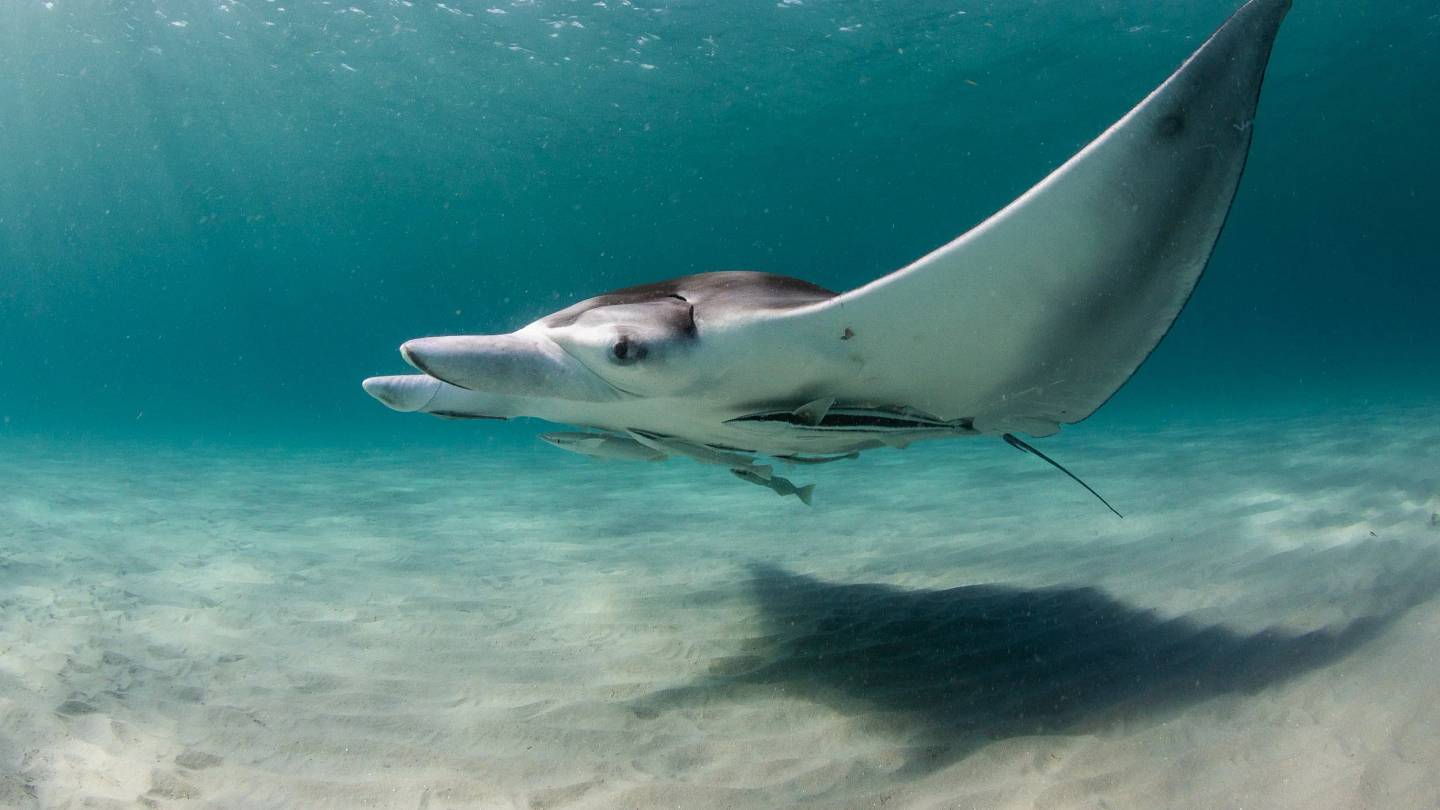

Imagine floating in clear Atlantic water when a shadow the size of a small van glides beneath you. It does not roar, honk, or demand a parking space. It simply flies through the sea on enormous wings, calmly filtering breakfast from the water column. That is the kind of entrance made by Mobula yarae, the newly identified Atlantic manta ray species that can reach an estimated 16 to 20 feet across.
The discovery is not “new” in the sense that this manta ray suddenly appeared last Tuesday wearing a name tag. The animal has been swimming through the western Atlantic for a very long time. What changed is science finally caught up. Researchers formally recognized Mobula yarae as a distinct manta ray species in 2025, making it the third accepted manta species in the world, alongside the reef manta ray and the giant oceanic manta ray.
For ocean lovers, that is thrilling. For conservationists, it is urgent. A species cannot be properly protected if it is hiding in plain sight under another species’ paperwork. The Atlantic manta ray has its own range, its own physical traits, its own risks, and likely its own conservation needs. In other words, this van-sized gentle giant just stepped out of the taxonomic shadows.
Meet Mobula yarae, the Atlantic Manta Ray
Mobula yarae is commonly called the Atlantic manta ray because its known home is the Atlantic Ocean, especially the western Atlantic. Its range stretches from the eastern United States through the Gulf of Mexico and Caribbean Sea down toward Brazil. Some research and conservation sources describe sightings as far north as Massachusetts and as far south as southern Brazil.
The scientific name honors Yara, a water spirit from Indigenous Brazilian mythology. That name fits beautifully. Manta rays already look like something halfway between biology and folklore: broad diamond-shaped bodies, sweeping pectoral fins, forward-facing mouths, and rolled cephalic fins that look like elegant little horns when they swim. If the ocean had a ballroom, mantas would absolutely be the dancers who arrive late and make everyone else look clumsy.
Like other manta rays, the Atlantic manta is harmless to humans. It is a filter feeder, meaning it eats tiny planktonic organisms rather than anything resembling a swimmer’s leg. When feeding, manta rays use their cephalic fins to funnel water into the mouth, where specialized structures trap food while water passes over the gills. The result is a massive animal powered by some of the smallest life in the sea.
How Big Is “As Big as a Van,” Really?
The headline-friendly comparison is not just hype. A full-size van can be roughly 16 to 20 feet long, and Mobula yarae can reach about that same span from wingtip to wingtip. That means a single Atlantic manta ray could cover much of a driveway if it were somehow parked there, which it would not enjoy and would probably judge silently.
It is not the largest manta ray known. The giant oceanic manta ray, Mobula birostris, can grow wider, with NOAA Fisheries listing its disc width at up to 26 feet. Still, a 20-foot Atlantic manta ray is not exactly petite. In the underwater world, that is a huge, graceful animallarge enough to stop a diver mid-kick and make a drone pilot double-check the screen.
Size matters for more than dramatic comparisons. Large-bodied marine animals often grow slowly, reproduce slowly, and take a long time to recover if populations decline. Manta rays are especially vulnerable because they do not produce large numbers of offspring. When fishing pressure, vessel strikes, or habitat disturbance remove individuals from the population, replacement is not quick.
Why Scientists Did Not Identify It Earlier
At first glance, manta rays can look deceptively similar. They share the same basic “underwater flying carpet” design: broad wings, flat bodies, pale bellies, dark backs, and a calm cruising style that seems almost unfairly elegant. But species are often separated by details, and details take time.
The Atlantic manta ray had been suspected for roughly 15 years before formal recognition. Marine biologist Dr. Andrea Marshall, known for earlier work that helped separate manta rays into more than one species, noticed that Atlantic individuals did not quite match the known reef manta or giant oceanic manta. The differences were subtle but persistent.
To confirm a new species, scientists needed more than a hunch and a few good underwater photos. They used integrative taxonomy, a method that combines multiple lines of evidence. That included body shape, color patterns, museum specimens, photo-identification records, and genetic data. The formal description was led by researcher Nayara Bucair and collaborators, with key contributions from international teams working across the United States, Mexico, the Caribbean, and Brazil.
The Clues: Spots, Shoulders, DNA, and a Lot of Patience
Manta rays can be identified individually by the spot patterns on their bellies, much like humans can be identified by fingerprints. Researchers photograph these patterns to track individuals over time. In the case of Mobula yarae, the ventral markings, dorsal shoulder patches, body proportions, and genetic signatures helped separate it from its relatives.
From above, the Atlantic manta may resemble the giant oceanic manta, with a dark back and broad form. From below, some features can look more like the reef manta. That confusing blend is one reason the species remained formally unrecognized for so long. It was not invisible. It was misfiled by nature’s very convincing paperwork department.
A crucial specimen from Florida helped anchor the formal species description. In taxonomy, a holotype is the reference specimen that permanently links a scientific name to a physical example. This is not glamorous work in the movie-trailer sense, but it is foundational. Without type specimens, scientific names become slippery; with them, future researchers have a reliable standard for comparison.
Where the Atlantic Manta Ray Lives
The Atlantic manta ray appears to favor tropical and subtropical Atlantic waters, including coastal zones, islands, reefs, estuarine regions, and productive areas where plankton is abundant. Florida is especially important because researchers have documented juvenile manta rays using nearshore waters along a heavily developed coastline.
The Florida Manta Project has studied manta rays in South Florida since 2016 using in-water photography, drones, aerial surveys, acoustic telemetry, and satellite tagging. Researchers have observed many juvenile rays returning to the same areas, suggesting that parts of South Florida may function as rare nursery habitat. That is a big deal. A nursery is not just a nice neighborhood for baby mantas; it is a critical life-stage habitat where young animals grow, learn, feed, and survive.
The awkward part is that these nurseries can sit close to beaches, boats, fishing piers, urban runoff, and coastal construction. The Atlantic manta ray may be graceful, but it is not wrapped in bubble wrap. Its habitat overlaps with some of the busiest human waters in the region.
Why the Discovery Matters for Conservation
Formal recognition changes the conservation conversation. Before Mobula yarae had a name, Atlantic records could be lumped with the giant oceanic manta or treated as uncertain sightings. That makes population trends harder to interpret. Are numbers declining? Are juveniles using specific nurseries? Are threats different in Florida, Mexico, the Caribbean, and Brazil? Those questions become much easier to answer when researchers know which species they are studying.
Names matter because policy often follows names. Conservation plans, fishing regulations, impact assessments, and habitat protections depend on accurate species identification. If a van-sized manta ray is being counted under the wrong label, managers may underestimate its needs or misunderstand where it is most vulnerable.
All manta and devil ray species face serious pressure, primarily from fisheries. Some are targeted, while others are caught accidentally as bycatch. For mantas, gillnets, trawls, fishing lines, and boat strikes can be especially dangerous. Their slow life history means populations do not bounce back like fast-breeding fish. A sardine population can refill the dance floor quickly. A manta population needs patience, space, and a much safer playlist.
Threats Facing a Gentle Giant
Bycatch and fishing gear
Bycatch is one of the biggest concerns for large rays. A manta ray may not be the intended catch, but nets and lines do not care about intention. Gillnets, shrimp trawls, and recreational fishing line can injure or kill rays. In South Florida, manta rays have been documented with fishing line entanglements, hooks, and other injuries.
Boat strikes
Because manta rays often swim near the surface, especially when feeding or traveling in shallow coastal areas, they can be hit by boat propellers. A large animal is not necessarily safe from a fast-moving hull. In busy coastal waters, even a graceful giant has to share space with engines, tourists, anglers, and weekend captains who may or may not have read the “slow zone” sign.
Coastal development and pollution
Nursery areas close to urban centers can be affected by dredging, shoreline hardening, stormwater runoff, plastic debris, and habitat disturbance. These pressures may not always kill mantas directly, but they can degrade the ecosystems that support plankton, cleaning stations, and safe juvenile habitat.
What Manta Rays Eat and Why That Makes Them Important
Manta rays eat plankton, tiny animals that drift through the ocean. That may sound modest for an animal with a wingspan comparable to a van, but it is one of the ocean’s great magic tricks: small organisms sustaining giant bodies. Mantas swim with mouths open, funneling plankton-rich water through specialized filtering structures.
This feeding style connects mantas to ocean productivity. They often appear where currents, upwelling, temperature fronts, and seasonal plankton blooms create natural buffets. Scientists can learn a lot about marine ecosystems by studying where mantas gather and when they move. A manta sighting is not just a wildlife moment; it can be a clue about the invisible physics and food webs of the sea.
How Citizen Scientists Help
One of the best parts of manta research is that ordinary people can contribute. Divers, snorkelers, boaters, photographers, and beachgoers can report sightings. A clear belly photograph can help researchers identify an individual ray. Date, location, behavior, and injury observations can add valuable data.
Citizen science is especially useful for wide-ranging animals that are difficult to study continuously. Researchers cannot be everywhere at once. Ocean users, however, are scattered across beaches, boats, reefs, piers, and dive sites. When trained to report responsibly, they become extra eyes for science.
The important word is responsibly. People should never chase, touch, corner, ride, or feed manta rays. The best manta encounter is calm and respectful. Let the animal choose the distance. If it stays, enjoy the moment. If it leaves, congratulate yourself on being less annoying than a jet ski.
What Makes This Discovery So Exciting?
The Atlantic manta ray is exciting because it reminds us that the ocean is still full of surprises, even among large animals. We often assume that only tiny deep-sea worms or obscure cave shrimp remain unnamed. Then a 20-foot manta ray cruises into the scientific spotlight and politely ruins that assumption.
The discovery also highlights how modern taxonomy works. New species are not always found by stumbling over a creature nobody has ever seen. Sometimes they are found by re-examining familiar animals with better tools, sharper questions, and enough humility to admit that “we already know this” can be the most dangerous sentence in science.
In the case of Mobula yarae, the breakthrough required field observations, underwater photography, museum collections, genetics, international collaboration, and years of persistence. That is not a quick viral moment. It is science doing slow, careful work until the truth finally has enough evidence to stand on its own.
Experience Notes: What It Feels Like to Encounter a Van-Sized Manta Ray
To understand why this species captures the imagination, picture the experience from the waterline. You slip into warm Atlantic water and hear the soft crackle of the reef, the distant hum of a boat, and your own breathing. At first, the ocean looks empty in the way oceans often do: blue, bright, and full of secrets it refuses to explain. Then a dark shape forms in the distance. It is too wide to be a turtle, too smooth to be a shark, and too calm to be anything in a hurry.
As it approaches, the scale becomes almost funny. Your brain tries to compare it to familiar objects because that is what brains do when they panic politely. A dining table? Too small. A garage door? Getting closer. A van? Yes, a van with wings, except silent, flexible, alive, and much better at parallel parking in water.
The manta does not charge. It glides. Its pectoral fins rise and fall in slow motion, more like a bird than a fish. Its mouth may open as it feeds, cephalic fins unfurling to guide water inward. Tiny plankton disappear into a filtration system so elegant that engineers should probably apologize to nature for taking so long to invent coffee filters.
If you are lucky enough to see the underside, the belly markings appear like ink blots arranged by a patient artist. Those spots are not decoration to researchers; they are identity cards. A good photo can help scientists know whether this animal has been seen before, whether it returns to the same nursery, whether it carries injuries, and how it fits into the broader population.
The emotional effect is difficult to exaggerate. Big wildlife often makes people feel small, but manta rays do something more interesting. They make you feel small without making you feel threatened. There is no predatory stare, no sudden lunge, no soundtrack from a summer shark movie. There is only size, calm, and motion. You are sharing water with an animal that could span a lane of traffic but eats plankton for a living. It is humbling in the most pleasant possible way.
That feeling is part of why the Atlantic manta ray’s formal recognition matters. People protect what they can name, understand, and emotionally picture. A newly identified manta species is not just a line in a scientific paper. It is a living creature moving through Florida waters, Caribbean channels, Gulf currents, and Brazilian coastlines. It is a reminder that discovery is not finished and that wonder still has room to swim.
Conclusion: A Giant Discovery With Real-World Stakes
The newly identified Atlantic manta ray, Mobula yarae, proves that the ocean can still surprise us on a grand scale. This is not a microscopic mystery hidden in a lab dish. It is a massive, graceful, plankton-eating ray that can grow as wide as a van and has been moving through Atlantic waters while science worked to understand it properly.
Its recognition as the world’s third manta ray species is more than a taxonomic update. It gives researchers a clearer framework for studying Atlantic manta populations, protecting nursery habitats, monitoring threats, and improving conservation policy. The discovery also reminds us that careful observation still matters. A strange pattern, a slightly different body shape, a recurring field note, or a belly photograph from a diver can help reveal a species that was there all along.
For readers, the takeaway is simple: the ocean is not done introducing itself. And when it does, sometimes the introduction has a 20-foot wingspan.