
A pocket CO2 sensor sounds like the kind of gadget a cautious engineer would carry into a crowded meeting room, a stuffy classroom, or that one conference hall where the air feels like it was last refreshed during the dial-up era. But the project behind “Pocket CO2 Sensor Doubles As SMD Proving Ground” is more than a tiny indoor-air watchdog. It is also a clever, hands-on training platform for surface-mount device assembly, better known as SMD solderingthe electronics rite of passage that separates “I can blink an LED” from “I can place a component smaller than a grain of rice without launching it into another zip code.”
At its heart, the build combines two hobbyist obsessions: measuring the invisible and making hardware smaller. The device uses a compact CO2 sensor module, a small microcontroller, a rechargeable battery circuit, and a tiny OLED display to show carbon dioxide readings in real time. The result is a portable air-quality meter that can fit in a pocket while also giving its creator a serious workout in modern PCB design, tiny component handling, and SMD soldering technique.
For makers, educators, electronics students, and anyone who has ever stared at a PCB footprint and whispered, “That pad is not big enough for human hands,” this project is a perfect example of how a useful tool can double as a skill-building exercise. It does not just measure indoor air. It measures patience, tweezers control, solder paste discipline, and one’s ability to remain calm when a 0603 resistor disappears.
Why a Pocket CO2 Sensor Matters
Carbon dioxide is not the only thing that determines indoor air quality, but it is one of the most practical signals for understanding ventilation. People exhale CO2, so when a room is crowded and outside air is not being introduced fast enough, CO2 levels tend to rise. That makes a portable CO2 monitor useful in classrooms, offices, workshops, vehicles, bedrooms, maker spaces, and event venues.
Organizations such as the EPA, CDC/NIOSH, and ASHRAE have repeatedly noted that indoor CO2 measurements can provide information about ventilation, though they should be interpreted carefully. A high reading does not automatically diagnose every air-quality problem, and a low reading does not guarantee perfect air. Still, CO2 is a practical proxy. If a small meeting room climbs from fresh outdoor-like levels to a sleepy 1,500 ppm, the room is basically waving a tiny white flag and asking someone to open a window.
CO2 Readings in Everyday Language
Outdoor CO2 is often around the low hundreds of parts per million, though it varies by location and conditions. Indoors, levels commonly rise as people occupy a space. Around 800 to 1,000 ppm is often treated as a useful comfort and ventilation reference point in many public discussions. Sustained readings above that range can suggest that a room may need more outdoor air, fewer people, better HVAC operation, or at least a door that is not treated like a museum artifact.
The beauty of a pocket CO2 sensor is that it turns a hidden condition into a number anyone can understand. You do not need a building automation dashboard or a graduate degree in mechanical engineering. You just need a small display that says, in effect, “This room is fine,” “This room is getting stale,” or “Congratulations, you have invented a terrarium for humans.”
The Hardware Behind the Tiny Air-Quality Meter
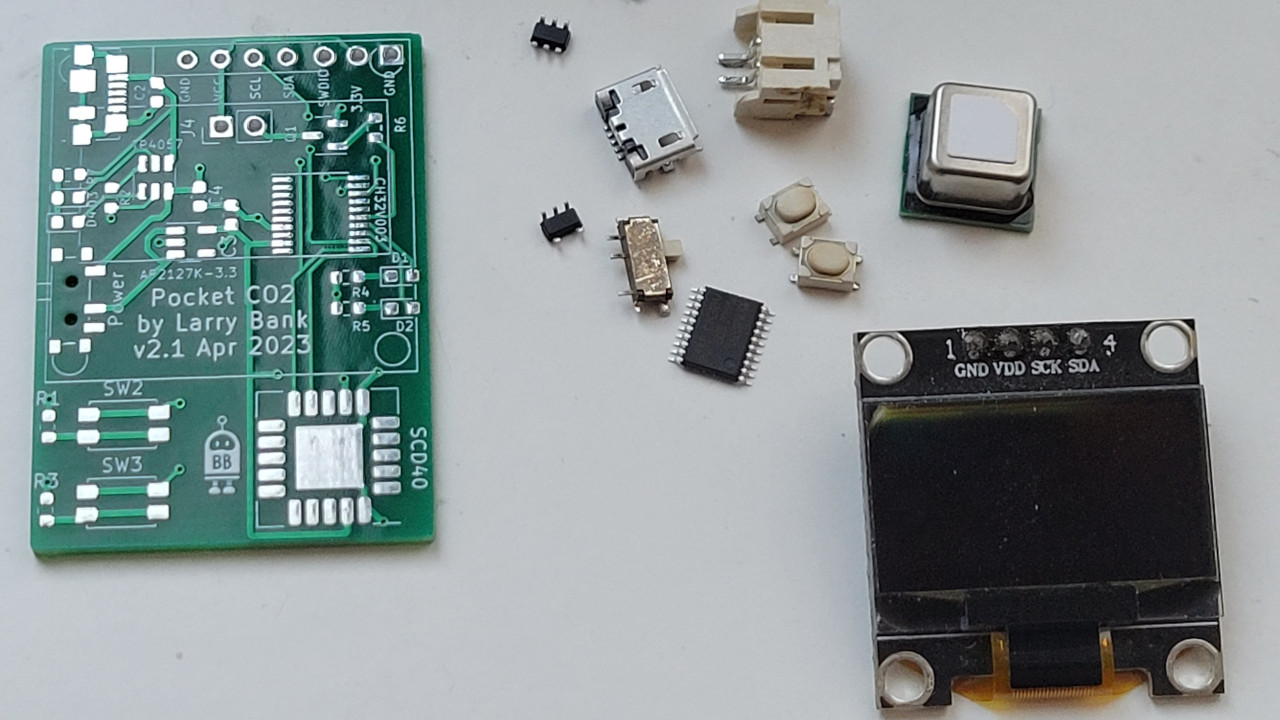
The pocket CO2 sensor project that inspired the title uses a modern mix of inexpensive and capable electronics. A low-cost CH32V003 microcontroller handles the brains of the device. This small RISC-V microcontroller has attracted attention among hardware hackers because it offers useful embedded features at a remarkably low price. For a compact project, that matters: every dollar and every square millimeter has a job.
The display is typically built around a small SSD1306 OLED, a popular 128-by-64-pixel screen used in countless DIY electronics projects. It is sharp, efficient, easy to read, and small enough to fit into pocket-sized hardware without turning the enclosure into a lunchbox. The power system includes a lithium battery charging circuit, often represented by chips in the TP405x family, allowing the device to be rechargeable instead of dependent on disposable cells.
The star component is the CO2 sensor itself. Many compact modern builds use sensors from the Sensirion SCD4x family, such as the SCD40 or SCD41. These are true CO2 sensors, not simple volatile organic compound sensors making a rough guess. The SCD4x series uses photoacoustic sensing technology, where light interaction and acoustic response are used to determine CO2 concentration. In plain English: it does not sniff vibes; it measures carbon dioxide.
Why True CO2 Sensing Beats Guesswork
Some cheaper “air quality” sensors estimate equivalent CO2 based on VOC readings. That can be useful for certain trends, but it is not the same as directly measuring CO2. If the goal is to understand ventilation in a room full of people, true CO2 measurement is the stronger choice. It gives a more meaningful number for deciding whether to increase airflow, reduce occupancy, or stop holding two-hour meetings in a sealed conference room that smells faintly of old coffee and ambition.
Modern CO2 sensor modules are also friendly to embedded projects. They commonly communicate over I2C, an interface that uses only a couple of signal lines. That simplifies PCB routing and firmware development. Many also provide temperature and humidity data, which can be useful for environmental compensation and for displaying a richer snapshot of room conditions.
Where the SMD Proving Ground Comes In
The phrase “SMD proving ground” is the secret sauce. The project is not only about building a useful pocket CO2 monitor; it is about using the project as a training board for surface-mount assembly. SMD components are mounted directly onto the surface of a PCB rather than inserted through holes. This is how most modern electronics are built, from smartphones to sensor nodes to tiny development boards that somehow have more computing power than a 1990s desktop.
For beginners, SMD can look intimidating. Through-hole parts are forgiving. They have long leads, big holes, and enough physical presence to be picked up without holding your breath. SMD parts, meanwhile, may arrive in tape reels looking like electronic confetti. But SMD also brings major advantages: smaller layouts, shorter signal paths, better manufacturing compatibility, and the ability to build devices that are genuinely pocket-sized.
A Good Project Teaches More Than a Practice Board
Practice boards are useful, but they can feel abstract. A pocket CO2 sensor gives every component a purpose. The microcontroller reads data. The OLED displays it. The charging circuit keeps the battery alive. The buttons or connectors support interaction and programming. The sensor gives the whole board a reason to exist. That purpose makes the learning process more satisfying because every successful solder joint brings the device closer to doing something practical.
This is where the project becomes brilliant. It allows a maker to practice soldering small passives, IC packages, connectors, and power-management parts while building a tool they might actually carry. It is much easier to stay motivated when the final product can tell you why your workshop feels like a cave.
Important Design Choices in a Pocket CO2 Sensor
Designing a small CO2 monitor is not just a matter of throwing parts onto a PCB and hoping the electrons find their way home. The sensor needs access to ambient air. The battery needs safe charging. The display needs to be visible. The microcontroller needs stable power and reliable communication. The enclosure needs openings that allow air exchange without making the device look like it lost a fight with a drill press.
Airflow and Sensor Placement
CO2 sensors should not be trapped in dead air. If the enclosure is too sealed, readings may lag behind real room conditions. A good pocket device needs vents near the sensing area so air can move naturally across the sensor. The designer also has to avoid placing heat-generating components too close to temperature-sensitive measurements. Tiny boards can become crowded quickly, and heat does not care that your PCB layout looked elegant at 2 a.m.
Power Consumption and Battery Life
A portable CO2 sensor should not need a charger every time it sees a conference room. The OLED display, sensor measurement cycle, microcontroller sleep behavior, and battery capacity all affect runtime. Firmware can help by reducing display refresh rates, using sleep modes, and taking measurements at sensible intervals instead of behaving like it is live-streaming the atmosphere to mission control.
Display Simplicity
A 128-by-64 OLED does not offer much space, but that can be a blessing. The best pocket monitor interface is simple: current CO2 ppm, perhaps temperature and humidity, and maybe a status indicator such as “Good,” “Stale,” or “Ventilate.” Nobody wants to navigate a seven-layer menu on a device the size of a matchbox. This is air quality, not a tax filing system.
What Builders Learn from SMD Assembly
Building a pocket CO2 sensor with SMD components teaches several skills that transfer directly to more advanced electronics projects. The first is component identification. Tiny capacitors and resistors are easy to mix up, especially when they arrive in nearly identical strips. Organization becomes survival. Labeling, sorting, and checking values before assembly can save hours of debugging later.
The second skill is solder control. Too little solder creates weak or open joints. Too much solder creates bridges, especially on fine-pitch IC pins. A clean iron tip, flux, magnification, and patience are not optional luxuries; they are the four horsemen of “please work on the first power-up.”
The third skill is inspection. SMD solder joints can look fine until magnification reveals a tombstoned resistor, a cold joint, or a microscopic bridge hiding between pins. Learning to inspect a board carefully before powering it reduces the chance of turning a proud project into a tiny smoke machine.
Common SMD Mistakes and How This Project Exposes Them
A CO2 sensor board can reveal assembly mistakes quickly. If the display works but the sensor does not respond, the issue may be I2C pull-ups, soldering on the sensor pins, power routing, or firmware addressing. If the charger works but the microcontroller resets, power stability may be the culprit. If nothing works, the board may be asking for the classic debugging ritual: check polarity, check voltage, check continuity, check your life choices, then check polarity again.
Because the device includes multiple subsystems, it makes a strong diagnostic exercise. Builders learn to divide the board into blocks: power, microcontroller, display, sensor, charging, and user interface. That is a professional habit. Real-world electronics troubleshooting is rarely solved by staring harder. It is solved by isolating systems and testing assumptions.
Why Makers Love Projects Like This
The maker community loves compact, useful devices because they prove that serious functionality does not require a huge bill of materials or industrial equipment. A pocket CO2 sensor sits at the intersection of health awareness, environmental sensing, embedded programming, PCB design, and hands-on assembly. It is small enough to be approachable, but rich enough to teach real engineering lessons.
It also reflects a broader trend: DIY hardware has moved far beyond blinking LEDs and breadboard spaghetti. Affordable sensors, open-source tools, cheap PCB fabrication, and low-cost microcontrollers have made it possible for hobbyists to build devices that would have seemed exotic not long ago. Today, a determined builder can design a rechargeable air-quality monitor at home, send out a PCB, assemble it with tweezers and flux, and carry it into a café like a tiny environmental detective.
Practical Uses for a Pocket CO2 Monitor
A pocket CO2 sensor is useful in more situations than most people expect. In a classroom, it can help teachers understand when ventilation may need attention. In a home office, it can explain why concentration drops during long work sessions. In a car, it can reveal how quickly CO2 rises when recirculation mode stays on. In a workshop, it can support better airflow decisions, especially when soldering, 3D printing, painting, or using equipment that affects indoor air.
It can also help people develop better habits. Instead of guessing when to open a window, run an exhaust fan, or take a break, they can use real data. The device does not need to be perfect laboratory equipment to be useful. It simply needs to be consistent enough to show trends and obvious problem areas.
Limitations: What a CO2 Sensor Cannot Tell You
A CO2 monitor is not a complete indoor air quality laboratory. It does not directly measure viruses, mold spores, carbon monoxide, particulate matter, formaldehyde, radon, or whether someone microwaved fish in the break room. It also does not replace proper HVAC design or professional environmental assessment.
The best way to use CO2 data is as a ventilation clue. If levels climb and stay high, the space may need more outdoor air or lower occupancy. If levels drop after opening a window or increasing ventilation, the sensor has confirmed a useful trend. It is a tool for awareness and decision-making, not a magic wand that blesses a room as safe.
Experience Notes: Building and Using a Pocket CO2 Sensor
One of the most valuable experiences related to a project like “Pocket CO2 Sensor Doubles As SMD Proving Ground” is discovering how quickly theory becomes physical reality. On paper, the design is neat: a microcontroller, a sensor, a display, a charger, a battery, and a compact PCB. In practice, the first lesson arrives when the parts are poured onto the bench and several of them appear to have been manufactured for ants with engineering degrees.
The best approach is to treat assembly like cooking, except the ingredients are expensive, tiny, and occasionally polarity-sensitive. Before soldering, lay out every component, compare values against the bill of materials, check orientation marks, and make sure the PCB is clean. Good lighting and magnification change everything. A cheap microscope or inspection camera can turn SMD from terrifying to merely dramatic.
Start with the lowest-profile parts first, such as resistors and capacitors, then move to ICs, connectors, and taller components. Use flux generously. Flux is not a personality flaw; it is the tiny chemical assistant that makes solder behave. Tack one pad, align the component, reheat gently, and then solder the remaining pads. When something bridges, do not panic. Add flux, use solder wick, and remind yourself that even experienced builders occasionally create shiny little copper accidents.
Power-up should be slow and deliberate. Check battery polarity, charging voltage, regulator output, and continuity before connecting the microcontroller or sensor if the design allows it. A current-limited bench supply is helpful because it can prevent a wiring mistake from becoming a very short fireworks show. Once the board powers safely, test each subsystem separately. Confirm the display works. Confirm I2C devices respond. Confirm the sensor reports plausible readings. Then breathe near the sensor and watch the CO2 number rise. This is the traditional maker victory dance, performed quietly so nobody asks why you are exhaling at a circuit board.
Using the finished device is equally educational. Carry it into different rooms and the numbers quickly become stories. A well-ventilated space may stay relatively stable. A small bedroom with the door closed may climb overnight. A crowded room may rise faster than expected. A car with recirculation enabled can become a surprisingly effective CO2 collection chamber. These observations make indoor air less abstract. The sensor turns “this room feels stuffy” into data.
The biggest personal lesson from a project like this is that useful electronics do not need to be large, expensive, or professionally assembled to teach professional habits. A pocket CO2 sensor forces the builder to think about sensors, power, firmware, layout, enclosure design, calibration, and user experience. It also teaches humility. The first board may not be perfect. The second will be better. By the third, you may find yourself casually discussing reflow profiles and I2C pull-ups like someone who has crossed a tiny, solder-scented bridge into a new level of hardware confidence.
Conclusion
“Pocket CO2 Sensor Doubles As SMD Proving Ground” is more than a catchy maker headline. It captures exactly why practical electronics projects are so powerful: they solve a real problem while teaching real skills. A pocket CO2 monitor helps users understand ventilation and indoor comfort, while the compact SMD design challenges builders to improve soldering, inspection, PCB planning, and debugging.
For beginners, it is an invitation to move beyond through-hole comfort zones. For experienced makers, it is a compact platform for experimenting with low-cost microcontrollers, modern CO2 sensors, battery charging, and efficient interface design. And for anyone who spends time in crowded rooms, it is a reminder that the air around us has a story. Sometimes that story says, “Everything is fine.” Sometimes it says, “Open a window before the meeting becomes a group nap.”
Note: This article is based on publicly available information from reputable electronics, environmental health, sensor-manufacturer, and indoor-air-quality resources. It is written for general educational and SEO publishing purposes, not as professional engineering, medical, or HVAC advice.