
Cold War history is full of plans that sound like they were brainstormed at 2 a.m. over bad coffee and too much adrenaline. Project Azorian was one of those plansexcept it was real, it was wildly expensive, and for a while it almost worked. In the late 1960s, the Soviet submarine K-129 vanished into the Pacific with nuclear weapons aboard. The Soviets could not find it. The United States could. That discovery kicked off one of the boldest covert operations ever attempted: a secret CIA mission to lift part of a Soviet ballistic missile submarine from nearly three miles below the ocean surface.
This was not a simple “spy ship sails out and grabs sub” kind of story. It was a towering feat of engineering, deception, and nerve. The CIA needed a cover story so convincing it could survive press scrutiny, Soviet suspicion, and the basic common sense question: why is Howard Hughes suddenly interested in ocean mining? The answer, officially, was manganese nodules. The real answer was Soviet hardware, possible code materials, missile technology, and any intelligence prize the wreck might still hold.
Project Azorian sits at the weird and fascinating intersection of espionage thriller, maritime engineering miracle, and geopolitical chess match. It also left behind a strange linguistic souvenir: the famous “Glomar response,” the government’s formula for saying it can neither confirm nor deny something. Not bad for a mission involving a giant claw, a fake mining ship, and a submarine grave in the middle of the Pacific.
What Was Project Azorian?
Project Azorian was the CIA-led effort to recover the wreck of the Soviet Golf II-class ballistic missile submarine K-129, which sank in 1968 in the North Pacific. The sub had departed from a Soviet base on the Kamchatka Peninsula and disappeared during patrol. It carried nuclear-armed ballistic missiles, and its loss immediately made it more than a tragic accident. It became an intelligence opportunity wrapped in steel, secrecy, and saltwater.
For Washington, the possible payoff was huge. If American intelligence could recover the submarineor at least a substantial section of itit might gain insight into Soviet missile design, submarine systems, fire-control equipment, sonar technology, and perhaps the holy grail of Cold War intelligence: cryptographic materials. In other words, this was not just about raising wreckage. It was about reading the Soviet playbook without asking permission.
That made Azorian one of the most ambitious CIA operations of the Cold War. The mission demanded deep-ocean recovery technology that barely existed at the time. It also required the U.S. government to carry out the operation without provoking an international incident. Recovering another country’s military submarine in international waters is not the kind of hobby you list on a résumé unless you enjoy diplomatic chaos.
Why the Soviet Submarine K-129 Mattered So Much
K-129 mattered because it was not just any submarine. It was a ballistic missile boat operating in the nuclear shadow of the Cold War. The late 1960s were defined by deterrence, suspicion, and a grim understanding that both superpowers were carrying enough firepower to ruin everyone’s week permanently. A missing missile submarine, therefore, was both a mystery and a potential jackpot.
American analysts believed that even partial recovery of the wreck could reveal valuable information about Soviet naval engineering and strategic capabilities. Every intact panel, hatch, instrument, or war-related component might answer questions U.S. intelligence had been asking for years. Even the condition of the wreck could tell a storyhow the submarine sank, whether a missile tube remained intact, and how the Soviets had designed critical systems.
The mission also had symbolic weight. Recovering a Soviet submarine from the bottom of the Pacific would demonstrate that the United States could marry intelligence work with advanced industrial engineering on a jaw-dropping scale. Azorian was about information, yes, but it was also about proving that American ingenuity could reach into the darkest part of the ocean and come back with state secrets.
The Howard Hughes Cover Story: Because Apparently That Was Plausible
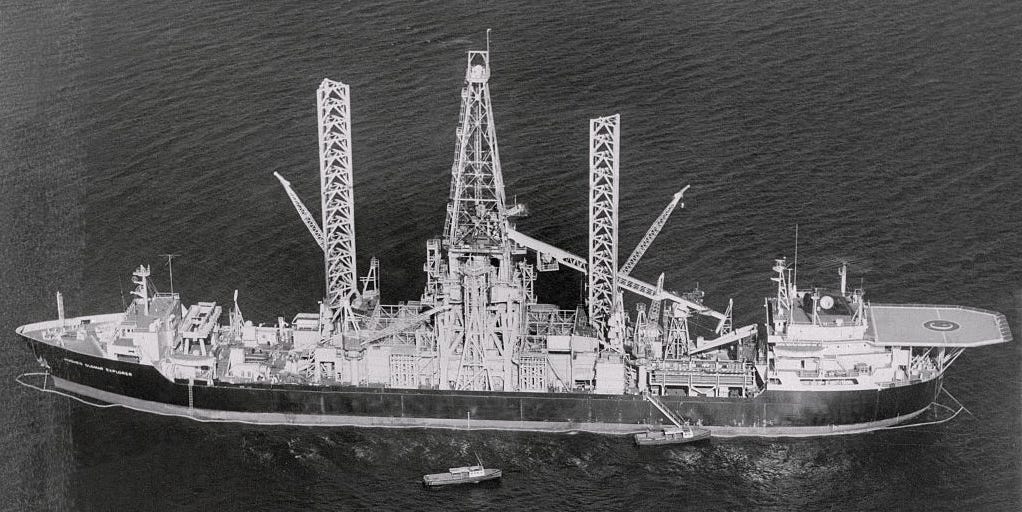
One of the most entertaining parts of the Azorian story is the cover story itself. To hide the mission, the CIA needed a plausible explanation for building a bizarre, oversized ship with a moon pool, a massive derrick, and specialized lifting equipment. Enter Howard Hughes, billionaire, recluse, and accidental mascot of one of the strangest covert operations in American history.
The official line was that the vessel, the Hughes Glomar Explorer, was intended for deep-sea mining. Specifically, it would harvest manganese nodules from the ocean floor. This was not total nonsense; deep-ocean mining had genuine commercial appeal at the time. That made the lie more elegant. The ship really did look like a futuristic industrial vessel. It just happened to have been designed to grab a Soviet submarine instead of merely collecting mineral lumps.
The cover mattered because secrecy was everything. If the Soviets knew the United States had located K-129 and intended to recover it, they could interfere diplomatically, militarily, or both. So the mining story had to be convincing not only on paper but in hardware. The ship, the crew environment, the equipment, even the artifacts associated with the mission had to reinforce the illusion. Azorian was espionage theater with a production budget that could have funded several normal insanities instead.
The Engineering Miracle of the Hughes Glomar Explorer
The reason Project Azorian still fascinates historians is simple: it sounds impossible. Recovering a 1,750-ton section of a wrecked submarine from about 16,500 feet below the surface was absurdly difficult in the 1970s. Honestly, it still sounds like the kind of plan that should end with someone saying, “Well, we tried our best,” before going home.
But the CIA and its contractors built a system designed to do exactly that. The Hughes Glomar Explorer included a central well, or moon pool, so the captured wreckage could be brought up inside the ship out of public view. A huge capture vehiclebasically a giant mechanical claw, nicknamed “Clementine”would descend on a long string of steel pipe, straddle the wreck, grip it, and lift it slowly upward. Pipe sections had to be added and removed one at a time, like the world’s most stressful set of industrial building blocks.
Just holding the ship in position over a target nearly three miles down was a major challenge. Ocean currents, weather, equipment strain, and the sheer fragility of wreckage all had to be managed in secret while curious Soviet vessels hovered nearby. Azorian was not just espionage. It was precision choreography above a black abyss.
A Moon Pool, a Giant Claw, and a Lot of Nerves
The moon pool was the magic trick. By lifting the recovered section into an enclosed opening within the ship, the operation could remain hidden from external observers. That meant other ships, aircraft, and satellites could not easily see exactly what the Americans were hauling up. It was part engineering solution, part stage curtain.
The claw itself was equally dramatic. Popular descriptions compare it to an arcade claw machine, which is funny right up until you remember the prize was a wrecked Soviet missile submarine in ultra-deep water. Unlike the machine at the mall, however, this claw had to work after a descent of several miles, under crushing pressure, on unstable wreckage that had been on the seabed for years. Small margin for error. Tiny bit more stressful than winning a stuffed bear.
The Recovery Mission in 1974
In the summer of 1974, the Glomar Explorer sailed from Long Beach and reached the recovery site on July 4. Over the following weeks, the ship conducted its covert lift under the gaze of Soviet ships that were suspicious but not fully aware of the true mission. The operation was so secret that even after the ship reached the site, the hardest part was only beginning.
Eventually, the capture vehicle secured the target section and began the long ascent. This was the moment everything had been building towardthe sort of make-or-break sequence that spy movies love, except this one involved steel fatigue, hydraulic power, immense weight, and the Pacific Ocean trying very hard to ruin everyone’s day.
Then came disaster. During the lift, the recovered section broke apart. A major portion of the wreck fell back to the ocean floor. What remained in the claw was only part of the original target. That partial recovery meant Azorian fell short of its most ambitious objectives. The missile section most prized by intelligence did not make it all the way up.
Still, the mission was not a total failure. The U.S. recovered a portion of the submarine, including the bodies of six Soviet sailors, who were later given a formal burial at sea with military honors. That solemn episode adds a haunting human dimension to a story often told as pure spycraft. Underneath the secrecy, the gadgets, and the geopolitical drama, this was also the grave of 98 men.
Was Project Azorian a Success or a Failure?
The honest answer is: both. Operationally, it was a partial success. The CIA proved that the United States could design and execute an ultra-deep recovery operation once thought nearly impossible. Even a partial lift from that depth was an engineering triumph. From a technological standpoint, Project Azorian pushed the boundaries of ocean recovery, heavy lifting, and maritime concealment.
Intelligence-wise, the verdict is murkier. Because many details remain classified or disputed, historians still debate exactly what was recovered and how valuable the haul truly was. The mission clearly did not achieve everything planners hoped. Yet it also delivered enough to remain legendary inside intelligence history. When a project almost steals a Soviet submarine from the bottom of the Pacific, “partial success” still sounds pretty impressive.
Politically, Azorian was fragile from the start. It was expensive, risky, and unfolding during a period of détente when Washington had reason to avoid unnecessary crises with Moscow. That the project moved forward anyway says a great deal about how valuable the potential intelligence prize seemed to American leaders.
How the Press Blew the Lid Off the Operation
Almost immediately after the 1974 recovery attempt, plans began for a second mission to retrieve the lost section. Then reality crashed the party. A bizarre burglary at offices connected to Howard Hughes helped generate media attention, rumors spread, and reporters began pulling at threads the CIA very much wished would remain unpulled.
By early 1975, the story started leaking into public view. The Los Angeles Times linked Hughes, the CIA, and the recovery operation. Soon afterward, commentator Jack Anderson aired the story nationally, and Seymour Hersh’s reporting in The New York Times brought the matter into full public light. Once the secret was out, the cover story was toast, the Soviets became fully aware of the mission, and plans for follow-up recovery effectively died.
This is one of the great lessons of Cold War intelligence: sometimes the hardest part is not building the ship or finding the wreck. Sometimes it is surviving paperwork, gossip, burglars, reporters, and the unstoppable force known as public curiosity.
The Birth of the “Glomar Response”
Project Azorian also made legal history. When journalists and researchers later sought records about the operation, the CIA responded that it could “neither confirm nor deny” the existence of such records. That formulation became famous as the “Glomar response,” named after the Glomar Explorer.
Today the phrase is part of the American legal and intelligence vocabulary, especially in Freedom of Information Act disputes. In that sense, Azorian did not just leave behind a legendary Cold War story. It reshaped the language of secrecy itself. Not many covert operations can claim to have changed both engineering history and administrative phrasing, but Azorian was an overachiever.
Why Project Azorian Still Captivates People Today
Project Azorian endures because it combines nearly every element people love in historical nonfiction: nuclear brinkmanship, real espionage, giant machines, secret budgets, oddball billionaires, oceanic mystery, and an ending that is impressive, tragic, and slightly absurd all at once. It feels cinematic because it was so deeply improbable. Yet the documents, artifacts, and declassified accounts show it really happened.
It also reminds us that Cold War competition was not limited to missiles, summits, and spy exchanges on bridges. Sometimes it unfolded in silence, in deep water, through engineering contracts, classified memoranda, and teams of specialists trying to do the impossible without being noticed. Azorian was a retrieval mission, yesbut it was also a portrait of how far superpowers were willing to go to know one another’s secrets.
Experiences From the Edge of the Pacific: What Project Azorian Must Have Felt Like
To understand Project Azorian fully, it helps to think not just about the facts but about the experience of the operation. For the men aboard the Hughes Glomar Explorer, this was not a neat historical anecdote. It was long hours, steel decks, classified briefings, and the strange emotional split of doing something extraordinary while pretending you were on a glorified mining job. Imagine going to work every day inside one of the most secret missions of the Cold War and still having to act casual whenever a Soviet ship drifted into view.
The physical environment alone must have been unforgettable. The Pacific recovery site was remote, open, and psychologically enormous. The crew knew the target lay far below, in darkness and pressure beyond normal human imagination. Every clang of machinery, every pipe section lowered into the water, every systems check would have carried the same silent thought: if this fails, it fails expensively, publicly, and maybe historically.
Then there was the tension of secrecy. The operation depended on discipline. Workers, engineers, intelligence officers, and support staff had to live inside layers of cover and compartmentalization. Some knew the big picture; others knew only their slice. That creates a uniquely Cold War atmosphereeveryone is busy, everyone is serious, and nobody is exactly encouraged to overshare over coffee.
The most gripping experience, of course, must have been the lift itself. For days, the crew worked through a slow-motion gamble, raising wreckage from a depth that made rescue or recovery almost feel mythical. There is no fast-forward button in an operation like that. Success arrives inch by inch. Failure does too. When the wreck broke apart during the ascent, the emotional drop must have been brutal. Years of planning, staggering expense, and technological brilliance had all led to a moment that was both triumphant and heartbreaking.
And then came the human reality inside the recovered section. This was not just enemy hardware. It contained the remains of Soviet sailors who had died years earlier. Accounts of the formal burial at sea reveal a different side of Azorianless spy thriller, more maritime brotherhood. Even amid intense geopolitical rivalry, submariners recognized the dead as fellow sailors. That moment gave the mission a solemn dignity that cuts through the glamour of espionage.
There was probably another feeling too: awe. Not the cheerful kind, but the heavy, almost disbelieving kind. Awe that the technology had worked at all. Awe that a covert operation could stretch from White House approval to shipbuilding yards to the emptiness of the Pacific. Awe that history could hinge on a giant mechanical claw descending through black water toward a wreck no one was supposed to touch.
For modern readers, Project Azorian still delivers that same emotional mix. It feels audacious, mournful, ingenious, and faintly surreal. It is a story of intelligence ambition at full throttle, but it is also a story about risk, limits, and the human beings standing on a deck in the middle of nowhere, trying to pull secrets out of the sea. That is why Azorian remains unforgettable. It was never just about stealing a Soviet submarine. It was about testing how far secrecy, technology, and nerve could go before history itself said, “That’s enough.”
Conclusion
Project Azorian remains one of the wildest true stories of the Cold War. It was part covert intelligence operation, part engineering moonshot, and part bureaucratic magic trick. The CIA did not fully recover the Soviet submarine K-129, but it came close enough to leave behind a legend. The mission exposed both the brilliance and fragility of espionage: you can build a giant secret ship, invent a deep-ocean claw, and still be undone by leaks, headlines, and public scrutiny.
Yet the operation’s legacy is bigger than the wreck it tried to raise. Azorian showed what governments will attempt when the strategic stakes are high enough. It changed the history of deep-sea recovery, shaped the language of intelligence secrecy through the “Glomar response,” and gave Cold War history one of its most incredible real-life plots. If you want a story with submarines, secrets, science, and just enough absurdity to feel human, Project Azorian delivers.