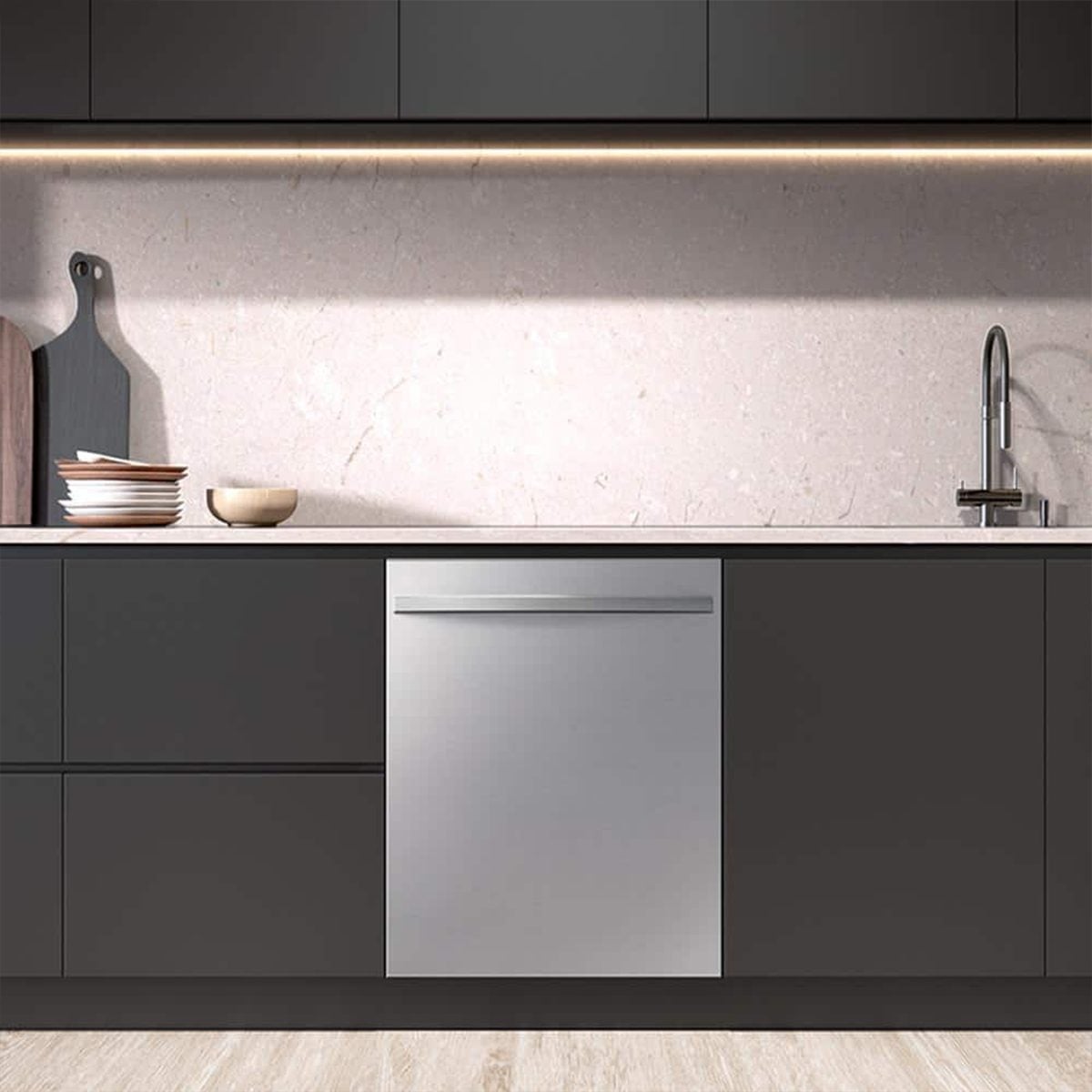

A great dishwasher should clean last night’s lasagna pan, dry the plastic containers, and remain quiet enough that nobody mistakes the kitchen for an airport runway. Unfortunately, glossy brochures do not tell you which machine will still behave itself after thousands of cyclesor whether anyone nearby can repair it when it suddenly starts communicating exclusively through blinking lights.
To identify the best dishwasher brands, we compared independent laboratory testing, appliance-reliability studies, first-year service-call data, owner satisfaction, repair accessibility, drying performance, rack design, noise levels, and overall value. The result is not simply a beauty contest for stainless-steel rectangles. It is a practical ranking of brands appliance professionals frequently trust for real American kitchens.
The five strongest choices are Bosch, Miele, KitchenAid, LG, and GE Profile. Each has a different personality: Bosch is the quiet all-rounder, Miele is the luxury marathon runner, KitchenAid is the loading champion, LG delivers strong technology for the money, and GE Profile combines useful features with broad service availability.
How Appliance Pros Judge Dishwasher Brands
Appliance professionals usually look beyond one highly rated model. A dependable brand should perform consistently across several product lines, use parts that technicians can obtain, and offer service coverage where its customers actually live.
Reliability and repair frequency
A dishwasher does not need to be indestructible, but repeated pump, rack, control-board, or drainage failures are expensive interruptions. First-year service rates are particularly useful because they show how many units require professional attention soon after installation.
Yale Appliance’s data covering more than 7,000 dishwashers placed Miele, Bosch, and KitchenAid below the category’s average first-year service rate. Meanwhile, J.D. Power’s 2025 reliability study ranked KitchenAid first, with Bosch and GE tied closely behind and LG also performing well. Different studies use different owners, time frames, and methods, so exact rankings varybut the same small group of brands repeatedly rises toward the top.
Cleaning and drying performance
Most modern machines can remove ordinary dinner residue. The differences appear when dishes contain baked cheese, dried oatmeal, lipstick, peanut butter, or whatever mysterious substance children manage to weld onto a bowl.
Drying also matters. Stainless-steel tubs, heated drying, mineral-assisted systems, fans, and automatically opening doors can all improve results. Plastics remain the final boss of dishwasher drying, so households that use many food-storage containers should pay close attention to this category.
Noise and rack flexibility
In an open-concept home, a noisy dishwasher becomes an unwanted dinner guest who stays for two hours. Models around 44 decibels or below are generally quiet enough for most kitchens, while premium machines can dip below 40 decibels.
Rack design is equally important. A third rack sounds like a small upgrade until it swallows spatulas, measuring spoons, ramekins, travel-mug lids, and half the utensils that previously cluttered the lower basket.
Local service availability
The best theoretical dishwasher is not the best dishwasher for your home when the nearest qualified technician is three states away. Before purchasing any premium brand, ask local repair companies whether they service it and how quickly they can obtain common parts.
1. Bosch: Best Overall Dishwasher Brand
Best for: Most households, open kitchens, quiet operation, and balanced performance.
Bosch earns the best-overall position because it performs well in nearly every category without requiring buyers to enter the luxury price stratosphere. Its lineup stretches from relatively accessible models to premium Benchmark machines, giving shoppers several ways to buy into the brand.
Bosch’s strongest advantage is quiet operation. Many models run in the low-40-decibel range, while select premium units reach approximately 39 or 40 decibels. At that level, you may find yourself checking the floor indicator simply to confirm the machine is running.
The brand’s PrecisionWash system uses sensors and targeted spray action to monitor cleaning, while adjustable middle racks and third-rack options improve loading flexibility. Upper-tier models add PowerControl, which lets users direct extra cleaning intensity toward a particular section of the lower rack.
Drying was once a common criticism of European-style condensation dishwashers, especially with plastic items. Bosch addressed that issue through technologies such as AutoAir and CrystalDry. CrystalDry uses a mineral-based process to convert moisture into heat, improving drying performance without relying only on an exposed heating element.
Bosch also receives strong marks in independent testing. Consumer Reports’ 2026 dishwasher coverage identified Bosch among the standout brands, and current repair data places it comfortably among the more reliable mainstream choices.
Potential drawbacks
Cycles can be long, and the lowest-priced models do not include every drying or rack feature associated with the brand. Some buyers also need time to adjust to the filter system and closely spaced tines. Check the exact series rather than assuming every Bosch dishwasher has CrystalDry, Wi-Fi, or the same third rack.
Professional verdict: Bosch is the safest recommendation for shoppers who want excellent cleaning, low noise, good reliability, and a broad selection of models.
2. Miele: Best Premium Dishwasher Brand
Best for: Long-term ownership, premium construction, sophisticated racks, and buyers willing to spend more upfront.
Miele approaches dishwashers like an engineering company that has been asked to build a quiet kitchen appliance and accidentally starts designing laboratory equipment. The machines feel substantial, operate smoothly, and are built around long-term ownership rather than a race to offer the lowest sale price.
Recent Yale Appliance service data gave Miele the lowest first-year service rate among the major dishwasher brands in its comparison, at 5.6 percent. That does not guarantee a repair-free life, but it is meaningful evidence for shoppers prioritizing dependability.
Miele’s rack systems are exceptionally adjustable, with carefully shaped areas for utensils, glasses, bowls, and awkward cookware. Select models include AutoDos, which automatically dispenses detergent from a PowerDisk based on the selected program. AutoOpen drying releases moisture by opening the door slightly near the end of the cycle. It is an elegantly simple solution: instead of trapping steam, the dishwasher politely lets it leave.
Cleaning performance is consistently strong, and premium models offer specialized cycles, interior lighting, advanced sensors, water-softening options, and app connectivity. Miele is especially appealing to households that cook frequently, wash delicate glassware, or plan to remain in the same home for many years.
Potential drawbacks
The obvious disadvantage is price. Miele dishwashers can cost substantially more than mainstream competitors, and proprietary detergent systems add an ongoing expense if used regularly. More importantly, authorized service coverage varies by location. Confirm local support before buyingnot after the dishwasher develops a German-accented error code.
Professional verdict: Miele is the premium choice for buyers who value refined engineering, excellent cleaning, thoughtful loading, and strong reliability more than a low purchase price.
3. KitchenAid: Best for Large Loads and Flexible Racks
Best for: Families, entertainers, home cooks, and anyone tired of playing dinner-plate Tetris.
KitchenAid dishwashers are especially good at using interior space. The brand’s FreeFlex third rack is deeper than a traditional flat utensil tray and can hold mugs, bowls, glasses, and larger cooking tools. For households that run full loads after dinner, that extra capacity can matter more than a dozen app-based features.
KitchenAid also performed exceptionally well in J.D. Power’s 2025 appliance reliability study, recording 63 problems per 100 appliances and ranking slightly ahead of Bosch and GE. Its recent first-year service rate in Yale Appliance’s comparison was also below the category average.
Select models combine the FreeFlex rack with adjustable middle racks, targeted bottle-wash areas, filtration systems, ProWash sensors, and fan-assisted ProDry options. Premium KitchenAid machines can also operate at roughly 39 or 40 decibels, making them competitive with the quietest mainstream alternatives.
The overall design feels American-family friendly. Large plates, mixing bowls, casserole dishes, water bottles, and oversized utensils generally fit with fewer loading negotiations. KitchenAid claims that certain FreeFlex-equipped configurations offer significantly more capacity than its traditional two-rack machines.
Potential drawbacks
KitchenAid dishwashers can become expensive once premium drying and rack features are added. Cleaning performance is strong, but bargain models may not provide the same experience as the heavily promoted high-end versions. Examine the rack layout in person because deep third racks can reduce clearance below when poorly adjusted.
Professional verdict: KitchenAid is a terrific choice for busy kitchens where capacity, sturdy racks, and accommodating load patterns are more important than minimalist European styling.
4. LG: Best Feature-to-Price Value
Best for: Budget-conscious buyers who still want strong cleaning, modern features, and adjustable racks.
LG has become one of the most competitive dishwasher manufacturers by offering features that often cost more elsewhere. Even midrange models may include stainless-steel tubs, flexible racks, third racks, Wi-Fi controls, multi-motion spray arms, and improved drying systems.
QuadWash uses four multi-motion spray arms to clean from several angles, while EasyRack Plus allows the upper rack and tines to be adjusted for irregular loads. Depending on the model, buyers may also get TrueSteam, Dynamic Dry, Dynamic Heat Dry, or an automatically venting door.
LG’s performance is not merely a list of impressive-sounding trademarked phrases. Consumer Reports included LG among its standout dishwasher brands for 2026, and Good Housekeeping has praised certain affordable LG models for both cleaning and drying. J.D. Power’s recent reliability results also placed LG near the leaders.
The ThinQ app can provide cycle notifications, diagnostics, maintenance reminders, and remote features on compatible machines. These tools are not essential, but a phone alert saying the dishes are finished can be useful when the machine is so quiet that nobody remembers starting it.
Potential drawbacks
Reliability can vary by model, and local repair experiences are inconsistent. Yale Appliance noted that one rack-related issue distorted LG’s broader service-rate results, while the brand’s core systems performed better. This is a reminder to research the exact model, not just the logo on the door.
Professional verdict: LG offers some of the best cleaning technology and convenience features per dollar, particularly for shoppers comparing machines in the middle of the market.
5. GE Profile: Best for Serviceability and Practical Features
Best for: Buyers who value broad U.S. service coverage, strong drying, bottle cleaning, and familiar controls.
GE Profile earns its place because it combines modern technology with a major practical advantage: GE appliances are widely sold and serviced throughout the United States. Availability does not make repairs fun, but it can make them fasterand “the part arrives Tuesday” is far better than “we have never seen this machine before.”
GE tied with Bosch near the top of J.D. Power’s 2025 dishwasher reliability ranking, trailing KitchenAid by only one reported problem per 100 appliances. That result supports GE Profile as more than merely the convenient option.
The brand’s most useful features solve recognizable household problems. Bottle Jets direct water into narrow containers. Dedicated silverware jets attack utensils packed closely together. Dry Boost improves drying for plastics, and select Profile machines add Twin Turbo Dry Boost with extra heat and fan assistance. Smart Assist sensors can monitor performance and provide maintenance guidance.
GE Profile also offers multiple handle styles, finish options, top- and front-control designs, Wi-Fi connectivity, and models at several price levels. Its machines are not always the absolute quietest or most luxurious, but they tend to be approachable and practical.
Potential drawbacks
GE’s extensive lineup can be confusing, and similarly styled models may have very different tubs, drying systems, noise ratings, and rack designs. Carefully compare model numbers. A promotional photograph showing an impressive feature does not mean every nearby machine at the retailer includes it.
Professional verdict: GE Profile is an excellent choice for homeowners who want capable cleaning, strong drying, useful targeted jets, and a better chance of finding local service.
Quick Comparison of the Best Dishwasher Brands
| Brand | Best For | Standout Strength | Main Consideration |
|---|---|---|---|
| Bosch | Most households | Quiet, balanced performance | Best drying features cost more |
| Miele | Premium long-term ownership | Build quality and reliability | High price and limited service in some areas |
| KitchenAid | Large families and cooks | Flexible, high-capacity racks | Premium configurations get expensive |
| LG | Feature-focused value buyers | Technology for the price | Model and service consistency varies |
| GE Profile | Practical ownership | Drying, targeted jets, service reach | Specifications vary widely by model |
How to Choose the Right Dishwasher for Your Kitchen
Check the noise rating
Choose approximately 44 decibels or lower for an open kitchen. Paying extra to reach 39 decibels may be worthwhile in a small home, but it offers less benefit when the laundry room, television, children, and family dog already provide an enthusiastic soundtrack.
Inspect the racks with your own dishes in mind
Bring measurements for your plates, cutting boards, wine glasses, travel mugs, and stockpot. Fold-down tines and adjustable racks are more valuable than decorative interior lighting when your everyday dishes do not fit.
Choose a drying system that matches your habits
Households using many plastic containers should prioritize active drying, fan assistance, mineral drying, or an automatically opening door. Buyers who mostly wash ceramic plates and glassware may be satisfied with simpler condensation drying.
Confirm installation requirements
Measure the opening, floor height, countertop depth, drain route, water connection, and electrical setup. Bosch and Miele models may have different plumbing or electrical expectations than the machine being replaced. Installation surprises are rarely the festive kitchen event one hopes for.
Look for ENERGY STAR certification
A standard-size ENERGY STAR certified dishwasher costs roughly $50 per year to operate under the agency’s current estimate and can save approximately 5,800 gallons of water over its lifetime. Soil sensors, efficient filtration, and improved spray systems help reduce consumption without requiring everyone to return to hand-washing dinner plates like weary pioneers.
Ask who will repair it
Call one or two local appliance-service companies before buying. Ask whether they work on the brand, whether they provide warranty service, and how difficult common parts are to obtain. This five-minute check may be more valuable than reading another 600 anonymous reviews arguing about whether a dinner fork became adequately shiny.
Real-World Experiences With Today’s Best Dishwasher Brands
The most revealing dishwasher experiences usually begin several weeks after installation, when the novelty wears off and the machine faces ordinary household chaos. Specifications matter, but daily annoyancesor the lack of themdetermine whether owners still like a dishwasher after the honeymoon period.
The quiet-kitchen experience
Moving from an older 55-decibel dishwasher to a Bosch in the low-40-decibel range can feel like removing construction equipment from the kitchen. Conversations continue normally, televisions do not need to be turned up, and evening cycles stop feeling like tactical operations. The downside is surprisingly comic: owners repeatedly open the door mid-cycle because they assume the silent machine never started. Floor-projected status lights become genuinely useful rather than decorative.
The premium-ownership experience
Miele ownership tends to reward people who appreciate mechanical details. Racks roll smoothly, components feel carefully fitted, and the interior seems designed by someone who has personally argued with a soup ladle. AutoOpen drying can produce excellent overnight results, while AutoDos eliminates detergent guessing. However, the experience is less delightful when local service is scarce. A premium dishwasher waiting several weeks for an authorized technician is still a premium container full of dirty plates.
The family-loading experience
KitchenAid’s deep third rack changes how some families load their machines. Coffee cups, cereal bowls, cooking tools, and small containers move upward, leaving more room below for dinner plates and cookware. This can reduce the number of nightly loads. Yet every flexible rack system has a learning curve. Place a tall mug in the wrong position and the spray arm may perform a tiny, repetitive drum solo against it for the entire cycle.
The technology-for-less experience
LG often creates the strongest first impression at a moderate price. QuadWash, adjustable racks, app notifications, steam options, and fan-assisted drying make the machine feel well equipped. Owners who choose the correct cycle and use rinse aid can get impressive results without buying a luxury model. The important lesson is to examine local service reputation. A feature-packed bargain loses some sparkle when the nearest technician refuses the assignment.
The practical-service experience
GE Profile tends to feel familiar rather than exotic, which is often a compliment. Bottle Jets are genuinely helpful for reusable bottles, vases, and narrow containers. Heated drying performs well for families with plastic dishes, while replacement parts and technicians may be easier to locate in many U.S. markets. The broad product range requires careful shopping, though. Two nearly identical GE machines can differ in tub material, rack flexibility, noise, and drying performance.
The lesson shared by every brand
Even an excellent dishwasher performs poorly when overloaded, blocked by a tall pan, fed too little hot water, or neglected until the filter resembles an archaeological excavation. Owners generally get better results by scraping rather than fully rinsing dishes, keeping spray arms clear, cleaning the filter, using fresh detergent, adding rinse aid, and selecting a full cycle for heavily soiled loads.
The best ownership experiences also begin with realistic expectations. No machine can perfectly load itself, quietly reorganize a chaotic silverware basket, or explain why one plastic lid has flipped over and collected enough water to host a koi pond. A good dishwasher simply makes these incidents occasional rather than routine.
Final Verdict
Bosch is the best dishwasher brand for most people because it delivers a strong combination of cleaning, quiet operation, reliability, rack flexibility, and model choice. Miele is the premium durability pick, KitchenAid is the capacity specialist, LG offers the most technology for the money, and GE Profile stands out for practical features and broad service accessibility.
Do not choose by brand name alone. Compare the exact model’s decibel rating, tub material, drying system, rack layout, warranty, and local repair network. The right dishwasher is not necessarily the one with the longest feature list. It is the one that fits your dishes, your kitchen, your budget, and your tolerance for drying one stubborn plastic container by hand.
Note: Reliability statistics and product lineups can change as manufacturers introduce new models. Verify current specifications, warranty coverage, installation requirements, and authorized service availability before purchasing.