
Cutting a mango should feel like a tiny tropical celebration, not a slippery kitchen wrestling match. Yet for many home cooks, the mango has a reputation for being the fruit world’s practical joke: beautiful on the outside, golden and juicy inside, and hiding a flat, stubborn pit exactly where your knife wants to go. The good news? Once you understand the mango’s shape, the best way to cut a mango becomes simple, safe, and surprisingly satisfying.
This guide walks you through the easiest method for cutting mango into cubes, slices, and recipe-ready pieces without wasting half the fruit or turning your cutting board into a mango crime scene. We’ll also cover how to choose a ripe mango, how to store cut mango, common mistakes, serving ideas, and real-life mango-cutting experiences that may save you from sticky fingers and mild emotional damage.
Why Mangoes Are Tricky to Cut
A mango looks roundish, but inside it has a long, flat seed running through the center. That seed is not polite. It does not sit neatly like a peach pit. Instead, it stretches from top to bottom like a hidden surfboard. The secret to cutting a mango well is learning to slice along the wide sides of that seed instead of trying to cut straight through the middle.
Most mangoes have two broad “cheeks” of fruit on either side of the pit. Once you remove those cheeks, you can score, slice, or scoop the flesh depending on what you plan to make. This is why the cheek method is widely considered the best way to cut a mango for everyday use. It gives you clean pieces, reduces waste, and keeps your hands away from the sharp edge of the knife.
How to Tell If a Mango Is Ready to Cut
Before you grab a knife, check whether the mango is ripe. A ripe mango usually gives slightly when gently pressed, similar to a ripe avocado or peach. It should feel soft but not mushy. If it feels like a baseball, it needs more time. If your thumb sinks in like it just discovered quicksand, the mango may be overripe.
Color is not always the best indicator because mango varieties can be green, yellow, orange, red, or a combination of all four. Some ripe mangoes stay partly green, while some colorful mangoes are still firm inside. Instead of judging by looks alone, use touch and smell. A ripe mango often has a sweet, fruity aroma near the stem end. If it smells sour, fermented, or unpleasant, skip it.
Best Mango Texture for Cutting
For neat cubes or slices, choose a mango that is ripe but still firm enough to hold its shape. Very soft mangoes are delicious, but they are better for smoothies, sauces, chutney, or eating over the sink like a person who has made peace with chaos.
Tools You Need to Cut a Mango
You do not need fancy equipment. A ripe mango, a stable cutting board, a sharp chef’s knife or paring knife, and a spoon are enough. A vegetable peeler can help if you want peeled slices. A mango splitter can be useful if you cut mangoes often, but it is optional. The best tool is really knowledge, though a sharp knife is a close second.
Always wash the mango before cutting, even if you do not plan to eat the peel. Dirt and bacteria on the skin can transfer to the flesh when the knife cuts through it. Use a clean cutting board and keep the mango steady. Mango juice is slippery, and slippery fruit plus a dull knife is not the kind of adventure anyone needs before breakfast.
The Best Way to Cut a Mango: Step-by-Step
The cheek-and-score method is the easiest and most reliable way to cut a mango. It works for snacking, fruit salads, salsa, smoothie prep, lunch boxes, yogurt bowls, and desserts.
Step 1: Wash and Dry the Mango
Rinse the mango under cool running water and rub the skin gently with your hands. Dry it with a clean towel or paper towel. Dry fruit is easier to hold, and your cutting board will be less slippery.
Step 2: Find the Tall Side of the Mango
Stand the mango upright on the cutting board with the stem end facing up. Look at the fruit from above. You will usually see that it has a wider side and a narrower side. The flat seed runs along the wide side, so you want to cut just to the left and right of the center.
Step 3: Slice Off the First Mango Cheek
Place your knife about one-quarter inch from the center line and slice downward, following the curve of the seed. If your knife hits something hard, that is the pit saying, “Nice try.” Shift the knife slightly outward and continue cutting. You should end up with one large oval piece of mango flesh with skin attached.
Step 4: Slice Off the Second Cheek
Turn the mango around and repeat on the other side. Now you should have two mango cheeks and a center section containing the seed. The cheeks are the prize. The seed section still has usable fruit, so do not toss it yet.
Step 5: Score the Mango Flesh
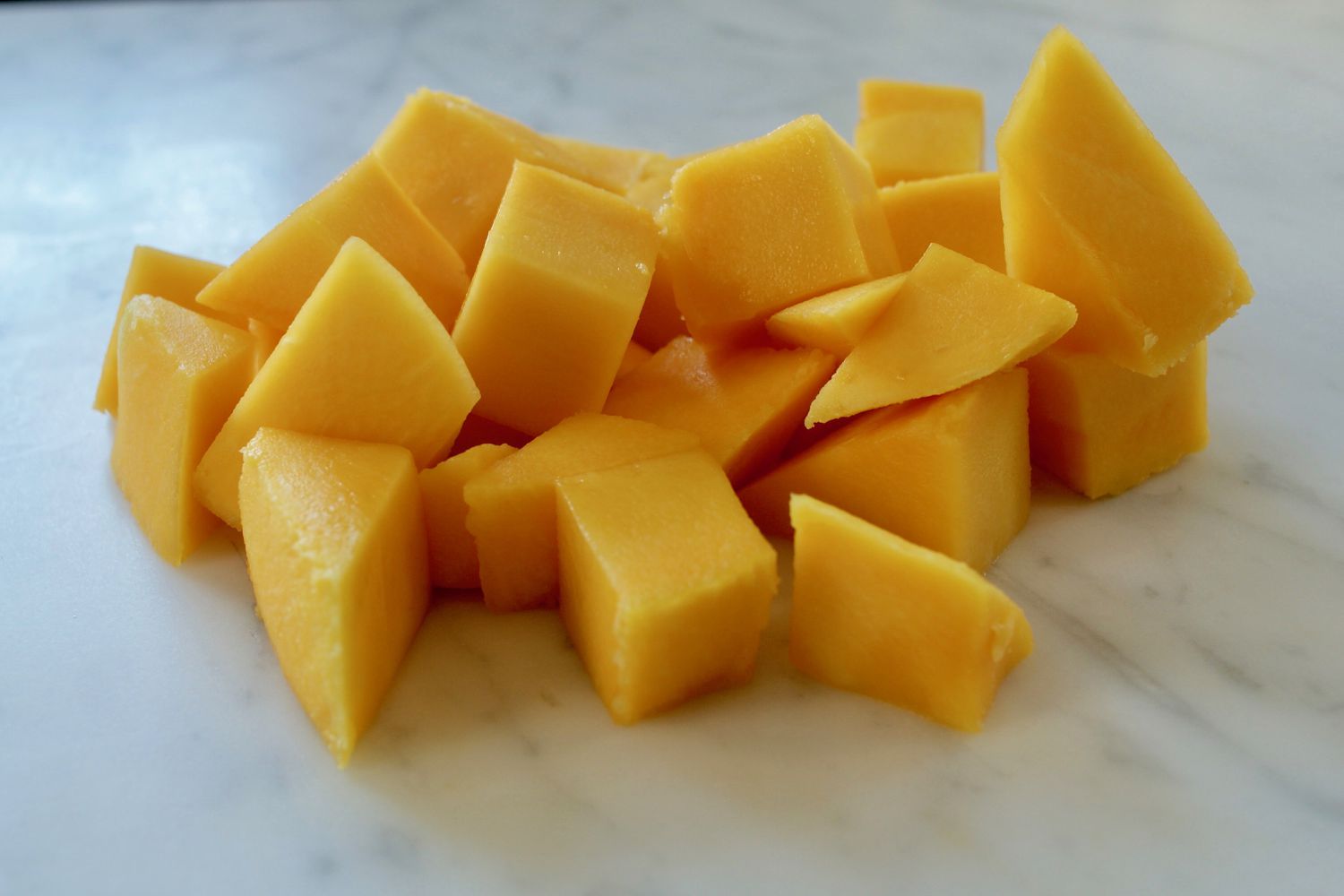
Hold one mango cheek skin-side down on the cutting board. Use the tip of your knife to make lengthwise cuts through the flesh without cutting through the skin. Turn the cheek and make crosswise cuts to create cubes. Think checkerboard, not demolition project.
Step 6: Scoop Out the Cubes
Slide a spoon between the mango flesh and the skin. Scoop out the cubes into a bowl. If the mango is ripe, the pieces should come away easily. If they cling like they signed a lease, use the knife to loosen them gently.
Step 7: Trim the Fruit Around the Pit
Lay the center seed section flat. Carefully trim off any remaining mango flesh from the sides. These pieces may be less pretty, but they are perfect for smoothies, salsa, sauces, or “chef snacks,” which is the official culinary term for eating the evidence.
How to Cut a Mango Into Slices
If you want mango slices for a fruit platter, sticky rice, salads, desserts, or a pretty breakfast bowl, use the same cheek method but skip the crosswise scoring.
After slicing off the cheeks, score the flesh lengthwise into long strips. Then use a spoon to remove the strips from the skin. For cleaner slices, you can peel the mango first with a vegetable peeler, then cut the cheeks away from the pit and slice them on the cutting board.
How to Cut a Mango Without Making a Mess
Mango mess usually happens for three reasons: the fruit is too soft, the knife is too dull, or the cutter is trying to peel the mango after it has already become a juice grenade. To keep things tidy, start with a mango that is ripe but not mushy. Use a sharp knife, dry the fruit after washing, and keep the skin on while scoring. The skin acts like a built-in bowl, which is very considerate of it.
If your mango is extremely ripe, place it in the refrigerator for 20 to 30 minutes before cutting. Chilling can make the flesh slightly firmer and easier to handle. It will not rescue a mango that has turned to pudding, but it can help a soft mango behave long enough to reach the bowl.
Common Mango-Cutting Mistakes
Mistake 1: Cutting Straight Down the Middle
The pit is in the middle, so cutting straight through the center usually leads to frustration. Instead, cut slightly off-center on both sides to remove the cheeks.
Mistake 2: Peeling Too Early
Peeling a ripe mango before cutting can make it slippery. Unless you need long peeled slices, keep the skin on while you score and scoop. It gives you control and protects your hand.
Mistake 3: Using a Dull Knife
A dull knife can slip, crush the fruit, and make the process harder. A sharp knife gives you cleaner cuts and better control. Use careful, steady pressure rather than force.
Mistake 4: Ignoring the Pit
The pit is wide and flat. If your knife hits it, do not push harder. Adjust your angle and cut around it. Mangoes reward patience, not brute strength.
Should You Eat Mango Skin?
Mango skin is technically edible, but many people avoid it because it can taste bitter, feel tough, and cause irritation for some individuals. Mango peel contains compounds related to those found in poison ivy, and sensitive people may react to it. For the best flavor and texture, most home cooks remove or avoid the skin.
Best Ways to Use Cut Mango
Fresh mango cubes are excellent on their own, but they also make recipes brighter, sweeter, and more interesting. Add diced mango to fruit salad, shrimp tacos, fish tacos, grilled chicken bowls, coconut rice, overnight oats, smoothies, yogurt parfaits, or spicy mango salsa. Mango also pairs beautifully with lime juice, cilantro, chili powder, mint, coconut milk, ginger, avocado, and jalapeño.
For a quick mango salsa, combine diced mango with red onion, lime juice, cilantro, jalapeño, and a pinch of salt. Serve it with tortilla chips, grilled fish, chicken, or tacos. It tastes like summer showed up wearing sunglasses.
How to Store Cut Mango
Once mango is cut, refrigerate it in a clean, airtight container. Cut fruit should not sit at room temperature for long, especially in warm weather. For best flavor and texture, eat refrigerated mango within a few days.
You can also freeze mango. Spread cubes on a parchment-lined baking sheet and freeze until firm, then transfer them to a freezer-safe bag or container. Frozen mango is excellent for smoothies, sorbet, sauces, and blended drinks. It may be softer after thawing, so it is better for blended recipes than fruit platters.
How to Cut Different Types of Mangoes
Common mango varieties in U.S. grocery stores include Tommy Atkins, Ataulfo, Kent, Keitt, Haden, and Francis. The cutting method is mostly the same, but texture can vary. Ataulfo mangoes, sometimes called honey mangoes, are smaller, sweeter, and less fibrous. They are great for eating fresh. Tommy Atkins mangoes are widely available and colorful, but they can be more fibrous. Kent and Keitt mangoes are often juicy and smooth, making them excellent for slicing and smoothies.
Smaller mangoes may need a paring knife instead of a large chef’s knife. Larger mangoes are easier to stabilize on a cutting board. No matter the variety, remember the rule: locate the broad sides, cut off the cheeks, score, scoop, and enjoy.
How to Cut a Mango for Kids, Parties, and Meal Prep
For kids or lunch boxes, mango cubes are easiest to eat. Cut them small enough for comfortable bites and store them chilled. For parties, long mango slices look elegant on platters, especially with pineapple, berries, kiwi, and citrus. For meal prep, cubes are the most flexible because you can toss them into smoothies, salsas, salads, and breakfast bowls throughout the week.
If you are serving mango to guests, cut it shortly before serving for the freshest flavor. A squeeze of lime can brighten the taste and help the fruit look lively. Mango does not brown as dramatically as apples or bananas, but it still looks best when freshly cut.
Extra Experience: What Cutting Mangoes Teaches You in Real Life
The first time many people cut a mango, they expect it to behave like an apple. That is a mistake. A mango is not an apple. A mango is a tropical puzzle wearing perfume. You slice confidently into the center, hit the pit, question your cooking skills, rotate the fruit, hit the pit again, and finally wonder if the mango was designed by someone who enjoys practical jokes.
After a few tries, though, the process becomes almost automatic. You learn to look at the fruit before cutting. You notice the wide side. You stop fighting the seed and start working around it. That small shift changes everything. Suddenly, the mango opens into two golden cheeks, and you feel like you have unlocked a kitchen achievement badge.
One helpful experience is to cut mangoes over a board with a groove around the edge. Mango juice travels. It has dreams. It wants to visit the counter, the floor, your shirt, and possibly another room. A grooved cutting board catches some of that juice and makes cleanup easier. If you do not have one, place a towel under the board to keep it from sliding.
Another practical lesson: do not cut a mango when you are in a hurry and wearing a white shirt. Mangoes have excellent comic timing. The moment you think, “I’ll just quickly dice this,” the fruit becomes extra slippery, and one cube makes a dramatic escape. Give yourself a minute, use a stable board, and treat the mango like the juicy little celebrity it is.
For beginners, the cheek-and-score method is more forgiving than peeling first. When the skin stays on, it gives your hand something firm to hold. The mango flesh remains contained, and the cubes pop out neatly with a spoon. This method is especially useful when making mango salsa because the pieces are already diced and ready to mix with lime, onion, cilantro, and chili.
For very ripe mangoes, the best experience is often not perfect cubes. Instead, slice off the cheeks, scoop the flesh directly into a blender, and make a smoothie or sauce. Add Greek yogurt, banana, lime juice, or coconut milk, and suddenly your “messy mango” becomes breakfast with a vacation accent. Not every mango needs to look like it came from a cooking show. Some mangoes are born for smoothies, and that is a noble calling.
For firmer mangoes, peeled slices can be beautiful. Use a vegetable peeler, cut the cheeks away from the pit, and slice the flesh into thin strips. These are perfect for salads, rice bowls, desserts, and fruit platters. A slightly firm mango is also easier to cut into matchsticks for slaws or spring rolls.
The biggest lesson is simple: the best way to cut a mango depends on how you want to eat it. For snacking, use cubes. For presentation, use slices. For smoothies, scoop the flesh and skip the beauty contest. For salsa, dice it small. And for the leftover fruit clinging to the pit, accept your reward as the cook and nibble it privately. Some kitchen traditions deserve protection.
Conclusion
The best way to cut a mango is the cheek-and-score method: wash the fruit, slice along both sides of the flat pit, score the flesh, scoop out the cubes, and trim the remaining fruit from the seed. This method is easy, efficient, and beginner-friendly. It keeps the mango stable, reduces waste, and gives you clean pieces for snacks, salsa, smoothies, desserts, and more.
Once you understand the mango’s flat seed, the fruit becomes much less mysterious. Choose a ripe but firm mango, use a clean board and sharp knife, keep the skin on while scoring, and refrigerate cut pieces promptly. With a little practice, you will go from mango confusion to mango confidenceand possibly become the person everyone asks to cut fruit at brunch. Use this power wisely.
Note: This article was written in original wording and synthesized from reputable culinary, produce, and food-safety guidance, including U.S.-focused food authorities and established cooking publications. No source links or citation placeholders are embedded, so the HTML is clean for web publishing.