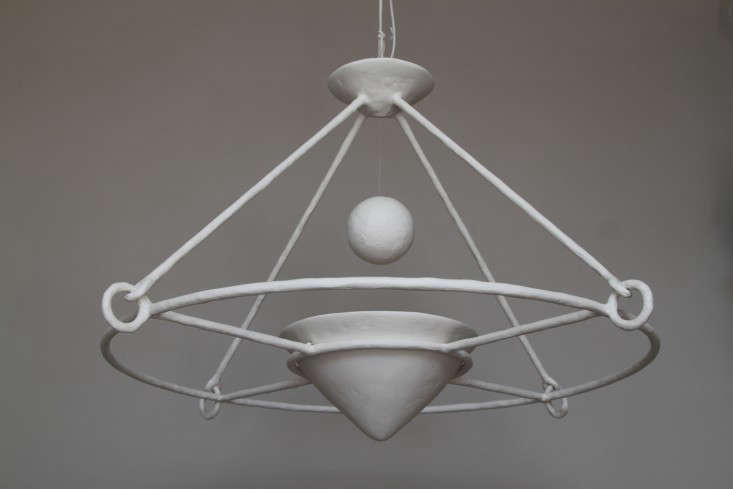

Plaster usually spends its working life pretending not to be noticed. It smooths a wall, patches a crack, and quietly leaves the glamour to marble, brass, and glass. In the hands of Stephen Antonson, however, this humble material stops being background scenery and walks directly into the spotlight. His hand-sculpted chandeliers, pendants, lamps, and sconces turn illumination into three-dimensional artoften chalky white, visibly handmade, and just irregular enough to feel alive.
Known throughout the design world as a master of plaster, Antonson has built a distinctive practice around an old medium and a modern idea: a light fixture should do more than brighten a room. It should shape the room, cast expressive shadows, reward close inspection, and look interesting even when the switch is off. That philosophy has made Stephen Antonson sculptural lighting a favorite among interior designers who want refinement without stiffness and drama without a disco ball entering the conversation.
Who Is Stephen Antonson?
Stephen Antonson was born in 1966 and grew up outside Detroit. He studied painting and sculpture at Carnegie Mellon University and Hunter College, training that remains easy to see in his work. His fixtures are functional objects, but their silhouettes, surface textures, proportions, and negative spaces are handled with a sculptor’s attention. Before establishing his own studio in 2008, he also worked at Martha Stewart Living, where an editorial culture of craftsmanship, styling, and practical problem-solving helped connect fine-art thinking with useful objects for the home.
Working from Brooklyn, New York, Antonson developed a studio practice centered on furnishings, lighting, mirrors, and decorative objects made largely by hand. The setting matters. His workshop has often been described less like a conventional lighting factory and more like an artist’s atelier: high ceilings, generous daylight, works in progress, tools, molds, armatures, and a great deal of white dust waiting to attach itself to anything wearing black.
Biography and studio practice:
Why Plaster Makes Such Compelling Lighting
Plaster behaves differently from the polished materials commonly associated with luxury lighting. Brass reflects and crystal sparkles; plaster absorbs and softens. Its matte surface catches light quietly, while ridges, brush marks, carved edges, and slight variations create changing shadows throughout the day. This is one reason Antonson so often works in white: curves read clearly, texture becomes visible, and the fixture can sit beside oak, lacquer, stone, linen, or intense color without disappearing.
His work also belongs to a twentieth-century lineage that includes Jean-Michel Frank, Serge Roche, and the Giacomettis, designers who understood plaster’s mix of modesty and theatricality. Antonson respects that history without copying it. His lighting can feel classical, modernist, organic, or playfully eccentric depending on the form and the room around it.
A Material That Records the Hand
The beauty of artisan plaster lighting lies partly in its imperfections. A perfectly smooth fixture can look manufactured; a carefully worked plaster fixture looks made. That distinction is not the same as roughness. Antonson’s surfaces are controlled, refined, and repeatedly adjusted, but they are not scrubbed of personality. The finish may reveal faint brush movement, rounded edges, or sculpted transitions that invite the eye to travel across the object.
Plaster lineage and white finish:
How Stephen Antonson’s Plaster Lighting Is Made
The apparent simplicity of a white fixture hides a labor-intensive construction process. For many large works, Antonson begins with a steel armature that establishes the framework and supports the electrical components. After wiring and priming, plaster is brushed onto the structure in successive layers. Each stage may be sculpted, dried, sanded, and reconsidered before another layer is added.
This is slow design in the most literal sense. Large chandeliers can require weeks of work, and the surface cannot be treated as an afterthought because the surface is the design. A fraction too much material can make a delicate arm feel clumsy. Sanding too aggressively can flatten a transition that was meant to catch light. The maker must balance engineering, electrical function, weight, proportion, and visual rhythm while the piece gradually becomes itself.
Tables and other furnishings require related but different methods. A wooden substrate may be built first, then primed, plastered over time, refined, and sealed. Smaller objects can be cast from molds and finished by hand. Antonson has also expanded into bronze, sometimes translating forms developed in plaster into a more permanent metallic medium. Even then, the original sculpting process remains important because the plaster model carries the gesture.
Fabrication process:
Signature Stephen Antonson Chandeliers and Fixtures
Antonson’s collection ranges from restrained sconces to chandeliers large enough to command a formal dining room. A family resemblance runs through the work: bold silhouettes, pale surfaces, sculptural repetition, and an interest in how a fixture occupies air.
The Hilary and Earle Chandeliers
The branching Hilary and Earle chandeliers feel balanced rather than mechanically repeated. Their architectural scale suits entries, dining rooms, and stair halls, while the matte plaster keeps the strong forms from producing the hard glare associated with polished metal. The related Hilary Sconce carries the vocabulary onto the wall.
The Angele Chandelier
The Angele Chandelier reveals Antonson’s modernist side. Its geometry recalls the solids used in drawing and still-life studies, translating cones, spheres, and balanced volumes into a composition that can work above an antique table or a minimalist island.
Petal, Shell, and Organic Scale
The Petal and Shell chandeliers move toward expansive organic forms. The full-size Petal spans roughly six feet, reading like a floating relief, while the Shell emphasizes width rather than a dramatic drop. Neither needs dangling crystal to feel luxurious; sculptural confidence does the job.
Orion, Finn, and the Sculptural Lantern
The Orion and Finn lanterns reinterpret a familiar architectural type through plaster. Their open frameworks feel both old and contemporary, helping them fit traditional and modern rooms. The Orion has been highlighted as an heirloom-worthy use of an ancient medium.
Pendants With Personality
Pendants such as Four Arches, Mushroom, Hex, Fontana, Harlequin, and James move between geometry and biomorphic shape. Even the optional hand-plastered chain for Four Arches becomes part of the sculpture rather than an off-the-shelf necessity.
Current collections and dimensions:
The Shackleton Collection: Icebergs in a Brooklyn Studio
One of Antonson’s most evocative bodies of work took inspiration from Antarctic ice and the famous Endurance expedition led by Sir Ernest Shackleton. Rather than copying an iceberg literally, Antonson studied the fractured planes, ledges, facets, and battered surfaces created by freezing, drifting, and collision.
The resulting furnishings included shelves, consoles, and tables named in reference to members of Shackleton’s crew. Tool marks from chisels, rasps, and sandpaper remained visible, suggesting ice that had been shaped by water and force. This collection clarified an important aspect of Antonson’s design method: plaster is not valuable because it can imitate smooth stone. It is valuable because it can record erosion, pressure, carving, and touch.
The icy inspiration also makes conceptual sense. Both plaster and ice can appear bright, pale, and visually weightless while remaining materially substantial. Both reveal form through shadow. Fortunately, only one of them can survive a dinner party.
Shackleton collection:
Why Interior Designers Use Antonson’s Lighting
Stephen Antonson’s fixtures appear in richly layered rooms, restrained contemporary apartments, beach houses, showhouses, and art-filled residences. That range is possible because the work offers contrast without demanding a specific decorating style. A white plaster chandelier can calm a room with glossy lacquer and patterned fabric. In a neutral interior, its texture prevents the palette from becoming flat. Against dark paint, it reads almost like a drawing in space.
Recent design coverage has continued to identify hand-crafted plaster lighting as part of a larger movement toward tactile surfaces, softened finishes, and fixtures that function as art. Antonson’s work is frequently cited because it arrived well before plaster became a mass-market look. The difference is visible: authentic sculptural plaster has depth, variation, and construction logic, while a generic imitation often resembles a metal fixture wearing a flour-based disguise.
Interior applications and current relevance:
Customization, Collaboration, and Collectible Design
Antonson frequently collaborates with architects and interior designers on custom commissions. Scale, arm configuration, finish, and proportion may be adapted for a particular room. This is especially important for sculptural chandeliers, where a few inches can determine whether a piece feels elegantly suspended or like it is preparing to interview the guests.
His collaborative work extends beyond lighting. He has created plaster architectural elements, including fireplace surrounds and site-specific installations, and has developed decorative hardware through a process that begins with hand-sculpted plaster prototypes. These projects show how easily his vocabulary can move from the ceiling to the wall, the mantel, the cabinet, or the tabletop.
The work also occupies the growing category of collectible design, where function, craft, scarcity, and artistic authorship overlap. Antonson’s pieces are not merely decorative lighting selected by wattage and finish. They are objects with a recognizable maker, a process, and a place within the history of plaster furniture and sculpture.
Collaboration and collectible design:
How to Style Sculptural Plaster Lighting
Give the Fixture Visual Breathing Room
A large plaster chandelier benefits from space around it. Avoid crowding it with an oversized centerpiece, busy ceiling treatment, and competing pendant lights in the same sightline. Let one major object lead. Plaster is quiet in color but not necessarily quiet in shape.
Use Contrast Thoughtfully
White plaster looks especially vivid against deep green, chocolate brown, oxblood, navy, or charcoal walls. In pale rooms, create contrast through materials instead: dark wood, bronze, veined stone, woven fibers, or colorful art. The goal is not to make the fixture shout but to make its edges readable.
Layer the Lighting
A sculptural chandelier should not be forced to perform every lighting task. Combine it with sconces, table lamps, picture lights, or discreet architectural illumination. This allows the chandelier to provide atmosphere while other sources handle reading, serving, and the important domestic work of locating a dropped olive.
Respect Scale and Installation Needs
Handmade plaster fixtures require thoughtful handling. Confirm ceiling support, overall weight, drop length, bulb access, and professional installation before ordering. Measure the room in three dimensions, not just by floor area. A broad fixture may work beautifully over a long table but overwhelm a narrow circulation path.
Why Stephen Antonson’s Work Endures
Stephen Antonson’s achievement is not simply that he revived plaster lighting. He demonstrated how an old material could support a contemporary studio practice without losing its historical resonance. His chandeliers and lamps feel connected to classical sculpture, French modernism, surreal decoration, and American craft, yet they remain unmistakably his own.
The strongest pieces balance opposites. They are pale but dramatic, roughened but refined, functional but sculptural, historically informed but not nostalgic. They can disappear into a room’s architecture from one angle and dominate it from another. Most importantly, they make light visible not only as brightness but as shadow moving across form.
Experience Notes: What It Feels Like to Live With Sculptural Plaster Lighting
A useful way to understand Antonson’s work is to imagine the daily experience of a room built around one substantial plaster fixture. At first, the chandelier may register mainly as a silhouette. You notice the spread of its arms, the unusual thickness of a curve, or the way a white form floats against the ceiling. It has presence, but it does not glitter for attention. This can feel surprisingly calming in a dining room or entry, where conventional statement lighting often relies on sparkle, shine, or a forest of exposed bulbs.
Then daylight begins to explain the surface. Morning light grazes one side and reveals fine changes in texture. By afternoon, the fixture may look flatter and more architectural. At night, the bulbs create a different object altogether, pushing shadows into joints and recesses. Living with sculptural plaster lighting is therefore less like owning a static accessory and more like watching a small piece of architecture change through the day.
The installation experience also encourages better planning. A handmade chandelier makes homeowners and designers think carefully about ceiling height, table position, sightlines, dimming, and surrounding materials. That extra attention is useful. Many rooms are decorated from the floor upward, with lighting chosen at the end as if the ceiling were merely a parking spot for electricity. A major plaster fixture reverses the process. It asks the room to be composed around volume in the air.
In practical use, the best results usually come from dimmable, warm illumination and multiple light sources. The chandelier establishes mood, while lamps and sconces add focused light. This layered approach makes the plaster appear richer because shadows remain visible. Blast it with overly cool, uniform light and even the most beautifully sculpted surface can start to resemble a medical demonstration model.
There is also a tactile temptation. Handmade plaster looks touchable in a way that polished glass does not. The eye senses brushwork, sanding, and carved transitions, even from across the room. Still, admiration is better than frequent handling. Gentle care preserves the matte finish and keeps oils or marks from building up on pale surfaces.
Stylistically, a plaster fixture offers unusual freedom. It can soften a room filled with straight-edged contemporary furniture, or sharpen a traditional interior by introducing abstraction. In a colorful room, white creates a pause. In a neutral room, texture supplies energy. Over time, this adaptability may be the most satisfying part of the experience. Furniture moves, walls are repainted, fabrics change, and art collections grow, yet a strong white sculptural fixture can continue to belong.
That is the real appeal of Stephen Antonson’s sculptural lighting. It does not chase novelty. It rewards attention. A chandelier may begin as the room’s headline, but eventually it becomes part of the architecturean object that quietly organizes everything below it while still offering a fresh shadow, curve, or detail whenever someone remembers to look up.
Research synthesis used 10+ reputable sources, including Stephen Antonson’s official studio materials, Remodelista, Architectural Digest, Curbed/New York Magazine, Galerie, ELLE Decor, VERANDA, House Beautiful, Liz O’Brien, Incollect, Studio Twenty Seven, and Wells Abbott. Key references: