
Note: This article is based on publicly reported information about the Paris 2024 Olympic closing ceremony and online audience reactions. It discusses appearance speculation as public commentary, not as verified medical fact.
Tom Cruise has spent more than four decades teaching audiences one important lesson: gravity is apparently just a suggestion. So when he appeared at the Paris 2024 Olympics closing ceremony, dropped into the Stade de France, grabbed the Olympic flag, rode off on a motorcycle, and helped launch the countdown to Los Angeles 2028, it should have been another clean victory lap for Hollywood’s most enthusiastic stuntman.
And for a few minutes, it was. The moment looked like a live-action movie trailer accidentally wandered into the Olympics and refused to leave. The music swelled, athletes cheered, cameras chased him, and the handoff from Paris to Los Angeles became pure blockbuster spectacle. But almost immediately, a second conversation began racing across social media faster than Cruise on a motorbike: viewers were not only talking about the stunt. They were talking about his face.
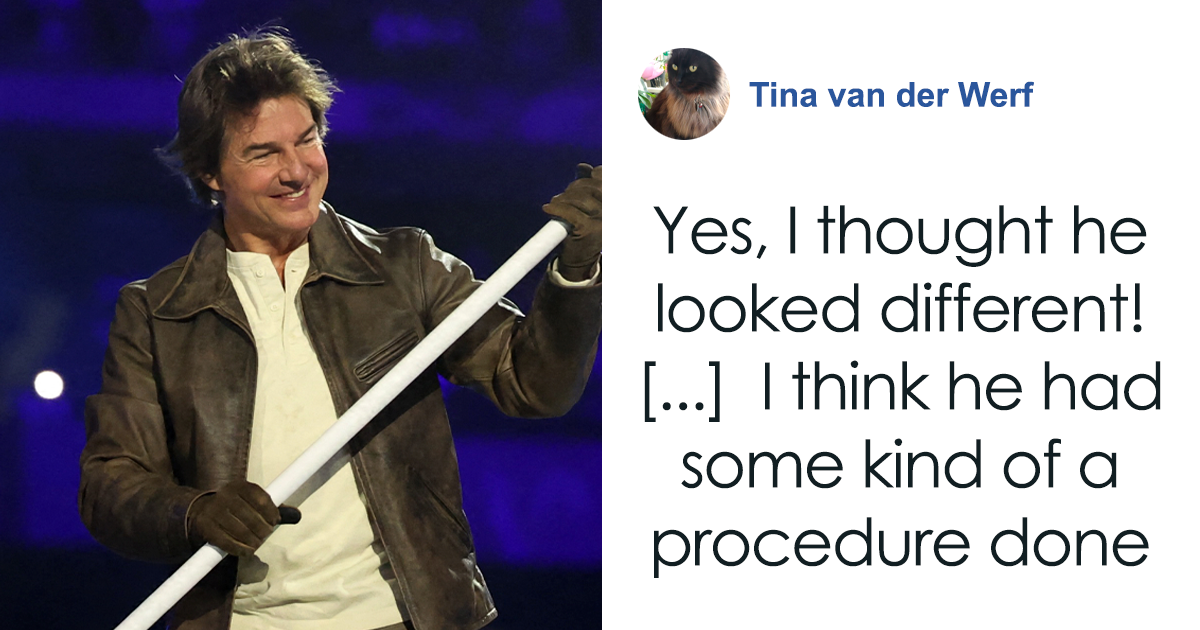
Searches for “Tom Cruise new face,” “Tom Cruise Olympics face,” and “Tom Cruise plastic surgery rumors” surged in celebrity chatter after the event. Some fans praised his energy at 62. Others said he looked different. A few went full internet detective, as if the Olympic flag had secretly contained a dermatology report. The result was a strange pop-culture split screen: one of the world’s biggest movie stars performed an elaborate Olympic handoff, and the internet squinted at his cheekbones.
The Olympic Stunt That Was Designed to Scream Hollywood
The Paris 2024 closing ceremony already had a difficult job. It needed to honor France, celebrate thousands of athletes, wrap up one of the most visually memorable Olympic Games in recent history, and begin the handoff to Los Angeles. That is a lot to fit into one evening, even before anyone says, “What if Tom Cruise flies in?”
The handoff sequence began with the traditional transfer of the Olympic flag. Los Angeles Mayor Karen Bass and gymnastics legend Simone Biles represented the United States on stage, symbolizing the move from Paris 2024 to LA28. Then the ceremony made its dramatic turn. Cruise appeared high above the stadium and descended into the venue, giving the moment the unmistakable flavor of a Mission: Impossible cold open.
From there, the segment shifted into classic Cruise territory. He accepted the flag, greeted athletes, attached the flag to a motorcycle, and sped away. The broadcast then moved into a pre-recorded sequence that sent him through Paris, onto a plane, and toward Los Angeles, where the Hollywood Sign became part of the Olympic imagery. By the time the flag reached a beachside celebration featuring major music stars, the message was obvious: Paris had elegance; Los Angeles was bringing cinema, celebrity, and maximum-volume showmanship.
Why Tom Cruise Was the Perfect Choice for LA28
There are many famous actors, but there are not many celebrities whose public brand is basically “insurance adjusters hate him.” Cruise has built the later phase of his career around doing the kind of stunts most people would avoid even in a video game. He has climbed skyscrapers, hung from planes, jumped motorcycles off cliffs, and generally behaved as if his retirement plan is a parachute and a grin.
That made him a natural ambassador for the Los Angeles handoff. LA is not just a city; it is an entertainment machine with palm trees. The Olympic Games returning to Southern California in 2028 gives organizers a rare opportunity to merge sports, movies, music, celebrity culture, and global tourism. Cruise represented that blend in one instantly recognizable package.
The stunt also matched his long-running image as a performer who refuses to let the audience see the seams. Reports after the ceremony emphasized that Cruise wanted to perform the major elements himself rather than rely entirely on doubles. Whether viewed as daring, obsessive, or very intense workplace enthusiasm, that commitment is a key reason his stunt work still generates headlines. In a media world full of green screens and digital polish, Cruise sells physical risk as an old-school movie-star currency.
Then Came the “New Face” Conversation
Yet the Olympic moment did not stay focused only on athletic symbolism or cinematic ambition. Soon after the broadcast, social media users began posting reactions to Cruise’s appearance. Some described him as looking unusually smooth. Others claimed he seemed “unrecognizable.” Many tossed around the usual celebrity-internet vocabulary: Botox, fillers, facelift, filters, lighting, makeup, age, camera angles, and the ever-popular “What happened?”
It is important to say this clearly: Tom Cruise has not publicly confirmed cosmetic surgery related to the Olympics appearance, and casual viewers cannot diagnose anything from a televised event. Lighting can change a face. Camera lenses can distort proportions. Makeup for high-definition broadcast can look different under stadium lights. A person can also simply age, lose weight, gain weight, retain water, sleep poorly, or stand under the world’s least flattering spotlight. The internet, however, is not known for saying, “Let’s wait for nuance.”
That is why the phrase “Tom Cruise’s new face” took off. It was simple, clickable, slightly rude, and perfectly built for the modern celebrity news cycle. In the old days, a star’s appearance might have been discussed in tabloids the next morning. Now, the commentary arrives in real time, wearing sweatpants, holding a phone, and typing at Olympic speed.
The Internet Loves a Face Mystery
Celebrity appearance speculation has become a sport of its own, complete with amateur analysts, side-by-side photos, and people who suddenly become experts in facial anatomy after two minutes on social media. Tom Cruise is far from the only target. Actors, singers, athletes, influencers, and even news anchors are routinely picked apart for looking older, younger, tired, refreshed, different, too natural, not natural enough, or somehow all of the above before breakfast.
Cruise’s case drew extra attention because his public image is tied so closely to control. He is known for precision: the perfect sprint, the perfect stunt, the perfect movie-star smile. When someone with that level of polish appears even slightly different to viewers, the internet treats it like a plot twist. The stunt was massive, but the face conversation felt more personal, more speculative, and more irresistible to online gossip.
There is also a deeper reason the reaction spread. Audiences have grown used to watching celebrities age in public while pretending not to age at all. A star is expected to remain familiar but fresh, mature but youthful, natural but flawless, human but suspiciously poreless. That is an impossible assignment. Even Ethan Hunt would reject it as unrealistic.
Was the Stunt Really Overshadowed?
In a strict news sense, the stunt was still the main event. Major outlets covered the Olympic handoff, the Hollywood Sign sequence, the flag transfer, and the LA28 symbolism. Sports fans discussed the transition from Paris to Los Angeles. Entertainment writers analyzed the production value. Olympic viewers remembered the ceremony’s blend of music, spectacle, and international celebration.
But in the attention economy, being the “main event” and being the “most discussed detail” are not always the same thing. Cruise’s performance generated admiration, but his appearance generated debate. Admiration tends to be straightforward: “That was cool.” Debate keeps people posting: “Did he look different?” “Was it lighting?” “Is everyone overreacting?” “Why are we like this?” And suddenly, the discourse has legs.
That is how a carefully staged Olympic stunt can be partially overshadowed by a close-up. The ceremony wanted viewers to think about Los Angeles 2028. Many did. But a noisy corner of the internet became fascinated by the way Cruise looked while delivering the message. In celebrity culture, the face is often treated as part of the performance, even when the performance involves rappelling into a stadium.
The Pop-Culture Meaning Behind the Reaction
The “new face” chatter says as much about audiences as it does about Cruise. People are increasingly aware of cosmetic procedures, photo editing, injectables, high-definition cameras, and celebrity image management. Viewers now look for signs. They compare screenshots. They analyze jawlines like sports commentators reviewing a replay.
At the same time, there is a strange unfairness in the way aging stars are judged. If an actor looks older, the internet says they “let themselves go.” If they look younger, people accuse them of getting work done. If they look exactly the same, people claim it must be artificial. The celebrity face has become a no-win group project, and everyone on social media has apparently assigned themselves team leader.
For Cruise, the attention is magnified because he has spent decades as a symbol of physical capability. He does not merely act in action movies; he markets them through his body. His running form, his stunts, his smile, and his refusal to slow down are all part of the brand. That makes any perceived change in appearance feel, to some viewers, like a change in the character they think they know.
Tom Cruise, Aging, and the Impossible Mission of Staying Familiar
Tom Cruise was born in 1962, which means he was 62 during the Paris 2024 Olympic closing ceremony. That fact alone should probably end half the online commentary. Most people at 62 are not jumping into stadiums. Many are pulling a hamstring while reaching for the TV remote. Cruise, meanwhile, was helping move the Olympic flag across continents in a sequence that looked like it had been approved by a committee of adrenaline.
Still, the public often struggles to let movie stars age normally. Cruise became famous as a young leading man in films such as Risky Business and Top Gun. He then spent decades evolving into an action star, dramatic actor, producer, and global box-office brand. Audiences have watched him across different eras of Hollywood, from glossy 1980s charisma to modern franchise spectacle. Because his career has been so long, different generations carry different mental images of him.
For some, Tom Cruise is Maverick in a flight jacket. For others, he is Ethan Hunt sprinting like the sidewalk owes him money. For younger audiences, he may be the rare older actor still headlining giant theatrical action films. When those mental images collide with a live broadcast close-up, viewers can react as if the star has changed overnight, even though the real story is that time has been doing its job one day at a time.
Why the Olympics Made the Reaction Bigger
The Olympics are not a normal red carpet. They are one of the few remaining live global television events where casual viewers, sports fans, celebrity watchers, and meme-makers all gather at once. That broad audience made Cruise’s appearance especially visible. A movie premiere might reach entertainment fans. The Super Bowl reaches another huge crowd. But the Olympic closing ceremony carries a rare international mix of viewers, and many of them were ready to post instantly.
The staging also mattered. Cruise’s entrance was dramatic, brightly lit, and designed for close-ups. The camera wanted his expression. The audience wanted the reaction. Social media wanted screenshots. In that environment, every frame becomes evidence for someone’s theory. A slightly odd angle can become a headline. A freeze-frame can become a thousand jokes.
That does not mean viewers were wrong to notice a difference. People notice faces; it is part of being human. But the speed with which noticing becomes diagnosing is where the conversation gets messy. Saying “he looked different to me” is one thing. Declaring exactly what caused that difference is another. The first is observation. The second is speculation wearing a lab coat it bought online.
The Stunt Still Worked
For all the chatter, the Olympic handoff achieved what it set out to do. It made people talk. It connected LA28 with Hollywood energy. It gave the closing ceremony a viral moment. It reminded viewers that Los Angeles knows how to stage a spectacle and that Tom Cruise remains unusually willing to risk his neck for entertainment.
The fact that the conversation split into two lanes may even prove the stunt’s effectiveness. People discussed the production, the music, the flag, the motorcycle, the Hollywood Sign, the skydiving, the celebrity cameos, and yes, Cruise’s appearance. In today’s media environment, a moment does not go viral because everyone talks about it in the same way. It goes viral because everyone finds an angle.
From an SEO perspective, that is why the phrase “Tom Cruise Olympics stunt” naturally overlaps with “Tom Cruise new face.” One keyword points to the event; the other points to the reaction. Together, they tell the full story of how modern celebrity coverage works. The stunt was physical. The reaction was digital. Both traveled fast.
What This Says About Celebrity Culture Now
The Cruise Olympics reaction is a perfect example of the modern fame trap. Celebrities are expected to deliver extraordinary entertainment while also looking exactly how the public remembers them. They must be superhuman enough to amaze us, but human enough not to alarm us. They must age gracefully, but not visibly. They must maintain their image, but not appear too maintained.
That contradiction fuels endless commentary. A star like Cruise becomes both performer and public puzzle. His body is praised for doing dangerous stunts; his face is analyzed for showing or not showing age. The same audience that applauds his physical commitment may also zoom in on his skin texture. It is admiration and surveillance, sometimes in the same sentence.
There is room for a better version of the conversation. We can discuss public image, celebrity branding, Hollywood beauty standards, and the pressures of aging in entertainment without pretending we know someone’s medical history. We can also admit the obvious: Cruise’s Olympics stunt was impressive, regardless of whether a screenshot launched a thousand group chats.
Experience-Based Reflection: Watching the Moment Like a Viewer, Not a Detective
One useful way to understand the “Tom Cruise new face” reaction is to imagine watching the closing ceremony in the most normal way possible: half paying attention, checking your phone, admiring the athletes, wondering whether you have snacks left, and then suddenly seeing Tom Cruise appear above a stadium like someone typed “Hollywood” into a fireworks machine.
At first, the response is simple. It is spectacle. Cruise descending into the Stade de France is the kind of TV moment that makes people look up from whatever they are doing. Even if you do not follow every Olympic tradition, you understand the visual language immediately. A famous actor is dropping into a historic stadium to carry the Olympic flag toward the next host city. It is dramatic, slightly absurd, and very American in the way only a motorcycle exit can be.
Then the camera gets closer. Maybe you notice he looks different. Maybe you do not. Maybe someone in the room says, “Is that Tom Cruise?” and someone else says, “Of course it is, who else would do this?” That is how many viewers experience celebrity moments now: the event and the commentary arrive together. You are not just watching the ceremony; you are watching people watch the ceremony.
Within minutes, the online conversation can change the way you remember what you saw. A person who originally thought, “That stunt was wild,” may start seeing posts about his appearance and go back to look again. Screenshots replace motion. A live performance becomes a still image. A face that was part of a fast-moving sequence becomes the entire subject. That is the strange power of social media: it can pause a moving body and turn it into an argument.
In that sense, the experience around Cruise’s Olympics appearance reveals how difficult it is to watch anything innocently anymore. A stunt is not just a stunt. It is content. It is a meme. It is a beauty-standard debate. It is an SEO trend. It is a celebrity-aging discourse. It is a comments-section bonfire with a tiny Olympic torch stuck in the middle.
The more generous viewing experience is also the more interesting one. You can notice that Cruise looked different to some people without turning the observation into a verdict. You can laugh at the over-the-top Hollywood handoff without mocking someone’s age. You can admire the physical ambition of the performance while recognizing that celebrity culture often asks impossible things from the people it celebrates.
There is also something oddly fitting about the whole situation. Tom Cruise has spent much of his career making the impossible look smooth. The Olympics stunt was another example of that brand: a high-risk, high-control, high-visibility performance designed to make viewers gasp. But the “new face” reaction reminded everyone that even the most controlled public image can be hijacked by audience perception. You can plan the stunt, rehearse the timing, coordinate the cameras, and still wake up to headlines about your face.
For readers, writers, and culture watchers, the lesson is clear. The real story is not just whether Tom Cruise looked different. The real story is why so many people cared, why the conversation moved so quickly, and why appearance can overshadow achievement even when the achievement involves flying through an Olympic ceremony like a man who misplaced his fear response.
In the end, Cruise’s Olympic moment was both a successful stunt and a revealing media event. It promoted LA28. It gave the Paris closing ceremony a Hollywood exclamation point. It showed that Cruise remains one of the few stars who can turn a ceremonial handoff into an action sequence. And it proved, once again, that the internet can watch a man rappel into a stadium and still ask, “Yes, but what moisturizer is this?”
Conclusion
Tom Cruise’s Olympics stunt was built to be unforgettable, and it was. The Paris 2024 closing ceremony handed the Olympic spotlight to Los Angeles with a sequence full of speed, symbolism, and old-fashioned movie-star nerve. Yet the public reaction also showed how modern celebrity moments rarely stay on script. Instead of focusing only on the flag, the motorcycle, or the Hollywood Sign, many viewers became fixated on Cruise’s appearance and the idea of a “new face.”
That reaction says less about one actor’s face than it does about the culture watching him. We live in a time when every public appearance becomes a close reading, every close-up becomes a screenshot, and every screenshot becomes a theory. Cruise may have delivered the Olympic flag, but the internet delivered the discourse. Mission accomplished, with side effects.