
The W76-2 nuclear weapon is one of the most debated additions to the modern U.S. nuclear arsenal. It is not the biggest nuclear warhead, not the newest submarine missile, and not the kind of headline-grabbing superweapon that comes with flashy animations and dramatic music. Instead, the W76-2 is controversial because of what it represents: a lower-yield nuclear option placed on a submarine-launched ballistic missile, a platform traditionally associated with strategic deterrence and massive retaliation.
In plain English, the W76-2 is a modified version of the W76-1 warhead, designed for use with the Navy’s Trident II D5 submarine-launched ballistic missile. Its yield is publicly described by many analysts as “low-yield,” meaning far less explosive power than standard strategic warheads carried by the same general missile family. But “low-yield” is a strange phrase when the subject is nuclear weapons. It is a little like calling a hurricane “breezy.” Smaller does not mean small, and limited does not mean safe.
The W76-2 entered the public policy conversation after the 2018 Nuclear Posture Review, which argued that the United States needed a prompt, survivable, lower-yield option to deter limited nuclear use by adversaries. Supporters say it strengthens deterrence by closing a perceived gap. Critics say it lowers the nuclear threshold and could increase the risk of miscalculation. The result is a weapon that is physically small compared with some strategic warheads, but politically enormous.
What Is the W76-2 Nuclear Weapon?
The W76-2 is a low-yield nuclear warhead deployed on submarine-launched ballistic missiles, commonly associated with the Trident II D5 system. It belongs to the broader W76 family of U.S. nuclear warheads, which has been part of the sea-based leg of the American nuclear triad for decades.
The original W76 was developed during the Cold War for submarine-launched missiles. Later, the W76-1 life extension program refurbished older W76-0 warheads, improving safety, reliability, and service life. The W76-2 emerged as a modification of that W76-1 line, intended to provide a lower-yield option without creating an entirely new weapon from scratch.
Why “Low-Yield” Does Not Mean “Low-Stakes”
The term “low-yield nuclear weapon” can mislead casual readers. In nuclear policy, “low-yield” usually means lower explosive power compared with large strategic warheads. It does not mean minor damage, limited consequences, or anything remotely similar to a conventional weapon. A nuclear detonation, even at a lower yield, would carry devastating blast, heat, radiation, political, humanitarian, and environmental consequences.
That is why the W76-2 nuclear weapon generates such intense debate. Its supporters focus on deterrence logic: adversaries must believe the United States has credible options at every level of escalation. Its critics focus on escalation danger: making a nuclear weapon appear more “usable” may make nuclear war more thinkable. And if there is one thing civilization does not need, it is nuclear war with better branding.
How the W76-2 Fits Into the U.S. Nuclear Triad
The U.S. nuclear triad consists of land-based intercontinental ballistic missiles, strategic bombers, and submarine-launched ballistic missiles. Each leg has a different purpose. Bombers can be visible and recallable. Land-based missiles are fast and hardened. Ballistic missile submarines are valued for stealth and survivability.
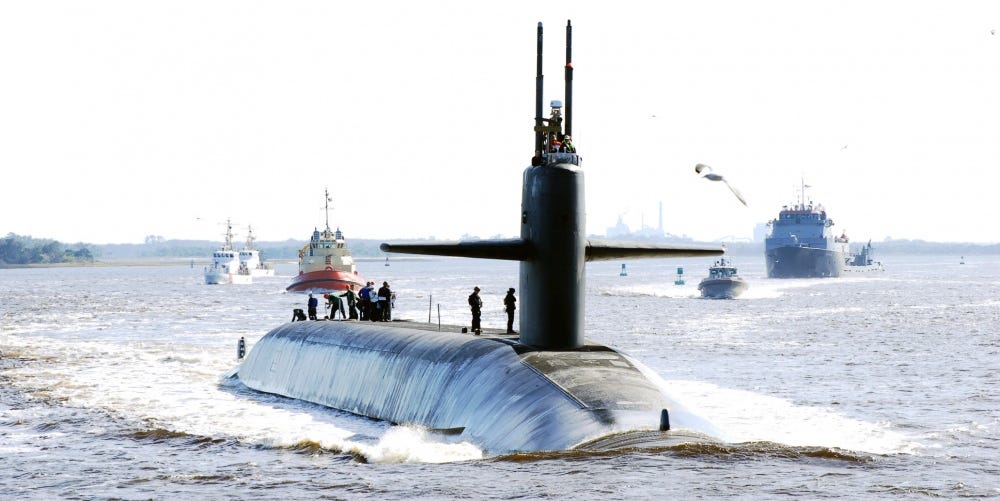
The W76-2 belongs to the sea-based leg, which many experts consider the most survivable part of the triad. Ohio-class ballistic missile submarines can patrol quietly beneath the ocean, making them difficult to locate. That survivability supports the concept of assured second strike: even if an enemy attacked first, the United States could still respond. This logic is grim, but it has shaped nuclear strategy for generations.
The Trident II D5 Connection
The Trident II D5 missile is a submarine-launched ballistic missile used by the U.S. Navy and also by the United Kingdom under long-standing arrangements. In U.S. service, it can carry multiple nuclear reentry bodies, including W76 and W88 warheads. The W76-2 gives this strategic delivery system a lower-yield option.
That pairing is exactly why the debate gets complicated. A Trident launch looks like a Trident launch. An adversary watching a ballistic missile rise from the ocean may not know whether it carries a lower-yield W76-2 or a higher-yield warhead. In a crisis, uncertainty can be dangerous. Nuclear strategy has many problems, and “please guess correctly while under attack” is certainly one of the worst.
Why Was the W76-2 Developed?
The official rationale for the W76-2 came from concerns about limited nuclear use by adversaries, especially Russia. U.S. policy documents argued that some competitors might believe they could use a small number of non-strategic or lower-yield nuclear weapons in a regional conflict to force the United States and its allies to back down. This is often described as “escalate to de-escalate,” although analysts continue to debate how accurately that phrase reflects Russian doctrine.
The 2018 Nuclear Posture Review said the United States would modify a small number of existing submarine-launched ballistic missile warheads to provide a prompt low-yield option. The idea was not to build a giant new class of weapons, but to create a near-term supplement to existing forces. In policy language, the W76-2 was meant to strengthen regional deterrence. In kitchen-table language, it was meant to tell adversaries: “Do not assume America has no credible response to limited nuclear use.”
The Deterrence Argument
Supporters of the W76-2 argue that deterrence depends on credibility. If an adversary believes the United States would hesitate to respond to a limited nuclear strike with a high-yield strategic weapon, that adversary might see an exploitable gap. A lower-yield SLBM warhead, supporters say, removes that temptation.
They also argue that a submarine-launched option is more survivable than aircraft-delivered nuclear weapons, which may have to fly through advanced air defenses. Because ballistic missile submarines are difficult to detect, the W76-2 offers a prompt and survivable response option. In this view, the weapon does not lower the nuclear threshold; it raises the confidence that nuclear use by an adversary would fail.
The Criticism
Opponents see the same facts and reach the opposite conclusion. They argue that placing a lower-yield nuclear warhead on a strategic missile blurs the line between limited and large-scale nuclear war. Since an adversary cannot easily know what kind of warhead is incoming, a launch intended as “limited” could be interpreted as the start of a major strategic attack.
Critics also say the United States already has flexible nuclear options, including aircraft-delivered systems with variable yields. From their perspective, the W76-2 is redundant, risky, and politically destabilizing. They worry that the phrase “low-yield” makes nuclear use sound more controllable than it really is. History has repeatedly shown that wars are excellent at ignoring the tidy theories written about them.
Production and Deployment Timeline
The W76-2 moved quickly from policy proposal to fielded capability. After the 2018 Nuclear Posture Review called for the weapon, the National Nuclear Security Administration worked on the modification through the existing nuclear weapons production complex. The first production unit was completed at the Pantex Plant in Texas in 2019.
By early 2020, the Department of Defense confirmed that the U.S. Navy had fielded the W76-2 low-yield submarine-launched ballistic missile warhead. Reports from arms-control researchers indicated that the first deployment involved the USS Tennessee, an Ohio-class ballistic missile submarine based at Kings Bay, Georgia. The exact number of deployed W76-2 warheads remains classified, though outside estimates often describe the quantity as small.
This fast timeline was part of the weapon’s selling point. Because it was a modification of an existing warhead rather than a clean-sheet design, advocates described it as comparatively quick and cost-effective. Whether “quick and cost-effective nuclear weapon” should be comforting is, naturally, a matter of perspective.
W76-2 vs. W76-1: What Is the Difference?
The W76-1 is a modernized version of the older W76-0 warhead. It was produced through a life extension program designed to keep the warhead safe, secure, and reliable without underground nuclear explosive testing. The W76-2 is derived from the W76-1 but configured for a lower explosive yield.
The most important difference for readers is not a technical blueprint, but a strategic role. The W76-1 is a standard strategic warhead for submarine-launched ballistic missiles. The W76-2 is intended to provide a lower-yield option for deterrence scenarios involving limited nuclear use. One is part of the traditional strategic deterrent; the other is a tailored response tool built into the same broad sea-based system.
A Weapon of Policy More Than Hardware
Most public debates about the W76-2 are not really about engineering. They are about strategy, signaling, alliance assurance, escalation control, and whether nuclear deterrence is strengthened or weakened by adding more flexible options. The hardware matters, but the policy message matters more.
That makes the W76-2 a classic example of how nuclear weapons are never just weapons. They are messages. They are bargaining chips. They are insurance policies written in terrifying ink. And because they exist in the minds of adversaries as much as in military inventories, interpretation can be as important as capability.
The Role of the W76-2 in U.S. Nuclear Policy
The W76-2 survived a change in administrations. While the Biden administration’s 2022 Nuclear Posture Review canceled the proposed nuclear-armed sea-launched cruise missile program, it retained the W76-2, saying it currently provides an important means to deter limited nuclear use. The review also stated that the weapon’s deterrent value would be reassessed as other systems, such as the F-35A with the B61-12 and the Long-Range Standoff weapon, enter the force.
This matters because it shows the W76-2 is not merely a one-administration footnote. It has become part of the broader debate over how the United States should deter Russia, China, and other nuclear risks in an era of renewed great-power competition. Even officials who may dislike some aspects of the weapon have had to weigh it against current threats, allied reassurance, and modernization timelines.
Russia, China, and the “Limited Nuclear Use” Problem
Russia remains central to the W76-2 debate because of its large and diverse nuclear arsenal, including non-strategic nuclear weapons. U.S. policy documents have expressed concern that Russia might use nuclear threats or limited nuclear employment to shape a regional conflict. The W76-2 is intended to reduce confidence in that strategy.
China’s nuclear modernization has also become more important in U.S. planning. As China expands and diversifies its nuclear forces, the United States is reassessing deterrence requirements for a world with two major nuclear competitors. The W76-2 is not a China-specific weapon, but it is part of a larger discussion about flexible deterrence in a more complex strategic environment.
Arguments in Favor of the W76-2
Supporters of the W76-2 nuclear weapon usually make four main arguments. First, they say it strengthens deterrence by making U.S. response options more credible. Second, they say it reassures allies who live close to nuclear-armed rivals. Third, they say it complicates adversary planning by denying any safe path for limited nuclear escalation. Fourth, they say it was a relatively low-cost modification compared with building a completely new system.
From this perspective, the W76-2 is less about fighting a nuclear war and more about preventing one. Its purpose is to convince adversaries that any nuclear use, even at low yield, would fail to produce political advantage. In deterrence theory, credibility can prevent catastrophe. The trouble, of course, is that credibility in nuclear strategy is like seasoning in cooking: too little may fail, too much may ruin the whole dish.
Arguments Against the W76-2
Critics argue that the W76-2 may make nuclear use seem more plausible. They worry that a president could view a lower-yield submarine-launched warhead as a more “usable” nuclear option in a crisis. Even if the intention is deterrence, the existence of a weapon can shape planning, expectations, and crisis behavior.
Another concern is ambiguity. A Trident II D5 missile launch would be detected as a strategic ballistic missile launch. The target country may not know whether the incoming missile carries a W76-2 or a much more powerful warhead. In a nuclear crisis, that uncertainty could push decision-makers toward worst-case assumptions.
Critics also question whether escalation can be controlled after any nuclear use. The idea of a limited nuclear exchange may look neat in a policy paper, but real conflicts include fear, incomplete information, damaged communications, domestic pressure, and leaders who may not calmly follow the escalation ladder like they are reading a hotel fire-exit map.
Why the W76-2 Matters Beyond the Military
The W76-2 matters because it forces the public to confront uncomfortable questions about nuclear deterrence. How much flexibility is enough? Does a lower-yield option prevent war or make nuclear war easier to imagine? Can a country signal limited intent with a weapon delivered by a strategic missile? What do allies need for reassurance, and what do adversaries perceive as provocation?
These are not abstract questions for think tanks alone. Nuclear weapons policy affects budgets, diplomacy, arms control, alliance politics, and global security. A single warhead type can become a symbol of a much larger debate: whether the world is moving toward more tailored deterrence or toward a more dangerous normalization of nuclear options.
Experience-Based Takeaways: How to Understand the W76-2 Debate
For students, readers, defense observers, and anyone trying to make sense of the W76-2 nuclear weapon, the most useful experience is learning to separate three things that often get mashed together: capability, strategy, and rhetoric. Capability asks what the weapon can generally do. Strategy asks why leaders believe it is needed. Rhetoric asks how supporters and opponents frame it for public debate. The W76-2 sits right at the intersection of all three, which is why discussions about it can become heated faster than a microwave burrito.
One helpful way to study the W76-2 is to compare official policy statements with arms-control critiques. The official documents emphasize deterrence, survivability, flexibility, and allied assurance. They present the weapon as a limited supplement designed to prevent adversaries from thinking they can use nuclear weapons first and get away with it. Arms-control critics emphasize ambiguity, escalation risk, and redundancy. They argue that the United States already has lower-yield options and that using a strategic missile for a limited nuclear role creates dangerous uncertainty.
Another practical lesson is to avoid taking the phrase “low-yield” at face value. In ordinary language, “low” sounds mild. In nuclear language, it still means catastrophic. When reading about the W76-2, a responsible reader should mentally replace “low-yield” with “lower-yield nuclear weapon” to keep the stakes clear. That small wording shift helps prevent the biggest misunderstanding in the debate: the idea that smaller nuclear weapons are somehow ordinary military tools.
A third lesson is that nuclear weapons are deeply tied to perception. The W76-2 was created partly to influence what adversaries believe about U.S. resolve. But perception cuts both ways. The United States may intend the weapon as a stabilizing deterrent, while an adversary may see it as evidence that Washington is preparing for limited nuclear war. This is the eternal frustration of nuclear signaling: you can send a message, but you cannot fully control how the other side reads it.
Finally, the W76-2 teaches that nuclear policy rarely offers clean answers. Supporters are not automatically reckless, and critics are not automatically naïve. Both sides are wrestling with genuine dangers. The supporter fears deterrence failure. The critic fears escalation failure. The hard part is that both fears can be reasonable at the same time. Understanding the W76-2 means sitting with that discomfort rather than trying to escape it with slogans.
Conclusion: The W76-2 Is Small in Yield, Big in Meaning
The W76-2 nuclear weapon is more than a modified warhead. It is a case study in modern nuclear strategy, where deterrence, credibility, escalation risk, and political signaling collide. Supporters view it as a necessary response to limited nuclear threats from adversaries. Critics view it as a dangerous step that could blur the line between conventional war, limited nuclear use, and strategic nuclear catastrophe.
What makes the W76-2 so important is not simply its explosive yield, but its role on a submarine-launched ballistic missile. That combination gives it survivability and promptness, but also creates ambiguity. In a crisis, ambiguity can deter. It can also terrify. Nuclear policy lives in that narrow, uncomfortable space.
For readers trying to understand the future of nuclear deterrence, the W76-2 is essential. It shows how the United States is adapting its arsenal for a world of renewed great-power rivalry, advanced air defenses, alliance anxieties, and fears of limited nuclear escalation. It also reminds us that every “limited” nuclear option carries unlimited moral and strategic weight. The W76-2 may be described as low-yield, but the debate around it is anything but low-impact.