
Some wildlife photos make you whisper, “Wow.” Pedro Jarque Krebs’ animal portraits make you lean toward the screen like the creature might blink first. In Wild Animals From Up Close: 32 Portraits By Pedro Jarque Krebs, the Peruvian fine art photographer presents wildlife not as background decoration, safari trophies, or “look what I saw on vacation” proof. He presents animals as personalities. Faces. Moods. Mysteries. In other words, the kind of subjects who clearly have opinions about your outfit.
Known for dramatic black backgrounds, luminous detail, expressive eyes, and close-up compositions, Pedro Jarque Krebs has built a distinctive place in wildlife photography. His work often feels like classic studio portraiture, except the sitter may be a jaguar, a flamingo, a bat, a bongo, a manatee, a golden snub-nosed monkey, or a bird that looks as if it has just remembered a very important royal appointment.
What makes these 32 wildlife portraits so memorable is not only technical beauty. It is the emotional switch they flip. Instead of showing animals as distant “species,” Jarque Krebs shows them as individuals. The result is intimate, theatrical, funny, elegant, and quietly urgent. These portraits are gorgeous, yes, but they also ask a serious question: if we can see so much character in a face, how can we pretend the life behind it does not matter?
Who Is Pedro Jarque Krebs?
Pedro Jarque Krebs is a Lima-born, award-winning photographer best known for fine art animal portraits. His academic background in philosophy and art history helps explain why his photographs often feel less like quick wildlife snapshots and more like visual essays. He is not simply documenting what an animal looks like; he is asking how we look at animals, what we project onto them, and what we fail to see when we reduce wild creatures to labels.
Over decades, Jarque Krebs has received major international recognition, including honors connected with the Sony World Photography Awards, Bird Photographer of the Year, Siena Awards, International Photography Awards, PX3 Prix de la Photographie Paris, and other respected competitions. His books, including Fragile and WildLOVE, explore animal dignity, vulnerability, consciousness, and the emotional relationships that exist throughout the natural world.
That philosophical thread matters. Many photographers capture movement: the chase, the leap, the splash, the wingspan. Jarque Krebs often does something different. He removes much of the environmental context and gives the animal a stage. The dark background becomes silence. The face becomes the story. The viewer has nowhere to hide, which is awkward if you were hoping to casually scroll while eating cereal.
Why These 32 Wild Animal Portraits Feel So Close
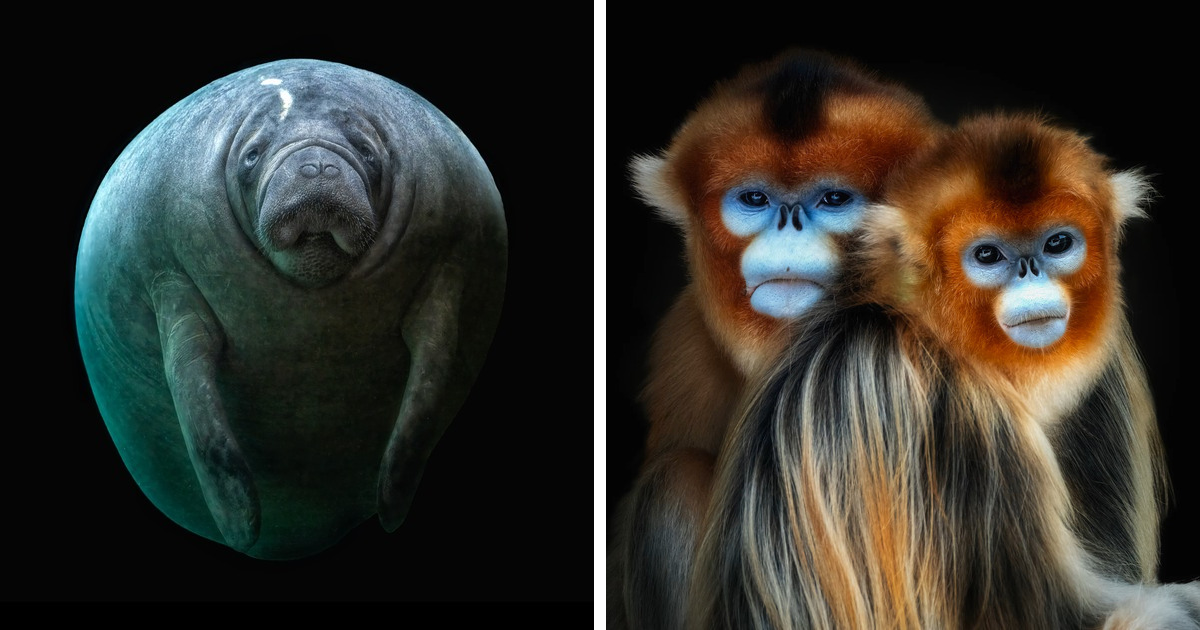
The phrase “from up close” does not only refer to physical distance. In these portraits, closeness is emotional. A manatee appears soft and ancient, like a floating philosopher who has seen enough nonsense for one lifetime. Golden snub-nosed monkeys stare with a mixture of mischief and melancholy. A jaguar’s gaze can feel electric, not because it is roaring, but because it is simply present. Even birds, which often become flashes of color in wildlife photography, appear here as self-contained characters with posture, attitude, and theatrical flair.
1. The Black Background Creates Instant Drama
One of Jarque Krebs’ signature techniques is isolating animals against a dark or black background. This choice removes visual distractions and gives each subject the gravity of a painted portrait. The viewer is not studying a habitat, a landscape, or a busy scene. The viewer is studying a face. It is the animal-world version of walking into a room and finding one spotlight aimed at the most interesting guest.
This approach also invites comparison with classical portraiture. The lighting can feel Baroque: deep shadow, bright highlights, rich contrast, and a sense that the subject has been waiting patiently for history to notice it. A flamingo becomes sculptural. A big cat becomes royal. A primate becomes uncomfortably familiar. The technique turns wildlife photography into fine art without stripping away the animal’s wildness.
2. The Eyes Carry the Story
Human beings are wired to search for faces and read eyes. Jarque Krebs uses that instinct brilliantly. His animal portraits often center attention on the subject’s gaze, allowing viewers to sense curiosity, patience, suspicion, calm, or comic confusion. Of course, we should be careful not to over-humanize wild animals. A monkey is not “basically your coworker before coffee,” even if the expression is convincing. But good animal portraiture can still reveal individuality without turning wildlife into cartoons.
In these 32 portraits, the eyes are not decorative details. They are entry points. A bongo’s calm face suggests grace and alertness. Bats become less spooky when seen as living, sensitive creatures rather than Halloween props with wings. An elephant’s expression can feel both gentle and immense, while a lion cub may appear innocent without losing the fact that it belongs to a powerful species. The best portraits balance charm with respect.
3. The Animals Become Subjects, Not Objects
That is the quiet power of Jarque Krebs’ work. His portraits do not say, “Look at this exotic animal.” They say, “Look at this being.” The difference is enormous. A subject has presence. A subject looks back. A subject demands more than admiration; it demands consideration.
This is why his photography connects so naturally with conservation. Global wildlife populations have faced severe pressure from habitat loss, climate change, pollution, overexploitation, invasive species, and other human-driven threats. When a portrait makes an animal feel close, the conservation conversation becomes less abstract. It is no longer only about “biodiversity,” a word that can sound like it belongs in a government report wearing sensible shoes. It becomes about lives with texture, emotion, and irreplaceable beauty.
The Artistic Style: Where Wildlife Meets Fine Art
Pedro Jarque Krebs’ wildlife photography is often described as studio-like, but that does not mean the animals are turned into props. Instead, the studio feeling comes from composition, controlled contrast, careful editing, and an emphasis on expression. His images may darken or simplify the background, refine light and shadow, and highlight the natural drama already present in the animal’s form.
In traditional wildlife photography, context is king. The animal is shown in its environment: a wolf crossing snow, a bird over wetlands, a tiger hidden in grass. Jarque Krebs often reverses that formula. He strips context down until the animal itself becomes the landscape. Feathers become architecture. Fur becomes weather. Eyes become geography. It is close-up wildlife portrait photography with a painter’s sense of mood.
Color, Texture, and Personality
One reason these portraits work so well online is that they are instantly readable. On a phone screen, where most images must fight for attention against recipes, memes, and somebody’s vacation sandwich, Jarque Krebs’ black-background animal portraits stop the thumb. Bright feathers, wet noses, patterned fur, wrinkled skin, and glossy eyes stand out with unusual clarity.
Texture plays a huge role. The leathery softness of a manatee, the silky fur of primates, the polished curve of a bird’s beak, or the dense coat of a big cat all become visual events. The viewer notices details that might vanish in a wider scene. Suddenly, the animal is not just “a species.” It is a portrait subject with wrinkles, whiskers, eyelashes, scars, colors, and expressions. Nature, it turns out, has an excellent design department.
Why These Portraits Connect With Modern Audiences
There is a reason animal portraits perform so strongly on visual platforms. People love animals, but they also love personality. Jarque Krebs’ work sits at the intersection of both. His portraits are sophisticated enough for galleries and accessible enough for casual viewers. You do not need a degree in photography to understand the appeal of a monkey looking like it knows your password.
At the same time, the work avoids becoming merely cute. Cuteness is easy. Dignity is harder. These portraits can be humorous, but they do not mock the animals. They allow strangeness, beauty, elegance, awkwardness, and seriousness to coexist. That emotional range gives the collection its staying power.
The Conservation Message Behind the Beauty
Wildlife photography has always carried a double responsibility: to delight and to remind. The delight pulls us in. The reminder asks what happens next. Jarque Krebs’ work encourages viewers to think about fragility, not through shock or guilt, but through connection. The animals look vivid, alive, and individual. That makes the possibility of their disappearance feel more personal.
Ethical wildlife photography also matters here. Responsible photographers avoid disturbing animals, baiting them irresponsibly, revealing sensitive locations, stressing nests or young, or forcing behavior for a dramatic image. The best wildlife photography respects the animal first and the photograph second. In a world where social media sometimes rewards risky behavior, that principle is not optional. It is the difference between admiration and exploitation.
Memorable Types of Portraits in the Collection
While each image in the 32-portrait series stands on its own, several types of subjects help explain the richness of the collection.
Primates: The Uncomfortable Mirror
Primates are among the most emotionally charged subjects in animal photography because their faces feel familiar. Golden snub-nosed monkeys, apes, and other primates can appear thoughtful, amused, skeptical, or solemn. Whether those are human interpretations or not, the effect is powerful. We see kinship. We see difference. We see a face that refuses to be background noise.
Big Cats: Power Without the Roar
Big cats often appear in wildlife media as symbols of speed, danger, and dominance. Jarque Krebs’ portraits can show that power without relying on action. A jaguar or lion does not need to leap to command attention. Stillness can be more intense. The face alone carries muscle, instinct, patience, and ancient confidence. Basically, the animal equivalent of entering a meeting and not needing to say anything.
Birds: Color With Character
Bird portraits in this style can be spectacular because plumage reacts beautifully to dramatic light. Flamingos, parrots, owls, and other birds offer shape, color, and posture that feel almost sculptural. A bird’s expression may be harder for humans to read than a mammal’s, but that mystery can make the portrait even more fascinating.
Unusual Creatures: The Stars We Forget
Not every unforgettable wildlife portrait needs a lion or eagle. Manatees, bats, reptiles, amphibians, and lesser-known mammals often steal the show because they feel less familiar. Jarque Krebs’ approach gives these animals the same visual importance as more famous species. That is a valuable artistic choice. Conservation cannot only care about the charismatic celebrities of the animal kingdom. The weird, quiet, slippery, leathery, nocturnal, and slightly funny-looking creatures also deserve the spotlight.
What Photographers Can Learn From Pedro Jarque Krebs
Even if you are not planning to photograph a jaguar anytime soonand honestly, your house cat may already be enough of a management challengethere are useful lessons in Jarque Krebs’ work.
Focus on Expression, Not Just Sharpness
A technically sharp image is important, but it is not the whole story. The best animal portraits feel alive because they capture timing, gesture, and expression. A slight head tilt, a direct gaze, a raised brow ridge, or a quiet pause can transform a good image into a memorable one.
Use Simplicity to Create Impact
Busy backgrounds can weaken a portrait. Jarque Krebs’ dark backgrounds demonstrate the power of subtraction. Removing distractions allows viewers to notice form, light, and emotion. This principle applies to pet photography, bird photography, zoo photography, and even human portraits.
Respect the Subject
Whether photographing animals in reserves, sanctuaries, controlled settings, or the wild, the subject’s welfare should come first. A photo is never worth causing stress, injury, or behavioral disruption. Respectful distance, patience, and knowledge of animal behavior are essential. The animal does not owe anyone a pose. Wildlife is not customer service.
Why This Series Works as SEO-Friendly Visual Storytelling
From a publishing perspective, Wild Animals From Up Close: 32 Portraits By Pedro Jarque Krebs is the kind of topic that naturally attracts search interest. It combines wildlife photography, animal portraits, fine art photography, conservation, and a named artist with a recognizable style. Readers may arrive because they love animals, photography, visual art, nature, or unusual internet galleries. Once there, they find a topic with both instant visual appeal and deeper meaning.
The strongest content around this subject should not simply say, “Here are beautiful animal pictures.” That is true, but too thin. A richer article explains why the images feel intimate, how the black-background technique changes the viewer’s perception, what makes animal portraiture different from traditional wildlife photography, and why conservation is part of the emotional experience.
That is exactly why Jarque Krebs’ portraits endure beyond a quick scroll. They are not just pretty. They are sticky. The faces remain in memory. The viewer may forget the article headline, the browser tab, or the snack they were definitely not supposed to eat at midnight. But the eyes of the animals linger.
Experiences and Reflections: Meeting Wildlife Through Portraits
Looking at Pedro Jarque Krebs’ animal portraits can feel surprisingly personal. At first, the experience is visual: the black background, the gleaming eyes, the textures, the almost royal posture of the subjects. But after a few images, something shifts. You stop thinking, “What animal is this?” and start thinking, “Who is this?” That is the magic trick, and it is a meaningful one.
Many people first encounter wildlife through screens, books, zoos, documentaries, or short clips online. The problem is that modern viewing habits can make animals feel disposable. We scroll past a tiger, a turtle, a bear, and a parrot in ten seconds, then move on to a recipe for banana bread. Jarque Krebs’ portraits resist that speed. They ask the viewer to slow down. A single face fills the frame. There is no dramatic chase scene, no narrator whispering urgently, no sweeping music telling us how to feel. There is only the animal and the uncomfortable realization that it has been looking back the whole time.
That experience can change how someone thinks about wildlife. A bat, for example, is often treated as a symbol of fear. In a close portrait, it becomes delicate, complex, and oddly elegant. A manatee may seem comical at first glance, but up close its face suggests gentleness and age. A primate’s expression may make viewers laugh, then pause, because the resemblance to human moods is almost too strong. A bird’s feathers may initially dazzle with color, but its posture and gaze can make it feel like a character from a grand old painting.
These portraits also create a useful kind of humility. Humans like to imagine ourselves as the main characters of Earth. We build cities, name everything, make documentaries, and occasionally congratulate ourselves for using reusable bags. But a powerful animal portrait reminds us that the planet is crowded with other forms of intelligence, perception, instinct, and beauty. Their lives are not side notes to ours. They are parallel stories, many of them older than our civilizations and far less impressed by our parking lots.
For photographers and art lovers, the experience is also a lesson in patience. Jarque Krebs’ work shows that a strong portrait is not always about action. Sometimes the deepest drama is stillness. The animal does not need to roar, fly, leap, or bare its teeth. A quiet face can carry enough tension to hold attention longer than spectacle. That is a valuable reminder in a visual culture addicted to speed.
For families, teachers, and young readers, these portraits can become a doorway into conservation conversations. Instead of beginning with statistics, begin with a face. Ask what details stand out. Ask what the animal might need to survive. Ask why its habitat matters. Ask what human choices might threaten or protect it. Suddenly, conservation becomes less like homework and more like responsibility. The animal is no longer an abstract example. It is someone the viewer has, in a small but memorable way, met.
The best experience of viewing Wild Animals From Up Close is not simply admiration. It is recognition. These animals are beautiful, strange, funny, serious, fragile, and alive. Pedro Jarque Krebs gives them the visual dignity of kings, comedians, philosophers, dancers, and quiet witnesses. And once you have looked closely, it becomes harder to look away.
Conclusion
Wild Animals From Up Close: 32 Portraits By Pedro Jarque Krebs celebrates the rare power of wildlife portrait photography to make animals feel immediate, individual, and unforgettable. Through black backgrounds, dramatic lighting, expressive detail, and a fine art approach, Jarque Krebs transforms wild creatures into portrait subjects with presence and dignity. His work is beautiful enough to stop a casual viewer and thoughtful enough to invite deeper reflection on conservation, animal consciousness, and the fragile future of wildlife.
These 32 portraits remind us that the animal kingdom is not only diverse; it is personal. Each face carries a different energy. Some are majestic, some comic, some tender, some mysterious. Together, they form a gallery of lives that deserve more than passing attention. In a noisy digital world, Pedro Jarque Krebs gives wild animals something precious: a moment of stillness in which we can finally meet their gaze.
Note: This article is an original, fully rewritten synthesis based on reputable photography, conservation, art, and wildlife references, created for web publication without copied source text.