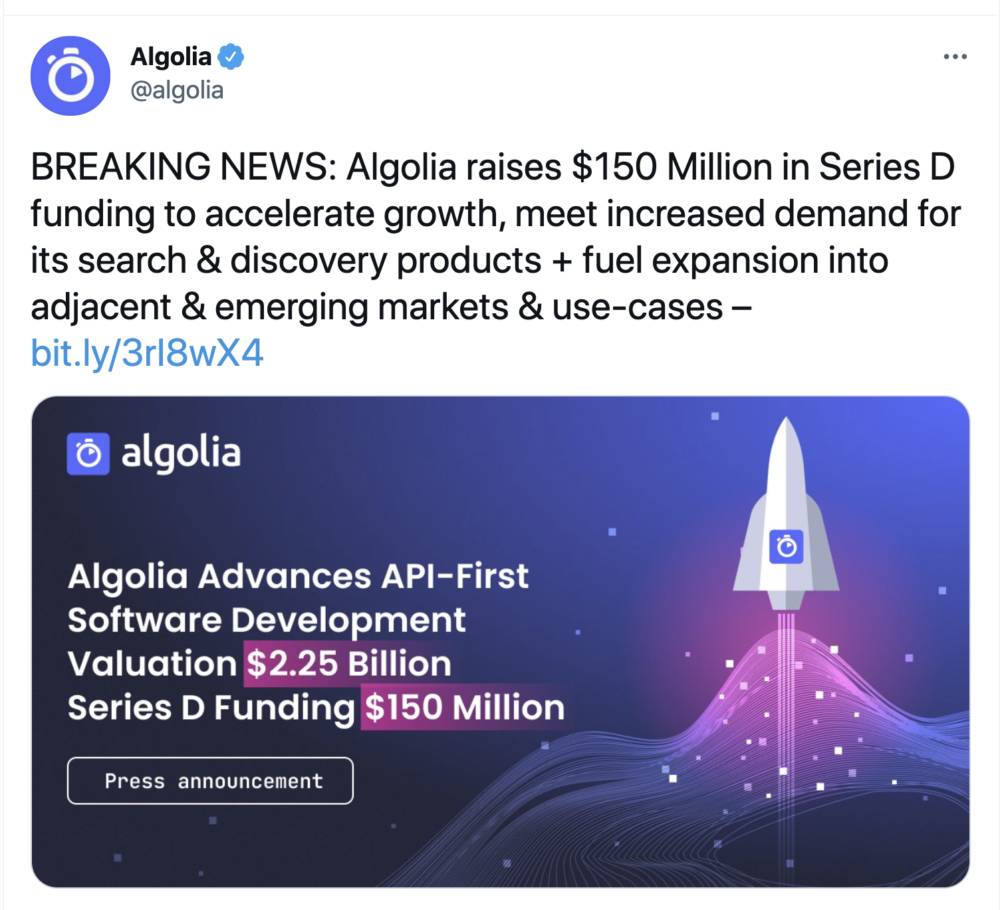

When Algolia reached a $2.25 billion valuation after raising $150 million in Series D funding, the obvious headline was “search startup becomes unicorn.” Nice, shiny, very Silicon Valley. But the more useful story is not the valuation itself. Valuations are like gym mirrors: flattering under the right lighting, dangerous when used as a business plan.
The real story is what Algolia’s rise teaches founders, product teams, investors, and SaaS operators about building a company around something many people once considered boring: site search. Not social media. Not crypto. Not a productivity app that promises to “change work forever” and then adds another inbox. Search.
Algolia showed that a narrow technical problem can become a massive market when the product is fast, developer-friendly, reliable, and tied directly to business outcomes. It also proved that infrastructure companies do not need to sound sexy at the beginning. They need to solve a painful problem so well that customers forget how painful life used to be.
What Is Algolia, Really?
Algolia is best known as an API-first search and discovery platform. In plain English, it helps companies add fast, relevant, customizable search to websites, apps, ecommerce stores, SaaS dashboards, documentation hubs, and digital products.
That may sound simple until you try building excellent search yourself. Then it becomes a small haunted mansion of ranking logic, indexing, filters, latency, typo tolerance, synonyms, personalization, analytics, scalability, and angry users who typed “blue jacket” and somehow got printer ink.
Algolia’s value proposition is straightforward: instead of spending months building and maintaining search infrastructure, developers can plug into a managed platform and create instant, polished search experiences. For ecommerce brands, better search can mean higher conversion rates. For SaaS companies, it can mean less user frustration and faster access to product data. For media and documentation sites, it can mean content actually gets found instead of quietly aging in the digital attic.
The $2.25 Billion Moment
In July 2021, Algolia announced a $150 million Series D funding round at a $2.25 billion post-money valuation. The round was led by Lone Pine Capital and included participation from major names such as Fidelity Management & Research Company, Twilio, Accel, and Salesforce Ventures.
That funding brought Algolia’s total capital raised to more than $300 million and marked a dramatic jump from its prior valuation after the 2019 Series C. At the time, the company had more than 10,000 customers and was processing well over one trillion searches annually. Those numbers mattered because they showed Algolia was not just selling software; it was becoming embedded inside the everyday digital experiences of thousands of businesses.
The valuation also reflected a broader market shift. Businesses were moving away from rigid, monolithic software stacks and toward composable architecture: APIs, modular services, headless commerce, flexible front ends, and tools that developers could assemble like very expensive LEGO bricks. Algolia fit that movement perfectly.
Learning 1: A “Small” Problem Can Hide a Huge Market
At first glance, site search looks like a feature. Features usually do not become $2.25 billion companies. But the best infrastructure startups often begin by making one painful function dramatically better.
Search is not a decorative extra. It is often the shortest path between intent and revenue. When a shopper searches for “waterproof hiking boots size 10,” they are not casually browsing like a person wandering through a mall to avoid the rain. They are raising their hand and saying, “I may buy this if you stop making it difficult.”
That is why search matters so much in ecommerce. Poor search leaks revenue. Irrelevant results frustrate users. Slow results break momentum. Missing filters bury products. In SaaS, weak search creates support tickets and slows adoption. In documentation, bad search makes even brilliant help content feel invisible.
Algolia’s lesson is that founders should not dismiss a market because the first use case sounds narrow. The better question is: how often does this problem happen, how painful is it, and does fixing it create measurable value?
Learning 2: Developers Are a Go-To-Market Strategy
Algolia leaned heavily into developer experience. That was not a cosmetic choice. It was the growth engine.
Developers do not adopt tools because the homepage says “seamless innovation for tomorrow’s enterprise ecosystem.” Developers adopt tools because the documentation works, the API makes sense, the SDKs save time, the examples are clear, and the first successful integration happens before the coffee gets cold.
Algolia understood this. Its product-led growth motion allowed developers to try the platform, build with it, and prove its value internally. This is one of the most powerful motions in modern SaaS: start with the builder, earn trust through usefulness, then expand into larger teams and enterprise contracts.
The lesson for SaaS companies is simple but often ignored: if your product requires technical adoption, your documentation is marketing, your API is sales, and your onboarding flow is customer success wearing a hoodie.
Learning 3: Speed Is a Feature, Not a Bonus
Algolia became known for fast, instant search results. That performance was not just a technical flex. It was part of the product’s emotional appeal.
Users rarely say, “I deeply appreciate the low-latency architecture of this search experience.” They say, “That was easy.” Great speed disappears into user satisfaction. Slow speed, on the other hand, announces itself like a marching band falling down stairs.
For ecommerce, milliseconds can influence browsing behavior. For SaaS tools, speed affects perceived product quality. For knowledge bases, instant retrieval can reduce friction and make users feel competent. Algolia turned speed into a business advantage by making search feel immediate, responsive, and modern.
The broader learning is that performance should not be buried in the engineering basement. It belongs in the value proposition. Faster products often feel more trustworthy, more premium, and more addictive.
Learning 4: Fundraising Works Best When You Do Not Look Desperate
One of the sharpest SaaS lessons around Algolia’s unicorn moment is about fundraising psychology. Companies tend to raise the best rounds when they do not urgently need the money.
This sounds unfair because it is. But it is also true. When a company has momentum, healthy metrics, strong customer demand, and enough runway, investors are competing for access rather than rescuing a balance sheet. The tone changes. The founder’s posture changes. The negotiation changes.
Algolia’s large round came at a time when API-first software, digital transformation, ecommerce growth, and product-led SaaS were all hot themes. But the company also had years of customer growth and product credibility behind it. The market narrative and the company metrics lined up.
The practical lesson: raise money from strength when possible. Capital should accelerate a working machine, not serve as duct tape for a broken one.
Learning 5: Every Great Company Has Awkward Years
From the outside, unicorn stories often look like a clean diagonal line from “two founders and a dream” to “giant valuation and branded fleece vests.” Reality is messier.
Even strong SaaS companies usually have periods when growth slows, positioning needs work, hiring gets complicated, or fundraising becomes harder than expected. Algolia’s path, like many startup journeys, included pivots, market education, and the challenge of expanding from developer adoption into broader enterprise value.
This is important because founders often compare their chaotic internal reality with someone else’s polished funding announcement. That is a terrible comparison. It is like comparing your kitchen after Thanksgiving dinner to a restaurant’s Instagram photo.
The lesson is not to romanticize struggle. Struggle is not strategy. But one difficult year does not mean the company is doomed. Sometimes it means the business is moving from one stage to another and needs new systems, new leaders, and sharper focus.
Learning 6: Start Narrow, Then Expand the Platform
Algolia began with search, but over time it moved deeper into discovery, recommendations, personalization, and AI-powered retrieval. That expansion makes sense because search is not isolated. It sits next to browsing, merchandising, recommendations, analytics, and customer intent.
This is a classic SaaS expansion pattern. Win a beachhead use case. Become trusted. Then expand into adjacent workflows where the same buyer, user, or data layer already exists.
The key is sequence. If Algolia had started by saying it wanted to power every digital discovery experience on Earth, the message might have sounded too broad. By first winning search, it earned the right to expand.
For founders, the takeaway is clear: narrow positioning is not small ambition. It is often the wedge that makes large ambition believable.
Learning 7: Vertical Segmentation Matters as You Scale
Algolia’s customer base has included ecommerce companies, SaaS platforms, media businesses, marketplaces, and enterprise applications. That diversity is powerful, but it also creates complexity.
A retailer cares about conversion rate, average order value, product discovery, and long-tail queries. A SaaS company cares about workflow speed, user adoption, and internal data access. A documentation team cares about answer quality and support deflection. Same core technology, different buying emotions.
As a SaaS company scales, it usually cannot sell every use case with the same message forever. Vertical segmentation becomes necessary. Sales teams need industry-specific language. Marketing needs sharper case studies. Product teams need to understand which features matter most in each segment.
The lesson: horizontal platforms can win big, but they often scale through vertical clarity.
Learning 8: AI Did Not Replace Search; It Raised the Bar
Since Algolia’s 2021 valuation milestone, the search market has changed dramatically. Generative AI, vector search, semantic retrieval, and retrieval-augmented generation have reshaped expectations. Users no longer want only keyword matches. They want systems that understand intent, context, and meaning.
Algolia’s move toward hybrid search and AI retrieval reflects this shift. The company’s acquisition of Search.io helped strengthen its semantic and vector search capabilities. Today, the market conversation is no longer just “Can users find the right result?” It is also “Can AI systems retrieve the right information, ground answers in trusted data, and do it quickly at scale?”
This matters because search is becoming part of the AI infrastructure layer. The better the retrieval, the better the answer. In that world, relevance, speed, and data quality become even more valuable.
The learning for modern SaaS builders is not to panic every time a new technology wave arrives. Instead, ask how the wave changes customer expectations and whether your core product can evolve into the new workflow.
Learning 9: Brand Trust Compounds in Infrastructure
Infrastructure software is different from lightweight apps. Customers do not rip out core systems every Tuesday because a competitor has a prettier button. Once a product is integrated deeply, trust compounds.
Algolia benefited from being embedded in customer experiences. Search touches live users. If it breaks, customers notice quickly. That makes reliability part of the brand. Developers and business teams need confidence that the platform will perform under load, handle scale, and keep improving.
This is why developer tools and API companies often build moats through trust, documentation, ecosystem, uptime, and community. The product is not just what happens inside the dashboard. It is the entire relationship between the company and the teams building on top of it.
Learning 10: The Best SaaS Products Make Customers Look Smarter
Algolia’s product helps businesses deliver better user experiences without forcing them to become search infrastructure experts. That is a powerful pattern.
Great SaaS often makes the customer look more capable than they would look alone. It gives a small team enterprise-grade power. It lets a retailer offer polished search without hiring a giant search engineering department. It helps a SaaS company improve product usability without rebuilding its architecture from scratch.
This is the heart of the API economy: specialized capabilities delivered as building blocks. Companies can move faster because they do not need to reinvent every technical wheel. They can focus on their own differentiation while borrowing excellence from focused vendors.
Practical Experiences From the Algolia Story
The most useful way to think about Algolia’s journey is not as a fairy tale about a startup becoming valuable. It is a working case study in how small product decisions accumulate into strategic advantage.
First, product quality travels faster when the user can feel it. Search is one of those rare features where the improvement is obvious. A user types, results appear, filters work, typos are understood, and the experience feels smooth. Nobody needs a 42-slide deck to understand that better search is better. This is why founders should look for product moments that create instant contrast. If the “before” feels clunky and the “after” feels effortless, you have something worth building around.
Second, the buyer and user may not be the same person, but both must win. Developers want clean APIs, strong documentation, reliable SDKs, and sane implementation. Business leaders want conversions, engagement, reduced support burden, and faster launches. Algolia’s success came from serving both sides. Many SaaS companies fail because they delight one audience while confusing the other. A product that developers love but executives cannot justify may stall. A product executives buy but users dislike may churn. The magic is in connecting technical elegance to business value.
Third, category creation takes patience. “Search-as-a-service” was not always an obvious budget line. Companies had to be educated that search was not merely a built-in feature but a performance layer that could affect revenue and user experience. This is common in infrastructure markets. The early sales process often involves teaching customers why the problem deserves attention. Over time, once the pain becomes widely understood, the category matures and adoption accelerates.
Fourth, expansion should follow customer gravity. Algolia did not randomly jump from search into unrelated software. Its movement into recommendations, personalization, semantic search, and AI retrieval followed the same underlying customer need: helping users discover the right information, product, or answer faster. That is a disciplined expansion path. The lesson for founders is to avoid “platform fever,” the dangerous condition where a company with one good product suddenly decides it is also a CRM, analytics suite, collaboration tool, and possibly a toaster.
Fifth, timing matters, but preparation matters more. Algolia’s unicorn round arrived during a period when investors loved API-first companies, developer tools, ecommerce infrastructure, and product-led growth. But the company was ready for that moment because it had already built years of customer traction, technical credibility, and market relevance. Lucky timing rewards prepared companies. It does not usually rescue unprepared ones.
Finally, Algolia’s story reminds us that durable SaaS companies are rarely built on hype alone. Hype can open doors, but retention, reliability, and real customer outcomes keep them open. The companies that last are the ones that become useful enough to disappear into the customer’s workflow. When search works beautifully, users do not applaud. They simply find what they need and move on. In software, that quiet success can be worth billions.
Conclusion
Algolia’s $2.25 billion valuation was more than a funding headline. It was proof that a focused, developer-friendly, API-first company could turn a technical pain point into a global SaaS platform. The company’s rise offers several durable lessons: solve a frequent problem, make adoption easy, connect product performance to measurable business outcomes, expand from a strong wedge, and raise capital when momentum gives you options.
The deeper takeaway is that great SaaS companies do not always begin with flashy categories. Sometimes they begin with a search box. But if that search box sits between millions of users and what they want, improving it can become a very big business indeed.