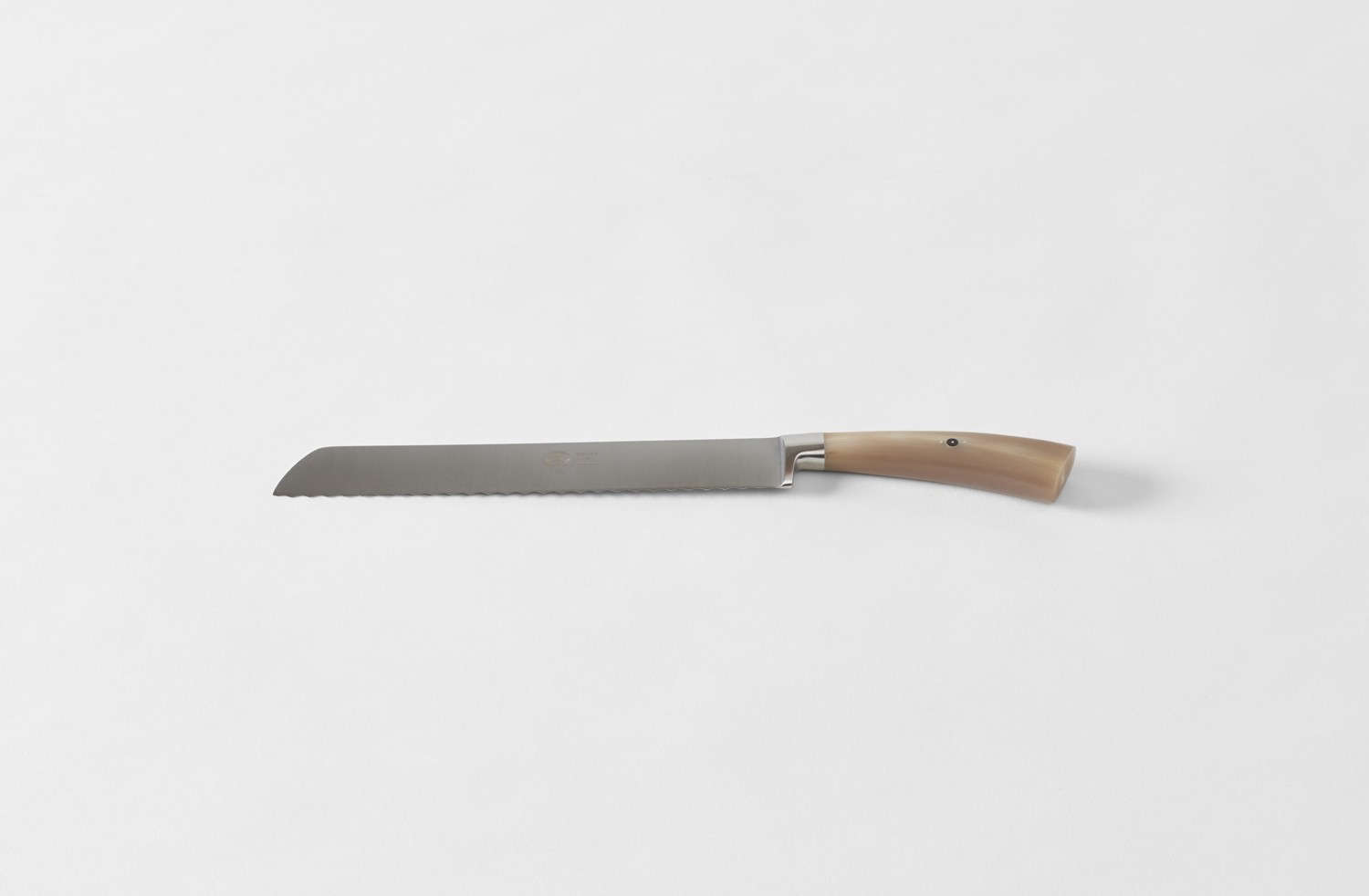

The Berti 9 Inch Ox Horn Bread Knife is what happens when a practical kitchen tool dresses for dinner. It has a long serrated stainless steel blade, a naturally patterned ox horn handle, and the kind of handmade Italian pedigree that makes an ordinary loaf of sourdough feel suspiciously underdressed.
This is not a bargain-bin bread slicer designed to survive three years in a crowded utensil drawer. It is a luxury kitchen knife made for cooks who value traditional craftsmanship, distinctive natural materials, and tools that are attractive enough to leave on display. The essential question, however, is whether its beauty is supported by genuine kitchen usefulnessor whether you are simply purchasing an expensive accessory for intimidating baguettes.
Based on documented product specifications, manufacturer information, specialist retailers, and independent bread-knife testing principles, the answer is nuanced. The Berti bread knife offers legitimate performance advantages, but its strongest appeal lies in the combination of function, heritage, and collectible design.
What Is the Berti 9 Inch Ox Horn Bread Knife?
The Berti 9 Inch Ox Horn Bread Knife is a handmade Italian serrated knife intended primarily for cutting bread, cakes, pastries, and foods with firm exteriors and delicate interiors. Depending on the retailer, its blade may be listed as 9 inches or, more precisely, 8.7 inches. Overall-length measurements also vary slightly, with detailed listings reporting approximately 13.2 inches and older descriptions rounding the knife to 14 inches.
That variation does not necessarily indicate different knives. Retailers frequently round metric measurements when converting them into inches. Berti’s comparable bread-knife specifications list blades around 21.9 to 22.3 centimeters, which converts to roughly 8.6 to 8.8 inches. Calling it a 9-inch knife is therefore reasonable, even if your ruler is feeling unusually argumentative.
| Product type | Serrated bread and cake knife |
|---|---|
| Blade length | Approximately 8.7 inches, commonly marketed as 9 inches |
| Overall length | Approximately 13.2 to 14 inches, depending on listing |
| Blade material | Stainless steel |
| Handle material | Natural ox horn |
| Construction | Anchored-tang construction on commonly listed models |
| Country of origin | Italy |
| Cleaning | Hand wash only |
More Than a Century of Italian Knife Making
Coltellerie Berti traces its history to 1895 and the Tuscan town of Scarperia, an area associated with Italian cutlery production. The company presents its knives as artisan-made objects rather than standardized industrial products. Its best-known production principle is wonderfully simple: the craftsperson who begins a knife also completes it.
That approach differs from assembly-line manufacturing, where grinding, shaping, polishing, sharpening, and handle installation may be divided among multiple stations. With the traditional Berti method, one artisan remains responsible for the finished object. The result is not mathematical uniformity. It is controlled individuality.
This matters especially when the handle is made from ox horn. Natural horn does not arrive at the workshop looking like a sheet of black plastic. Its coloration, translucency, grain, and marbling vary from piece to piece. Two Berti bread knives may share the same dimensions and construction while looking noticeably different. Berti identifies its knives as handmade in Italy and notes that it has practiced its craft since 1895; product documentation also warns that handles made from natural materials will vary from photographs.
Why the Single-Artisan Method Matters
The single-artisan philosophy creates a stronger connection between maker and object, but it should not be treated as magic dust sprinkled over the blade. A handmade knife still needs sound geometry, a comfortable handle, secure construction, and an effective edge.
What the method genuinely adds is character and accountability. Small differences in finishing are part of the knife’s identity rather than defects automatically erased by mass production. Buyers who want every handle to look exactly like a website photograph may find this inconvenient. Buyers who appreciate natural variation will probably consider it the point.
How the Serrated Blade Performs
A bread knife has a strangely difficult assignment. It must penetrate a hard crust without applying so much downward pressure that the tender crumb underneath collapses. A smooth chef’s knife can cut bread when exceptionally sharp, but a serrated edge gains traction more easily and converts a gentle back-and-forth motion into controlled slicing.
The Berti uses a long serrated stainless steel blade designed to bite into firm crusts while limiting compression. Retail descriptions characterize it as a relatively substantial blade capable of cutting thick-crusted loaves without flattening them. Independent bread-knife testing also supports the general design logic: longer serrated blades make it easier to cross wide loaves, while well-shaped serrations reduce tearing and keep soft interiors intact.
Crusty Sourdough and Artisan Boules
Large sourdough boules are the natural habitat of a knife like this. The blade is long enough to cover much of a medium or large loaf, reducing the number of short, frantic strokes required. Instead of attacking the crust like a lumberjack with a personal grudge, the user can make relaxed, horizontal passes and allow the serrations to do the work.
A blade in the 9-inch range is generally considered practical for home bread cutting, although some testing organizations prefer knives closer to 10 inches for especially wide bakery-style loaves. The Berti therefore lands in a useful middle ground: long enough for most household breads but not so oversized that it becomes awkward around smaller rolls, tomatoes, or cakes.
Soft Sandwich Bread, Brioche, and Challah
Soft bread reveals poor knife technique immediately. Push too hard and a tall loaf becomes a short loaf with emotional damage. The correct method is to place the blade lightly on the crust and use smooth strokes with minimal downward force.
The Berti’s length helps because each stroke moves more of the edge through the bread. The user does not need to compensate with aggressive pressure. As with any serrated knife, performance will depend on the condition and geometry of the teeth, but the overall format is well suited to brioche, challah, milk bread, and tender sandwich loaves.
Cakes, Tomatoes, and More
A bread knife should not be sentenced to a lifetime of bread alone. Serrated blades are useful whenever a food has a resistant exterior and a soft center. Common examples include tomatoes, citrus fruit, melons, eggplant, and certain pastries.
The Berti’s long blade can also level cake layers, trim domed sponge cakes, divide panettone, and slice delicate pastries without dragging a smooth edge through them. Food Network and Serious Eats both identify tomatoes, cakes, and produce with tough skins as appropriate jobs for a serrated knife.
It is not, however, a substitute for every kitchen knife. Do not use it to chop herbs, mince garlic, cut bones, or hack through frozen food. A bread knife is a specialist. Asking it to split a frozen chicken is like asking an opera singer to repair your roof: possible drama, limited upside.
The Ox Horn Handle Is the Main Attraction
The natural ox horn handle is the feature that separates this Berti knife from hundreds of less expensive serrated alternatives. Horn can display tones ranging from creamy amber and smoky gray to deep brown or nearly black. Translucent streaks and irregular markings make every handle visually distinctive.
That individuality gives the knife the presence of a serving piece or collectible object. It looks appropriate beside a walnut bread board, linen napkins, and a loaf whose starter has a human name. Yet the material is not merely decorative. Properly shaped and polished horn can feel smooth, warm, and substantial in the hand.
Anchored-Tang Construction
Common U.S. listings describe this model as having an anchored tang. In this construction, the blade’s tang is inserted securely into a solid handle rather than being sandwiched visibly between two handle scales.
This makes sense for a handle intended to showcase a continuous piece of horn. It creates a clean silhouette and allows the natural material to remain the visual focus. The trade-off is that buyers cannot inspect the full tang along the handle’s exterior, as they might with a conventional riveted Western knife. The quality of the internal fit and finishing therefore matters.
Ergonomics and Everyday Handling
A knife may be beautiful enough for a museum, but dinner still needs slicing. The Berti’s traditional handle shape appears designed for a straightforward pinch or full-handle grip. Because natural horn varies, exact balance and texture may differ slightly between individual knives.
The relatively straight relationship between the blade and handle should provide predictable control. However, as with many straight bread knives, users with large hands may bring their knuckles close to the cutting board. Moving the handle slightly beyond the edge of the board can create more clearance.
Anyone purchasing such a costly knife should consider handle comfort personally whenever possible. Hand size, grip style, arthritis, wrist strength, and preferred cutting motion all influence whether a knife feels graceful or merely expensive.
Is a Luxury Bread Knife Worth the Price?
This is where romance meets arithmetic. U.S. listings have placed the Berti ox horn bread knife in the neighborhood of $375, although availability and pricing change. That is dramatically more than many high-performing commercial bread knives, some of which cost less than a family pizza night.
From a performance-only perspective, the Berti is difficult to justify. Independent testers routinely find excellent bread knives below $100, and some culinary experts discourage large investments in serrated knives because their individual teeth are difficult to sharpen properly at home. Once performance declines, professional servicing may be complicated or uneconomical.
But performance per dollar is not the only legitimate buying criterion. People purchase handmade cookware, artisan ceramics, mechanical watches, and solid-wood furniture because they enjoy the object as well as its function. The Berti offers craftsmanship, natural material, Italian heritage, and visual uniqueness that a restaurant-supply knife does not attempt to provide.
The Berti Is Best For
- Collectors of handmade Italian kitchen tools
- Home bakers who frequently serve artisan bread
- Buyers who value natural horn and individual variation
- Hosts who want an attractive knife for table service
- Gift shoppers seeking a distinctive culinary heirloom
Consider a Less Expensive Knife If
- You care almost entirely about cutting performance per dollar
- You regularly put knives in the dishwasher
- You want a lightweight, rubberized, highly grippy handle
- You prefer tools that can be replaced without emotional paperwork
- You cut extremely large boules and want a blade longer than 10 inches
How to Care for a Berti Ox Horn Bread Knife
The knife should be washed by hand using warm water, mild dish soap, and a soft sponge. Do not soak it in a sink, and do not place it in a dishwasher. Prolonged moisture, high heat, and harsh detergents can affect natural handle materials and may damage the fit or finish over time.
Dry the blade and handle promptly with a soft towel. Store the knife in a block, on a suitable magnetic rack, or inside a protective blade guard. Leaving it loose in a drawer invites the serrations to collide with other utensilsand gives anyone searching for a teaspoon an unnecessarily exciting afternoon. Berti retailers specify hand washing, while general knife-care guidance recommends protected storage to reduce edge damage and accidental cuts.
Protecting the Serrated Edge
Use a wood or quality plastic cutting board. Glass, stone, ceramic, and granite surfaces are too hard and can accelerate edge wear. Avoid twisting the blade while it is embedded in dense food, and never use it as a pry bar.
When the knife begins to tear tomatoes, scatter excessive crumbs, or require noticeably greater pressure, it may need professional attention. Serrated sharpening involves treating the individual scallops rather than simply running the entire blade over a flat stone. Ask the sharpening service whether it works with premium serrated knives before handing over your Berti.
A Realistic Berti 9 Inch Ox Horn Bread Knife Experience
Imagine opening the package for the first time. The immediate reaction is unlikely to be, “Yes, this appears adequate for toast.” The horn handle pulls attention before the blade does. It may contain smoky bands, warm brown streaks, pale translucent sections, or nearly black areas. The pattern will not perfectly match the product photograph, which is precisely why the material feels special.
The knife has more ceremony than an inexpensive bread slicer. You naturally place it on the counter rather than tossing it into a drawer. It looks at home beside a substantial wooden board and creates the faint impression that lunch has acquired a dress code.
The first practical test is a crusty sourdough boule. After placing the loaf on its side, you rest the serrations against the crust and begin with a light sawing motion. The key is restraint. Pushing downward immediately defeats the purpose of the blade. Once the teeth establish traction, the knife advances through the crust and into the softer crumb with much less force.
The nearly 9-inch blade offers enough reach for most home-baked loaves. A very wide country miche may require additional strokes, but standard boules, batards, baguettes, and sandwich breads fall comfortably within its range. The rigid, substantial feel can inspire confidence on thick crusts, while the long edge helps maintain a consistent slicing angle.
Next comes a ripe tomato, the traditional courtroom witness for serrated knives. A good edge should catch the skin without requiring the cook to hold the tomato in a death grip. With a gentle forward-and-back movement, the blade should create clean slices while limiting juice loss. The long knife feels excessive for a single cherry tomato, of course, but excellent for beefsteak tomatoes, layered sandwiches, and trays of bruschetta.
Cake preparation reveals another side of the design. The blade can level a domed sponge or divide a layer horizontally using long, measured strokes. Because the handle is visually striking, the knife also works as a serving object when slicing panettone, coffee cake, or holiday bread at the table. Guests may ask about it, which is either delightful conversation or proof that the appetizers are taking too long.
The luxury experience also brings responsibility. You wash the knife immediately instead of abandoning it beside a buttery cutting board. You dry the horn carefully. You return the blade to protected storage. None of these steps is difficult, but the Berti does not encourage careless ownership.
Over time, the most satisfying feature may be neither the blade nor the brand name. It may be the familiarity of the particular handlethe markings that belong only to that knife and the small rituals built around using it. That is the strongest argument for the Berti. It turns an ordinary kitchen task into a tactile, visual experience without forgetting that the bread still needs to be sliced.
Final Verdict
The Berti 9 Inch Ox Horn Bread Knife combines a practical serrated blade with unusually expressive materials and more than a century of Italian knife-making tradition. Its approximate 9-inch length suits most household loaves, cakes, tomatoes, pastries, and thick-skinned produce. The anchored-tang construction preserves the clean appearance of its solid natural handle, while handmade production gives each example individual character.
It is not the rational choice for someone seeking the cheapest route to neat sourdough slices. Excellent bread knives are available for a fraction of the price, and serrated blades can be challenging to sharpen. The Berti makes sense when performance is only one part of the decisionand craftsmanship, presentation, heritage, and ownership pleasure matter just as much.
In other words, this knife will cut bread. It will also make you feel that the bread should have arrived from a stone bakery in Tuscany on a bicycle. For the right buyer, that additional pleasure is not frivolous. It is the whole reason to choose Berti.