
References can feel like the mysterious final boss of the job search. You spend hours polishing your resume, adjusting margins by half a pixel, choosing between “managed” and “led,” and then suddenly a hiring manager asks, “Can you send over your references?” Cue the tiny panic music.
The good news: including references in your job application is much easier than most candidates think. The slightly surprising news: in most modern U.S. job searches, you should not put references directly on your resume unless the employer specifically asks you to. Instead, you should prepare a clean, professional reference list that matches your resume and is ready to send when requested.
This guide explains exactly how to include references on a resume the right way, when to send them, who to choose, what details to include, and how to avoid awkward mistakes. Think of your references as your professional hype team: they should be credible, prepared, and capable of saying more than, “Yes, this person owned a laptop.”
Should You Put References Directly on a Resume?
Usually, no. For most job seekers, references should be placed on a separate reference page, not inside the resume itself. A resume is prime real estate. Every line should help prove your qualifications, highlight achievements, or connect your experience to the job description. Listing references too early can waste valuable space and expose your contacts before the employer actually needs them.
The old phrase “References available upon request” is also considered unnecessary in most cases. Employers already know they can ask for references. Adding that line is a little like writing “Interview available if invited” at the bottom of your resume. True, but not exactly a power move.
There are exceptions. If a job posting specifically requests references with the application, follow the instructions. Some academic, government, nonprofit, healthcare, and senior-level roles may ask for references earlier in the process. When in doubt, read the application requirements carefully. The best resume strategy is not “always include references” or “never include references.” It is “provide references professionally when requested.”
Step 1: Read the Job Posting Before Doing Anything
Before creating a reference list, study the job posting. Employers often tell candidates exactly what they want. Some will say, “Submit resume and cover letter only.” Others may request “three professional references” or ask you to include references in an online application form.
If the posting does not mention references, leave them off your resume and prepare a separate document for later. This keeps your application focused and protects your references from being contacted too early. Your former manager probably likes you, but they may not enjoy surprise phone calls before coffee.
What to look for in the job posting
- Whether references are required with the initial application
- How many references the employer wants
- Whether professional, academic, or character references are preferred
- Whether reference letters are requested instead of contact information
- Whether references should be uploaded as a separate document
If the employer gives specific instructions, follow them exactly. If the employer does not mention references, wait until they ask. That usually happens after an interview, near the final selection stage, or during a background-check process.
Step 2: Choose the Right References
The strongest references are people who can speak clearly and positively about your work, reliability, skills, attitude, and results. A famous person who barely knows you is usually less useful than a former supervisor who can explain how you improved a process, handled pressure, trained a teammate, or solved a customer problem.
Good professional references may include former managers, supervisors, team leads, clients, professors, internship coordinators, volunteer supervisors, or mentors. For recent graduates, academic references can be helpful, especially if they supervised research, projects, internships, or leadership activities.
Best people to ask
- A former manager who directly supervised your work
- A team lead who saw your skills in action
- A professor or advisor who knows your strengths well
- A client or partner who can describe your professionalism
- A volunteer coordinator if the role connects to your target job
People to avoid using as references
- Family members
- Close friends who cannot discuss your work performance
- Current supervisors unless they know you are job searching
- Anyone you have not spoken to in years
- Anyone who may give a lukewarm or unclear recommendation
Aim for three to five references. Most employers ask for three, but having a few backups helps you tailor the list to each role. For example, if you are applying for a project coordinator position, choose references who can discuss organization, communication, deadlines, and cross-functional teamwork.
Step 3: Ask Permission Before Listing Someone
Never list someone as a reference without asking first. Even if they adored working with you, professional courtesy matters. A prepared reference can give a stronger, more specific recommendation. An unprepared reference may sound confused, rushed, or suspiciously like they are trying to remember whether you were “the spreadsheet person” or “the one who brought muffins.”
Send a polite email or message asking whether they would be comfortable serving as a professional reference. Include the type of roles you are pursuing, why you thought of them, and what skills or projects you hope they can speak about.
Sample message asking for a reference
Subject: Reference Request
Hi Jordan,
I hope you are doing well. I am applying for marketing coordinator roles and wanted to ask if you would be comfortable serving as a professional reference for me. Since we worked together on the product launch campaign, I thought you could speak to my project management, writing, and collaboration skills.
I would be happy to send my updated resume and a few details about the roles I am applying for. Thank you for considering it.
Best,
Taylor
Once someone agrees, thank them and keep them updated. Send your current resume, the job description, and a short reminder of relevant achievements. You are not scripting their answer; you are helping them remember useful details.
Step 4: Create a Separate Reference Page
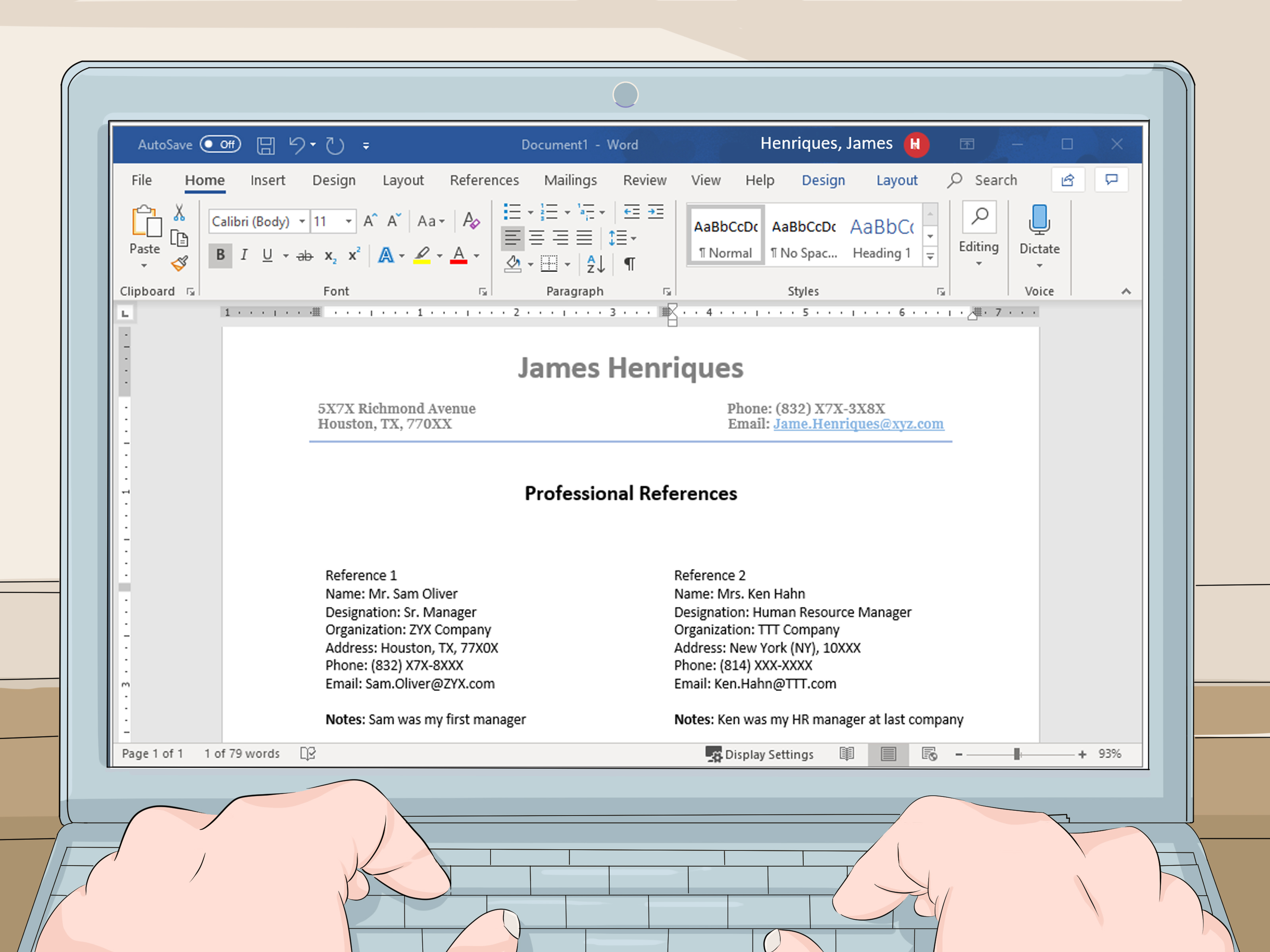
Your reference list should be a separate document that visually matches your resume. Use the same name header, font style, spacing, and contact information. This makes your application materials look organized and intentional. It also helps the employer identify the document if it gets separated from the rest of your application.
At the top of the page, include your name, phone number, email address, LinkedIn profile if relevant, and possibly your city and state. Then add a title such as “Professional References.”
What to include for each reference
- Full name
- Current job title
- Company or organization
- Professional email address
- Phone number, if they agreed to share it
- Your relationship to the reference
- Optional: one short line explaining what they can discuss
Keep the formatting simple. Avoid tables, heavy graphics, icons, photos, or decorative layouts. Applicant tracking systems and busy recruiters prefer clarity over resume confetti.
Reference page example
Professional References
Jordan Lee
Senior Marketing Manager, BrightPath Media
[email protected] | 555-123-4567
Relationship: Former supervisor at BrightPath Media
Can speak to: Campaign planning, writing, teamwork, and deadline management
Maria Gonzalez
Operations Lead, Northstar Logistics
[email protected] | 555-987-6543
Relationship: Project lead during internship
Can speak to: Process improvement, communication, and attention to detail
Dr. Alan Brooks
Professor of Business Communication, Lakeside University
[email protected] | 555-222-3010
Relationship: Academic advisor and capstone project mentor
Can speak to: Research, presentation skills, and leadership
Step 5: Know When to Send References
Timing matters. Unless the employer asks for references in the original application, send them only when requested. This usually happens after the first interview, after a final interview, or when the employer is seriously considering an offer.
Sending references too early can create two problems. First, it may distract from your resume and cover letter. Second, it may lead to your references being contacted before you have had a chance to brief them. The better approach is to have your reference sheet ready, polished, and saved as a PDF so you can send it quickly when the request arrives.
How to send references by email
Keep the message short and professional. Attach the reference list as a PDF unless the employer requests another format.
Subject: References for Taylor Morgan
Hi Ms. Carter,
Thank you for speaking with me about the marketing coordinator position. Attached is my professional reference list, as requested. Please let me know if you need any additional information.
Best regards,
Taylor Morgan
Before sending, notify your references that an employer may contact them. Share the company name, job title, interviewer’s name if available, and a few reminders about the work you did together. This helps your reference sound focused and relevant instead of surprised.
Step 6: Keep Your Reference List Updated
A reference list is not a “create once and forget forever” document. People change jobs, phone numbers, email addresses, and sometimes entire career paths. Before each major job search, confirm that your references are still willing and available.
Update job titles, companies, and contact details. Remove references who are no longer relevant or who may not remember your work clearly. Add stronger references as your career grows. If you recently completed a major project, internship, certification program, leadership role, or freelance assignment, consider whether someone from that experience should join your list.
Reference maintenance checklist
- Confirm each person still agrees to be listed
- Check spelling of names, titles, and organizations
- Verify phone numbers and email addresses
- Match references to the job you are pursuing
- Send your updated resume to each reference
- Thank references after they help you
After the hiring process, send a thank-you message. If you get the job, share the good news. References are part of your professional network, not a vending machine where you insert a request and receive praise.
Common Mistakes to Avoid
Adding references to every resume
This makes your resume longer and less focused. Unless the job posting asks for references, save that space for achievements, skills, certifications, and measurable results.
Using personal references for professional roles
A friend may think you are wonderful, punctual, and excellent at choosing restaurants. That does not necessarily help a hiring manager evaluate your workplace performance. Use professional or academic references whenever possible.
Forgetting to brief your references
A reference who knows the job description can speak directly to the employer’s needs. Share key details so they can connect your past work to the new opportunity.
Providing outdated contact information
If an employer cannot reach your reference, it may slow the process. Always verify contact details before sending your list.
Choosing someone just because of their title
A senior executive who barely knows you is not automatically a strong reference. Choose people who can provide real examples of your performance.
Resume References for Different Career Stages
For students and recent graduates
Use professors, academic advisors, internship supervisors, research mentors, club advisors, or volunteer coordinators. Focus on people who can describe your responsibility, communication, learning ability, and follow-through.
For experienced professionals
Use former supervisors, managers, colleagues, clients, or cross-functional partners. Choose references who can discuss leadership, measurable results, problem-solving, collaboration, and your ability to succeed in the target role.
For career changers
Select references who can speak to transferable skills. If you are moving from teaching to corporate training, for example, a school administrator may discuss presentation skills, curriculum design, communication, and leadership.
For freelancers or consultants
Use clients, project partners, agency contacts, or long-term collaborators. Ask references to discuss reliability, results, communication, and the business value you delivered.
Mini Template: Separate Reference Page
Your Name
Your Phone Number | Your Email Address | LinkedIn URL | City, State
Professional References
Reference Name
Job Title, Organization
Email Address | Phone Number
Relationship: Former manager, professor, client, mentor, or supervisor
Can speak to: Skill area, project type, leadership, communication, or results
Repeat the same format for three to five references. Save the file as something clear, such as Taylor-Morgan-References.pdf. A file named final-final-real-version-USE-THIS-one.pdf may be emotionally honest, but it is not ideal.
Experience-Based Advice: What Actually Works When Including References
One of the most practical lessons about references is that hiring managers are usually not looking for a perfect speech. They are looking for consistency. If your resume says you managed projects, your interview describes strong communication skills, and your reference confirms that you were organized, dependable, and easy to work with, the employer feels more confident. References work best when they support the story you have already told.
In real job searches, candidates often underestimate how much preparation helps. A strong reference call may last only a few minutes, but those few minutes can influence a final decision. Imagine two candidates with similar skills. One gives references who are surprised, vague, and hard to reach. The other gives references who understand the role, remember specific achievements, and respond quickly. The second candidate looks more organized before they even start the job.
Another useful experience is learning to match references to the role. A candidate applying for a customer success position might choose a former manager who can discuss client communication and conflict resolution. For a data analyst role, a professor or supervisor who can talk about accuracy, reporting, and problem-solving may be more useful. References are not trading cards; you do not have to play the same three every time.
It also helps to maintain relationships before you need something. Many job seekers wait until the final interview to contact a former supervisor they have not spoken to in four years. That can still work, but it is not ideal. A better habit is to occasionally check in with past managers, mentors, professors, or collaborators. Congratulate them on promotions, share career updates, or send a short thank-you note after a meaningful project. Professional relationships are easier to activate when they have not been frozen in time like leftovers from 2018.
Candidates should also respect privacy and workplace sensitivity. If you are currently employed and your manager does not know you are job searching, do not list that person without careful thought. Instead, use previous supervisors, trusted former colleagues, clients, mentors, or academic contacts. You can also tell the hiring manager, “Please do not contact my current employer at this stage.” That is a normal and reasonable request.
Finally, references are not just a formality. They are a credibility bridge between your application and the employer’s final decision. Treat them with the same care as your resume. Choose people thoughtfully, ask permission, provide context, keep the document clean, and say thank you afterward. A great reference will not rescue a weak resume, but it can absolutely strengthen a strong candidacy. In a competitive hiring process, that extra confidence can make a real difference.
Conclusion
Knowing how to include references on a resume is mostly about knowing when not to include them. In most cases, keep references off the resume itself and prepare a separate professional reference page. Choose three to five people who know your work, ask permission, provide context, format the list clearly, and send it only when requested.
The goal is simple: make it easy for employers to verify that you are as capable, reliable, and impressive as your resume suggests. Your references should not be an afterthought. They should be a prepared, polished part of your job search strategy.
Note: This article is written for general U.S. job-search guidance. Always follow the specific instructions in the job posting or employer application system.